📍 Destination Overview
Buenos Aires, Argentina's capital on the Rio de la Plata, is called the 'Paris of South America' for its elegant architecture. Plaza de Mayo is the nation's heart, with the pink Casa Rosada. The colourful Caminito in La Boca is a birthplace of tango; Recoleta Cemetery is an open-air museum and the Teatro Colon a great opera house, where elegance and passion meet.
🏠 Location
Argentina · Buenos Aires · capital on the Río de la Plata
🗓️ Best Season
Mar-May / Sep-Nov
🕐 Time Difference
-11 hrs vs Beijing
💰 Currency / Language
Argentine Peso ARS / Spanish
🕐 Suggested Duration
3-4 days · old town + La Boca + tango
🔌 Outlet / Voltage
Type C / I outlets · 220V · adapter needed
☀️ Best Time to Visit & Climate
🍂 Autumn: Mar–May
Heat and humidity ease off and the jacarandas turn—the most comfortable season for strolling the old city and lingering at sidewalk cafés.
🌸 Spring: Sep–Nov
Warming days and longer light; jacarandas bloom from October and the calendar fills with tango festivals and open-air markets.
January
🌡️
30°/20°
February
🌡️
29°/20°
March
🌻
27°/18°
Best
April
🍁
23°/14°
Best
May
🌥️
19°/11°
Best
June
🌧️
16°/8°
July
🌧️
15°/8°
August
🌤️
18°/9°
September
🌸
20°/11°
Good
October
🌷
23°/13°
Best
November
🌤️
26°/16°
Best
December
🌡️
29°/19°
📷 Top Attractions
More Attractions →
May Square
Plaza de Mayo is the political and historical heart of Buenos Aires: it was the city's Plaza Mayor at Garay's second founding in 1580, and only took its open form after the Recova arcade was demolished in 1884. The pink Casa Rosada on the east side is the presidential palace, its balcony famous from the Perons' addresses; the May Pyramid at the centre, raised in 1811, is the city's oldest public monument, ringed by the Metropolitan Cathedral, the colonial Cabildo and the Banco de la Nacion. Since 1977 the Mothers of Plaza de Mayo have marched around the pyramid every Thursday afternoon for their disappeared children, their white headscarves painted on the pavement below. Free and open around the clock, it is an unavoidable stop for understanding modern Argentine history.
Square & Landmark

Obelisco de Buenos Aires
The Obelisco is Buenos Aires' most photogenic landmark: a 67.5 m square-column monument designed by Alberto Prebisch, unveiled on 23 May 1936 for the city's 400th anniversary (1536-1936) and built in just 31 days. It stands on the traffic island where Avenida 9 de Julio — at its widest about 140 metres, among the widest avenues on Earth — crosses theatre-lined Avenida Corrientes. The monument cannot be climbed, but the spot is Argentina's kilometro 0, where all national road distances begin; when Argentina wins the World Cup or on national holidays, hundreds of thousands gather here, and on ordinary nights it is the fixed vantage point for photographers. Steps away stands the Teatro Colon, one of the world's great opera houses — an easy walking pairing.
Square & Landmark

Teatro Colón
The Teatro Colon is Buenos Aires' — and Latin America's — most celebrated opera house, opened in 1908 beside Avenida 9 de Julio. Its horseshoe auditorium seats about 2,500, with acoustics reckoned among the world's finest: unamplified voices carry to every seat. The golden dome fresco by Argentine master Raul Soldi, the marble grand staircase and gilded salons rival any opera house in Europe; Callas, Pavarotti and Domingo all sang here. The guided tours are superb — English visits descend beneath the stage into rehearsal rooms and costume workshops, revealing opera's backstage industry. A performance, or even just the tour, explains Argentina's devotion to the art form.
Events & Shows

Recoleta
Recoleta is one of Buenos Aires' most elegant neighbourhoods, famous for the Recoleta Cemetery, the Cultural Centre and French-style architecture. Boutiques, cafés and galleries line the streets, and the weekend artisan fair draws crowds — the best place to feel the city's 'Little Paris' spirit.
Historic Ruins & Heritage

El Caminito
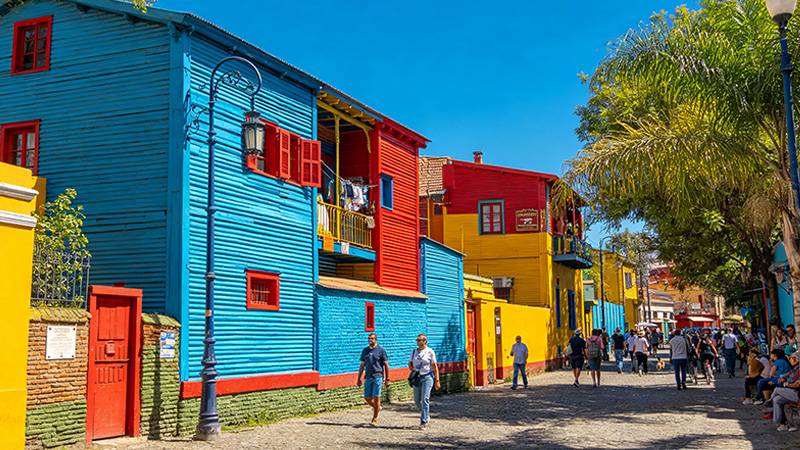
El Caminito is an open-air 'street museum' in Buenos Aires' La Boca district, famous for the vivid corrugated-iron façades of immigrant conventillos and tango murals. Painter Benito Quinquela Martín anchored the Río de la Plata art scene here, and today buskers sing tango while stalls sell handicrafts, the lane a spilled paintbox of colour. It is a must-visit emblem of the city's immigrant roots and exuberant South American spirit. Nearby tango restaurants and mural walls turn all of La Boca into a flowing canvas.
Old Town & Historic District

Cementerio de la Recoleta
The Recoleta Cemetery in Buenos Aires' Recoleta district is a world-famous urban necropolis, renowned for its dense cluster of marble mausoleums, statues and Gothic, neoclassical and art-deco architecture. It is the final resting place of presidents, aristocrats and celebrities including Eva Perón (Evita), a veritable open-air sculpture museum. Its labyrinth of shaded galleries is both a place of remembrance and a beloved spot to absorb Argentine history and architectural art. The weekend craft fair and open-air cafes just outside let solemnity and street life oddly coexist.
Historic Ruins & Heritage
🎯 Buenos Aires Experiences
Tango Show
A passionate Argentine night.
Caminito, La Boca
Street dancing in the colorful alley.
Recoleta
Sculptures in the cemetery of the famous.
Argentine Asado
Charcoal-grilled steak and red wine.
Teatro Colón
A temple of world-class opera.
Seasons are reversed in the Southern Hemisphere. Spring (Oct-Nov) and autumn (Mar-May) have pleasant weather, best for strolling. Summer (Dec-Feb) is hot and humid. Tango can be enjoyed year-round. The Argentine Peso fluctuates greatly. Mind your belongings and travel safety.
🚌 Transport & Stays
City Transport
✈️Taxi fare by distance (reference)
Ezeiza Airport
About 45 min from downtown
Taxi fare by distance (reference)
🚇Per ride by zone (reference)
Subte Metro
Covers main city areas
Per ride by zone (reference)
🚗Base fare by distance (reference)
Ride-hailing App
Getting around town
Base fare by distance (reference)
✈️Depends on fare class (reference)
Domestic flights
To Patagonia and beyond
Depends on fare class (reference)
Recommended Stay Areas
🌳 Recoleta (recommended)
Elegant, safe neighborhood
🎨 Palermo
Artsy trend and dining
🏛️ City Center
Near Plaza de Mayo and theaters
🛍️ San Telmo
Antique markets and tango
Free Consultation
Want to plan your Buenos Aires trip in more depth?
Tell us your departure city, travel dates and interests, and Usitour will tailor a trip just for you.