📍 Destination Overview
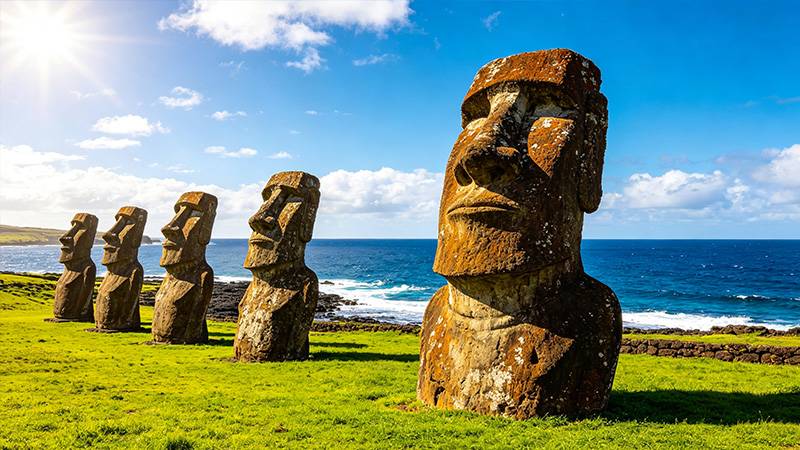
Easter Island, deep in the South Pacific some 3,600 kilometres from Chile, is among Earth's most isolated inhabited places. About nine hundred colossal Moai statues, carved half-figures on Ahu platforms and revered as ancestors, dot the island. Tongariki's row of fifteen and the Rano Raraku quarry are the finest sights; birdman ruins and brilliant starry skies deepen its solemn mystery.
🗿 Location
Chile - Remote South Pacific island - Island of the Moai
📅 Best Season
Mild year-round · Peak Oct-Apr
🕐 Time Difference
-14 hrs vs Beijing
💰 Currency / Language
Chilean Peso CLP / Spanish / Rapa Nui
🕐 Suggested Duration
3-4 days - Statues + volcano + island
🔌 Outlet / Voltage
Type C / L sockets · adapter needed
☀️ Best Time to Visit & Climate
🌤️ Mild year-round · Peak Oct–Apr
Pleasant maritime climate.
Jan
🔥
27°/18°
Best
Feb
☀️
28°/19°
Best
Mar
🌞
27°/18°
Best
Apr
🌤️
25°/17°
Best
May
🌧️
23°/16°
Jun
🌧️
21°/15°
Jul
🌧️
20°/14°
Aug
🌧️
20°/14°
Sep
🌤️
20°/14°
Oct
🌞
22°/15°
Best
Nov
🌞
24°/16°
Best
Dec
☀️
26°/17°
Best
📷 Top Attractions
More Attractions →
Easter Island (Rapa Nui)
Easter Island — Rapa Nui to its people — is one of the most remote inhabited places on Earth, a triangle of volcanic grassland some 3,700 km from mainland Chile. Scattered across it stand around 900 moai, monumental figures carved to represent deified ancestors who watch over the land of their clans. At the Rano Raraku quarry dozens of unfinished statues remain embedded in the crater slope, while the fifteen restored giants of Ahu Tongariki line up with their backs to the Pacific — the island's definitive sunrise. Reaching it takes roughly a 5.5-hour flight from Santiago; give yourself at least three full days.
Beach & Island
Ahu Tongariki
Ahu Tongariki is the largest and most spectacular Moai group on Easter Island (Rapa Nui), Chile. On the east coast, 15 giant Moai stand on a ~200 m Ahu altar facing inland, backs to the Pacific — for their scale, the solemn sunrise silhouettes, and the restoration by Chilean and Japanese teams, it is the most awe-inspiring archaeological site and sunrise spot on the island. The 15 Moai vary in size, the tallest ~14 m (with Pukao topknot), on a ~200 m Ahu facing inland (Moai always face away from the sea, watching over the village). The site was toppled and scattered by the 1960 tsunami — restored in the 1990s by Chilean university archaeologists and Japan's Tadano crane company, which lifted the fallen Moai back upright. Ahu Tongariki is the classic sunrise spot — the sun rising over the Pacific with 15 Moai silhouettes against the golden sky is the island's most iconic image. A Pukao quarry is nearby. Visiting to feel the grandeur and mystery of Rapa Nui civilization in 15 giant Moai and a Pacific sunrise is a must-do archaeological and sunrise experience.
Historic Ruins & Heritage

Rapa Nui National Park
Rapa Nui National Park covers some 40 percent of Easter Island, and the whole island entered the UNESCO list as a cultural landscape in 1995. Moai sites are everywhere: Rano Raraku, the quarry where the giants were born, slopes dotted with figures from rough-cut to near-complete; Ahu Tongariki lines 15 moai along the coast for the island's grandest sunrise; and stone houses of the birdman cult cling to the rim of Orongo crater. Sightseeing requires a single national park ticket, sold at the airport and in town — carry it at all times, as it is checked at many site entrances.
National Park & Nature

Ahu Tahai
Ahu Tahai is one of the most important archaeological sites on Easter Island (Rapa Nui), Chile. This coastal complex ~1 km west of Hanga Roa features five standing Moai on an Ahu altar with a ceremonial plaza — one of the few Moai sites reachable on foot and the most convenient place to experience the mystery and grandeur of Rapa Nui civilization. Restored by archaeologist William Mulloy in 1974, the five Moai of varying sizes (~1 m to ~4.5 m) stand on the Ahu facing inland (Moai always face away from the sea, watching over the village). The site also has Pukao (red scoria topknots) and Hare Paenga (boat-shaped house) foundations nearby. Tahai is the classic sunset spot on Easter Island — the sun sinking into the Pacific with five Moai silhouettes standing solemnly against the golden sky is the island's most iconic image. Visiting Ahu Tahai to feel the mystery and grandeur of Rapa Nui civilization in Moai silhouettes and a Pacific sunset is a must-do archaeological and sunset experience on Easter Island.
Historic Ruins & Heritage

Papa Vaka Petroglyphs
Papa Vaka, just off the north-coast road of Rapa Nui, is one of the island's largest and densest petroglyph complexes. In Rapanui, papa means 'stone' and vaka 'canoe', after a huge slab carved with a 12-metre double-hulled canoe — some read it as the very vessel that carried the first ancestors across the sea. Across exposed basalt slabs, shallow reliefs show marine themes: tuna, sharks, octopus or squid, turtles, fish hooks (mangai) and rows of unexplained holes, reflecting a culture oriented to the sea and its fishing rites. One rock, Papa Mangai, holds the island's greatest concentration of stone fish-hook motifs. There are no moai or ceremonial platforms here, yet no site speaks more directly of Rapa Nui cosmology and navigation memory.
Historic Ruins & Heritage

Seven Archangels (Hitu Merahi)
Hitu Merahi, usually rendered as the Seven Archangels, is a group of modern stone sculptures on the northern seafront of Hanga Roa. It is neither an archaeological site nor a reconstructed display of ancient moai. Chilean artist Paula Yankovic created the ensemble with seven Rapa Nui sculptors, each contributing one of the seven figures that face the Pacific, as a statement of brotherhood between the island and mainland Chile. A plaque at the centre sets out the sequence behind the work: love is energy, energy is humility, humility is peace. The installation sits within walking distance of town, is free and open at all hours, and needs no Rapa Nui National Park ticket. Seen alongside the nearby Moai of Peace and the Tahai complex, it shows how contemporary Rapa Nui art answers the island's thousand-year-old stone tradition.
Historic Ruins & Heritage
🎯 Isla de Pascua Experiences
Tongariki
Moai standing together.
Quarry
Half-buried statues.
Tahai Sunset
Sunset over the statues.
Birdman Site
Volcano ceremonies.
Anakena
Palm-fringed beach.
Isla de Pascua is warm year-round; the best time to visit is Oct–Apr, with temperatures around 15–28°C. Other months range 14–23°C, with fewer crowds and better value.
📰 Travel Guides
More Guides →🚌 Transport & Stays
City Transport
✈️About 5.5 hrs (reference)
Mataveri Airport
Direct flight from Santiago
About 5.5 hrs (reference)
🚗Per day (reference)
Car Rental / Charter
Island tour of statues
Per day (reference)
🚲Depending on fitness (reference)
Bicycle
Nearby town sights
Depending on fitness (reference)
🧭Guide recommended (reference)
Guide
Learn statue culture
Guide recommended (reference)
Recommended Stay Areas
🏘️ Hanga Roa Town (recommended)
Island's only main town
🌊 Near the sea
Seaview stays
🗿 Around town
Convenient for island touring
🏕️ Eco Lodge
Island experience
Free Consultation
Want to plan your Isla de Pascua trip in more depth?
Tell us your departure city, travel dates and interests, and Usitour will tailor a trip just for you.