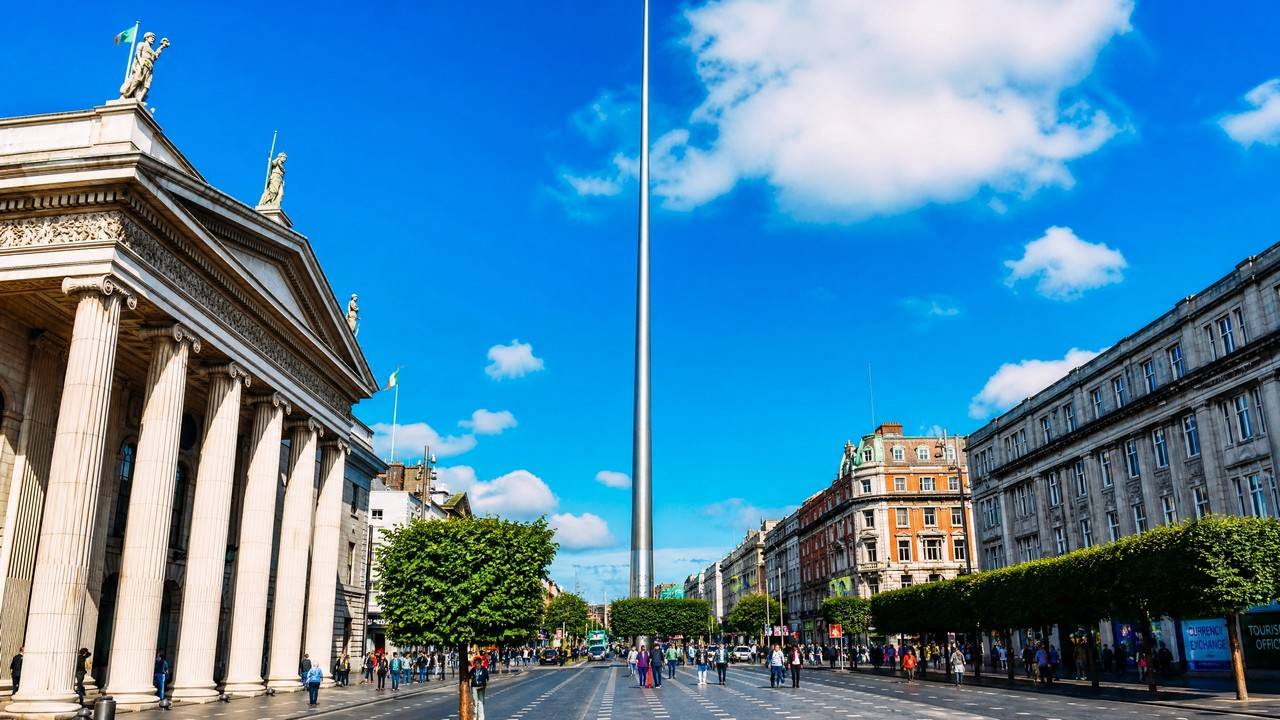
Dublin

Dublin Travel Guide

The Irish capital crossed by the River Liffey, where Trinity College's ancient books, the rich aroma of Guinness stout and live music in the Temple Bar district intertwine - a green-island capital of both literature and cheer.

📍 Destination Overview

Dublin is the capital of Ireland; the River Liffey runs through the city, dividing it into north and south banks, a city with both deep literary heritage and a lively, convivial spirit. It nurtured literary giants such as Joyce, Wilde, Yeats and Beckett, and is listed by UNESCO as a City of Literature. In the ancient Trinity College, the Long Room library with its rows of towering bookshelves is spectacular, housing the 1,200-year-old illuminated Book of Kells. Another side of the city is its exuberant pub culture - the world-famous Guinness stout was born here, and the Gravity Bar on the top floor of the Guinness Storehouse lets you overlook the whole city while enjoying a pint. In the cobbled Temple Bar district, pubs nightly send out the fiddle and song of traditional Irish music, lively and bustling. Dublin Castle, St Patrick's Cathedral and Phoenix Park each have their own charm. The weight of literature, the richness of stout and the cheer of the pubs make Dublin warm and enchanting.

🏛️ Region
Ireland · On the Liffey
capital of Leinster
🗓️ Best Season
May
Sep / St Patrick's Day in March
🕐 Time Difference
−7 to −8 hrs vs Beijing
💰 Currency / Language
Euro (EUR) / English & Irish
🕐 Recommended Duration
2
3 days — College + Stout + Pub district
🔌 Outlet / Voltage
Type G outlets · 230V
UK-style three-pin, bring an adapter

☀️ Best Time to Visit & Climate

🌤️ Summer: May–Sep
Longest days, most pleasant climate.
☘️ March: St Patrick's Day
A grand green celebration.
Jan
🌧️
8°/3°
Feb
🌥️
8°/3°
Mar
☘️
10°/4°
Apr
🌱
12°/5°
Verdant
May
🌤️
15°/7°
Best
Jun
☀️
18°/10°
Best
Jul
☀️
20°/12°
Best
Aug
🌤️
19°/12°
Best
Sep
🍂
17°/10°
Best
Oct
🍁
14°/8°
Nov
🌧️
10°/5°
Dec
🌧️
8°/4°

📷 Top Attractions

St. Patricks Cathedral
No.1 Dublin
St. Patricks Cathedral
St Patrick's Cathedral is the largest church in Ireland and the National Cathedral of the Church of Ireland (Anglican). Founded in 1191 and named after St Patrick — who is said to have baptized converts nearby — with its Gothic spires, stained glass, medieval floor tiles, memorial statues, and Jonathan Swift (author of Gulliver's Travels) as dean buried within, it is Dublin's most important religious building and the spiritual center of the Church of Ireland. Founded in 1191 on the site of St Patrick's 5th-century baptismal well — rebuilt in Gothic style in the 13th-14th centuries, extensively restored in the 19th century with Guinness family funding. Ireland's largest church — ~91 m long, Gothic spire ~43 m. Interior features stained glass, medieval floor tiles, knightly banners and memorial statues. Jonathan Swift (Gulliver's Travels) was dean (1713-1745) and is buried inside with his beloved Esther Johnson (Stella). The choir remains active. Visiting to feel a millennium of faith and Swift's literary legacy in Ireland's largest Gothic church is a solemn, profound cultural experience in Dublin.
Church & Religious Site
Guinness Storehouse
No.2 Dublin
Guinness Storehouse
Guinness Storehouse is Dublin's most popular tourist experience. This seven-story immersive exhibition is housed in a 1904 fermenting building at St James's Gate — the birthplace of Guinness — telling the 250-year story of the black stout from barley, hops, water and yeast through roasting, pouring and tasting, culminating in the top-floor Gravity Bar with 360° Dublin skyline views and a perfectly poured pint. The building is shaped like a giant pint glass — each of seven floors has a theme: ground floor introduces the four ingredients and Arthur Guinness's 1759 lease; floor 1 explores water, barley, hops and yeast; floor 2 roasting and tasting; floor 3 advertising history and "Guinness is Good for You"; floor 4 the art of pouring the perfect seven-step pint; floor 5 Guinness and Irish culture; floor 7 the Gravity Bar. Visiting to experience the richness of the black stout and Dublin's skyline in the 250-year legend of Ireland's national drink is a must-do cultural experience in Dublin.
Museum
Dublin Castle
No.3 Dublin
Dublin Castle
Dublin Castle is an ancient castle carrying centuries of Irish history—once a seat of power, now used for state ceremonies, a witness to Dublin's deep history and a key window into Ireland's past. Dublin Castle stands in central Dublin, a hugely important historic landmark. Its history is long—first built in the Middle Ages (around the 13th century, on an earlier Viking site), for centuries the center of English rule in Ireland, witnessing Ireland's turbulent history; after independence it was handed to Ireland and is now used for state ceremonies (like the president's inauguration). Over the centuries, it is now a grand complex blending styles: medieval tower remains (Record Tower) and Georgian palace buildings. The highlight is the State Apartments—former viceregal rooms, splendid, visitable by guided tour; also a chapel, courtyards and underground Viking and medieval relics. Step into this ancient castle, visit the splendid rooms and old relics, recall centuries of history. Visiting Dublin, its ancient Dublin Castle, is a storied sight.
Church & Religious Site
Ha'penny Bridge
No.4 Dublin
Ha'penny Bridge
Ha'penny Bridge (officially Liffey Bridge) is the iconic pedestrian cast-iron bridge over the River Liffey in Dublin, Ireland. Opened in 1816, this white cast-iron arch with its elegant curve is Dublin's most photogenic bridge, linking Temple Bar with the city center north — Dublin's most recognizable landmark and a classic postcard image. Designed by British engineers and opened in 1816 — Dublin's oldest cast-iron bridge, officially "Liffey Bridge." A white cast-iron arch ~43 m long with an elegant curve over the Liffey. Named "Ha'penny" for the half-penny toll once charged (free since 1919). The bridge links Temple Bar on the south with the city center on the north — Dublin's busiest pedestrian bridge. At night, lights illuminate the bridge and its Liffey reflection. Visiting to feel the atmosphere of both Liffey banks from Dublin's most elegant cast-iron arch is a classic, romantic landmark experience.
Square & Landmark

🎯 Dublin Experiences

Long Room Library
Ancient books and the Book of Kells.
Guinness Storehouse
Enjoy a pint with a city-wide view.
Pub Music
Fiddle music in Temple Bar.
Castle History
Historic building complexes.
Riverside Stroll
The view from Ha'penny Bridge.
Dublin is the capital of Ireland, with a temperate maritime climate that is mild and rainy. Summer (May–Sep) has the longest days and is most pleasant; March's St Patrick's Day is a grand green celebration. Don't miss Trinity College's Book of Kells and Long Room library, the Guinness Storehouse, and the traditional Irish music drifting nightly from the Temple Bar district. The weather is changeable with frequent showers, so bring rain gear. This is the gateway to the west coast. Prices and exchange rates are for reference.

🚌 Transport & Stays

City Transport
✈️
Airport Bus
Dublin Airport to city
About 30–40 min (reference)
🚋
Luas Tram / Walking
Compact city center
Per trip (reference)
🚆
Intercity Train / Bus
Toward Galway / Cork
Depends on schedule (reference)
🚗
Car Rental / Self-drive
The Wild Atlantic Way
Renting a car recommended (reference)
Recommended Stay Areas
🎻 Temple Bar District (recommended)
Near nightlife and sights
🛍️ Around Grafton Street
Near shops and Trinity
🏛️ Castle / Old Town
Historic core area
🚉 Around the Train Station
Convenient for trips
Free Consultation

Free Consultation

1-on-1 travel consultant customizes your Dublin trip for free based on your schedule and preferences.