📍 Destination Overview
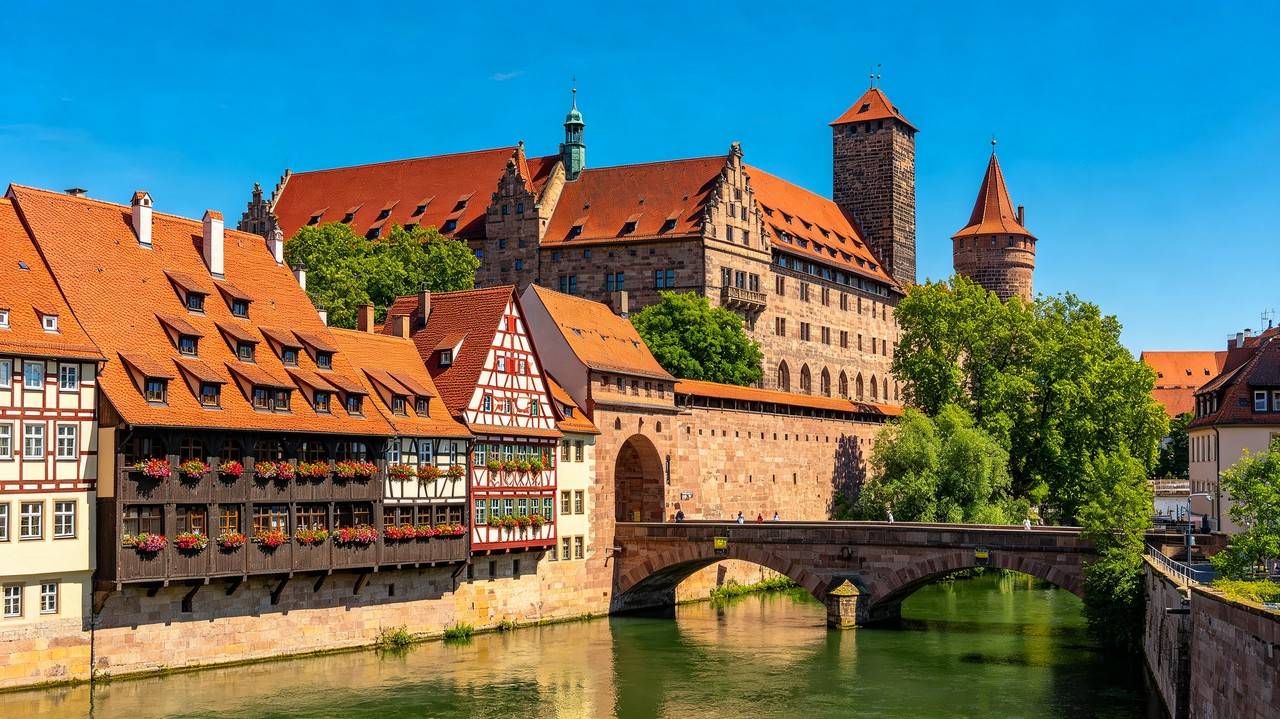
Nuremberg is the central city of the Franconia region in northern Bavaria, a walled medieval old town. The Imperial Castle sits on the northern heights overlooking the red-roofed old town, with the Pegnitz River flowing through. This is the hometown of painter Dürer and was an important city of the Holy Roman Empire. The post-WWII Nuremberg Trials took place here, leaving a weighty historical legacy. Each Advent season, the Christkindlesmarkt at the Hauptmarkt is one of the world's most famous Christmas markets, with the aroma of gingerbread and mulled wine filling the old town.
🏰 Location
Germany · Bavaria · Medieval city in Franconia
🗓️ Best Season
May-Sep
🕐 Time Difference
UTC+1/UTC+2 (DST); -6~-7 from Beijing
💰 Currency / Language
Euro EUR / German
🕐 Suggested Duration
1-2 days · Imperial Castle + Old Town + City Walls
🔌 Outlet / Voltage
Type C/F outlets · 230V · adapter needed
☀️ Best Time to Visit & Climate
🌸 Summer: May–Sep
Pleasant weather for the old town and city walls.
Jan
❄️
3°/-3°
Feb
🌥️
5°/-3°
Mar
🌤️
10°/0°
Apr
🌷
15°/3°
May
🌸
20°/8°
Best
Jun
☀️
23°/11°
Best
Jul
☀️
25°/13°
Best
Aug
🌤️
24°/13°
Best
Sep
🍂
19°/9°
Best
Oct
🍁
13°/5°
Nov
🌥️
7°/1°
Dec
🎄
4°/-2°
📷 Top Attractions
No.1 Nürnberg
Memorium Nürnberger Prozesse
The Nuremberg Trials Memorial is a site of major historical significance, the venue of the world-famous Nuremberg Trials after WWII, where the international community judged Nazi war criminals, upheld justice and laid the cornerstone of modern international law, a solemn, profound and thought-provoking place. After WWII, to try the major war criminals of Nazi Germany for their crimes against peace, war crimes and crimes against humanity (including the horrific atrocities of the Holocaust), the victorious Allies established an international military tribunal in Nuremberg in 1945 to 1946 and held a series of historic trials, the famous Nuremberg Trials. These trials were a landmark in history: the first time the international community formally tried those who launched aggressive war and committed crimes against humanity, establishing the important principle that individuals bear legal responsibility for war crimes and crimes against humanity, laying a key cornerstone for modern international criminal law and human rights protection. The trial was held in Courtroom 600 of the Nuremberg Palace of Justice. Today this historic site is the Nuremberg Trials Memorial: visitors can see the famous Courtroom 600 where the historic trial was held (if no session is in progress), and through the memorial's detailed exhibits (documents, photos, films, artifacts) deeply understand the background, process, meaning and far-reaching impact of the Nuremberg Trials. Visiting the memorial with solemnity and reflection, remembering this history of justice and warning for future generations, is a profound experience.
Museum
No.2 Nürnberg
Albrecht Dürer Haus
Dürer's House is the residence where Albrecht Dürer, the greatest artist of the German Renaissance, once lived and worked. Visiting this well-preserved historic home to remember the artistic giant is a culturally meaningful stop in Nuremberg. Albrecht Dürer is one of the greatest and most influential artists of the German and European Renaissance, hailed as the Leonardo da Vinci of the North. He achieved supreme mastery in painting, printmaking (especially exquisite woodcuts and engravings), drawing and art theory; his works (such as Praying Hands and Melencolia I) are treasures of world art. Dürer was a Nuremberger, and the city is proud of its great native son. This Dürer's House, below the Kaiserburg, is a typical, exquisite 15th-century Nuremberg half-timbered burgher's house, where Dürer lived, worked and created for about twenty years until his death. Today it is a museum, carefully restored and furnished as in Dürer's time: visitors can see the living rooms, kitchen, and most importantly his studio and printmaking workshop (often with printmaking demonstrations recreating his methods), feeling the environment where the master lived and created; the museum also displays reproductions of Dürer's works and related introductions. Visiting Nuremberg's Dürer's House, stepping into the home of this Renaissance giant and remembering his great achievements, is a stop to feel the city's cultural depth.
Museum
No.3 Nürnberg
Pegnitz
The Pegnitz is a beautiful river flowing through Nuremberg's old town, adding a graceful waterside charm to this ancient medieval city. Its old bridges, historic riverside buildings and charming corners form the poetic, picturesque classic scenes of Nuremberg's old town. Winding through the center of the old town, the Pegnitz splits it into two parts; its waters are gentle and green, with quaint medieval scenery on both banks. Along this river that runs through the city are many of Nuremberg's most charming, photogenic sights: most famous are the ancient bridges across it and the historic buildings along the banks, especially the famous Holy Spirit Hospital (Heilig-Geist-Spital), a medieval almshouse partly built over the Pegnitz on arches, reflected in the water, one of Nuremberg's most classic, photogenic images; in addition, there is the old Hangman's Bridge and a mid-river island, riverside half-timbered houses, churches and more, all picture-perfect. Strolling along the Pegnitz, along the riverside paths and old bridges, visitors enjoy the rippling water, ancient bridges, riverside historic buildings and the reflections of old houses, the poetic, tranquil side of Nuremberg's old town, especially intoxicating in the soft evening light, and a great angle to photograph the city. Strolling Nuremberg's Pegnitz riverside and enjoying the poetic scenery of the river threading the old town, its bridges and old houses, is a pleasant, enchanting experience in this medieval city.
National Park & Nature
No.4 Nürnberg
Kaiserburg
The Kaiserburg (Imperial Castle) is Nuremberg's most important landmark. This magnificent fortress atop the northern hill of the old town witnessed Nuremberg's glory as a key city of the Holy Roman Empire, looking down over the red-roofed medieval old town, the city's most historic sight. The Kaiserburg's history reaches back to the Middle Ages; it was one of the most important imperial residences of the Holy Roman Empire, in the Middle Ages nearly every Holy Roman Emperor visited or resided here, making Nuremberg for a time one of the empire's de facto central cities, of eminent status. Built along the hillside in layers, the castle is vast and imposing, comprising the imperial quarters, chapel, deep well, towers, walls and courtyards, blending Romanesque and other styles, ancient and sturdy. Visitors can tour the imperial quarters and halls (learning imperial history), the ancient two-level chapel, and a deep old well said to be dozens of meters deep (with lively water-drawing demonstrations); climbing the famous Sinwell Tower (round tower) reveals a superb panorama of the red-roofed medieval old town, church spires, walls and the whole city. The castle hill and surroundings are also a great spot to photograph Nuremberg's old town. Visiting Nuremberg's Kaiserburg, which witnessed imperial glory, and taking in the medieval old-town panorama, is the city's not-to-be-missed number-one sight.
Castle & Fortress
No.5 Nürnberg
Red Cross Museum
The International Red Cross and Red Crescent Museum sits opposite the Palais des Nations in Geneva, a profound and moving humanitarian theme museum. The Red Cross was founded by Geneva merchant Henry Dunant—after seeing war's horrors he advocated neutral aid for the wounded and pushed the birth of the Geneva Conventions. The museum's three main themes—'Defending Human Dignity,' 'Rebuilding Family Links' and 'Reducing Natural Risks'—through moving objects, images, testimonies and interactive installations tell of the Red Cross's century and a half of saving lives and defending dignity in war, disaster and crisis. The exhibits are modern and affecting, prompting thought on humanitarian meaning. This museum is an important window into human mutual help and hope amid suffering.
Museum
🎯 Nürnberg Experiences
Imperial Castle Climb
Panoramic view of the red-roofed old town.
Christmas Market
Gingerbread and mulled wine at Christkindlesmarkt.
Wall Walk
Medieval defensive walls tour.
Nuremberg Sausages
Grilled sausages, a Franconian specialty.
Dürer House
The Renaissance master's studio.
The December Christkindlesmarkt is one of the world's most famous; book accommodation early. Summer May-Sep has pleasant weather for old town walks. Climb the Imperial Castle for panoramic views.
🚌 Transport & Stays
City Transport
🚄Depends on class (reference)
Train
Munich to Nuremberg ~1 hour
Depends on class (reference)
🚇Single ~€3.9 (reference)
U-Bahn
Connects station to old town
Single ~€3.9 (reference)
🚶—
Walking
Compact old town, walkable
—
🚌Same zone fare (reference)
City Bus / Tram
Covers areas not served by rail
Same zone fare (reference)
Recommended Stay Areas
🏰 Inside Old Town (recommended)
Near Imperial Castle and Christmas Market
🧱 Along the City Walls
Near main old town entrances
🚉 Near Central Station
Transport hub, convenient connections
🌊 Pegnitz Riverside
River views and quiet lodging
Free Consultation
Want to plan your Nürnberg trip in more depth?
Tell us your departure city, travel dates and interests, and Usitour will tailor a trip just for you.