📍 Destination Overview
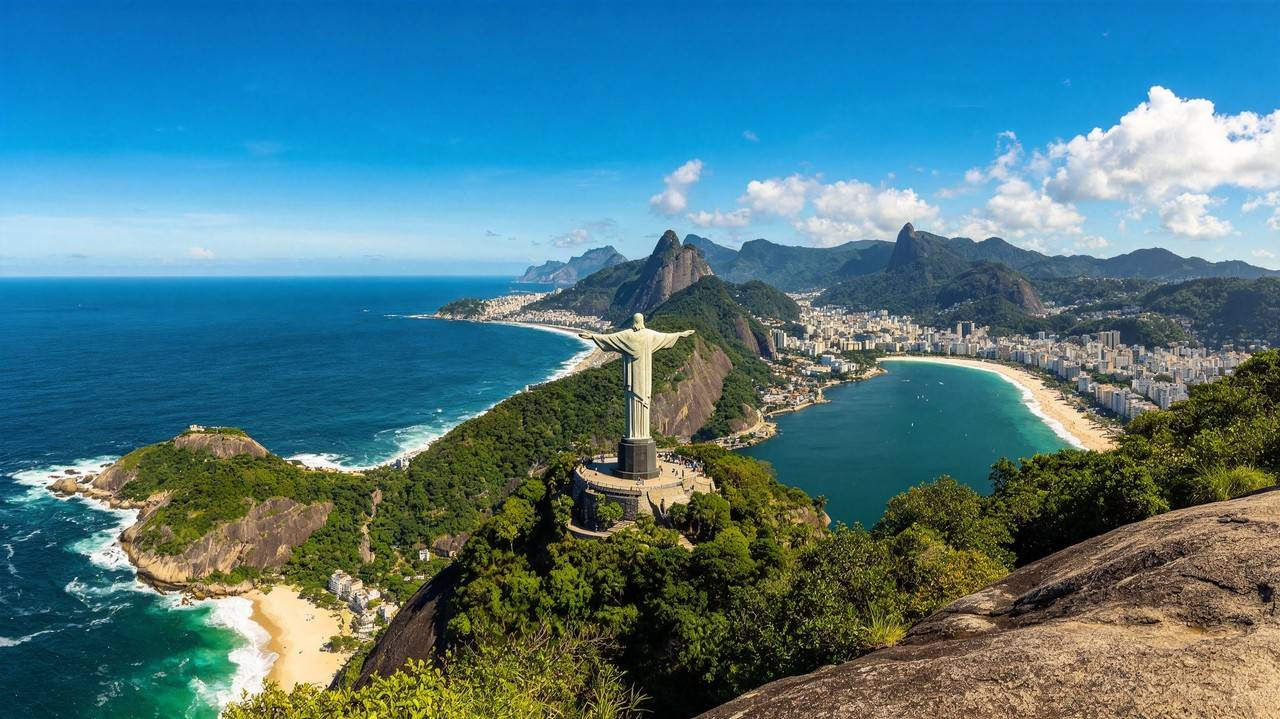
Rio de Janeiro, set between mountains and the Atlantic, is Brazil's most famous city. Christ the Redeemer stands atop Corcovado overlooking the city and bay—Brazil's symbol—while the Sugarloaf cable car offers sea-and-mountain panoramas. Copacabana and Ipanema beaches stretch on with samba rhythms, and the February-March Carnival ignites the city, making Rio one-of-a-kind in passion.
⛰️ Location
Brazil · Rio de Janeiro State · marvelous city between mountains and sea
📅 Best Season
Dec-Mar (beaches) / Feb-Mar (Carnival)
📰 Time Difference
−11 hrs vs Beijing
💰 Currency / Language
Real BRL / Portuguese
📰 Suggested Duration
3-4 days · Christ statue + beaches + Sugarloaf
🔌 Outlet / Voltage
Type N/C outlets · 127/220V · adapter needed
☀️ Best Time to Visit & Climate
🏖️ Summer to Early Autumn: Dec–Mar
Beach high season under blazing sun.
🎭 Feb–Mar
The greatest samba party on earth.
Jan
🌆
30°/24°
Best
Feb
🎭
30°/24°
Best
Mar
☀️
29°/24°
Best
Apr
🌤️
28°/22°
May
🌱
26°/21°
Jun
🌥️
25°/19°
Jul
🌤️
25°/18°
Aug
🌤️
25°/19°
Sep
🌸
25°/20°
Oct
🌤️
26°/21°
Nov
🌊
27°/22°
Dec
🌆
29°/23°
Best
📷 Top Attractions
More Attractions →
Pão de Açúcar
Sugarloaf Mountain (Pao de Acucar) is one of Rio de Janeiro's defining landmarks, a granite monolith rising from the entrance of Guanabara Bay to 396 metres, named for its sugarloaf shape. The classic way up is the two-stage cable car, the bondinho: from the Praia Vermelha base station in Urca to Morro da Urca at about 220 metres, then a second car to the summit. Each ride takes about three minutes, cars run every 20 minutes, and each cabin holds about 65 people. The second cable stretches roughly 750 metres across empty air over Urca Bay and is the most dramatic stretch of the trip. At the summit, open terraces circle the peak for 360-degree views over the bay, Copacabana and Botafogo beaches and the skyline, with Christ the Redeemer on Corcovado visible on clear days. The summit faces west-southwest, so the sun sets behind the Corcovado ridge and the city lights come up beneath you, Rio's signature viewing moment. Morro da Urca has a cafe, viewpoints and a small stage, plus a short trail included with your ticket; at the foot lie the 1.2 km Pista Claudio Coutinho path and the Mureta da Urca seawall where locals gather.
Square & Landmark

Christ the Redeemer
Christ the Redeemer (Cristo Redentor) crowns Corcovado mountain in Rio de Janeiro's Tijuca National Park, 710 m above the sea — Brazil's best-known landmark. The statue is 30.1 m tall (38 m with its 8 m pedestal), spans 28.5 m and weighs about 1,145 tonnes, a reinforced-concrete frame clad in soapstone triangles. Engineer Heitor da Silva Costa led the design, French sculptor Paul Landowski shaped the body and Romanian Gheorghe Leonida modelled the face. Work began in 1922 and the monument was inaugurated on 12 October 1931, the feast day of Brazil's patron saint Nossa Senhora Aparecida, whose chapel sits inside the base. It was voted one of the New 7 Wonders of the World on 7 July 2007. The electric cog railway, running since 1884, climbs 3.82 km through the Tijuca Forest — replanted from 1862 on Emperor Pedro II's orders, one of the world's first large-scale reforestations. The 360-degree terrace frames Sugarloaf, Copacabana and Ipanema, Guanabara Bay and the Maracanã; dawn cloud seas and late golden light are the two finest hours.
Square & Landmark

Rio de Janeiro Cathedral
The Metropolitan Cathedral of Saint Sebastian (Catedral Metropolitana de São Sebastião) on Avenida República do Chile 245 in central Rio de Janeiro is the seat of the Archdiocese of Rio and one of Brazil's boldest modern churches. Architect Edgar de Oliveira da Fonseca drew on Mayan step-pyramids for a column-free truncated cone: 75 m tall outside, 64 m inside, 106 m across the base, with a circular hall holding some 20,000 people and clear sightlines to the altar from every corner. The cornerstone was blessed on 20 January 1964, the feast of St Sebastian; the building was inaugurated on 16 November 1976 and solemnly dedicated as cathedral on 15 August 1979. Four stained-glass strips run the full 64 m internal height and converge at a Greek-cross skylight, so midday sun pours red, blue, green and gold light across the marble floor. Behind the sanctuary stand bronze figures of the four evangelists and two organs. The basement Sacred Art Museum holds Pedro II's throne, a golden rose gifted by a pope and baptismal furnishings of the Portuguese royal family. Pope John Paul II celebrated Mass here in 1997 and Pope Francis twice during World Youth Day 2013. Its predecessor, the Nossa Senhora do Carmo church on Praça XV, crowned Pedro I in 1822 and Pedro II in 1841 — the only Christian imperial coronations ever held in South America.
Church & Religious Site

Praça Floriano
Cariocas call it “Cinelândia” — Cinema-land: in the 1930s a cluster of Art Deco movie palaces rose around Praça Floriano, and at its peak most ran films simultaneously. The cinemas have mostly found new uses, yet the square's cultural gravitas holds. The Paris Opera-inspired Theatro Municipal, opened in 1909, anchors one side, with the National Library and the Museu Nacional de Belas Artes alongside, and the metro stop bears the nickname. A traditional stage for political rallies, the square turns especially rewarding once the façades light up.
Square & Landmark

Museu Histórico do Exército e Forte de Copacabana
Wedged onto the southern tip of Copacabana's curve, the fort was built between 1908 and 1914 to guard the entrance to Guanabara Bay. Today it splits its personality between an army history museum — Krupp coastal guns, armoured vehicles, and the story of the 1922 lieutenants' revolt that briefly turned the fort's cannons on its own city — and one of Rio's best-placed café terraces, run by the storied Confeitaria Colombo. Claiming a sea-facing table an hour before sunset is the local playbook.
Museum
No.6 Rio de Janeiro
Copacabana Beach
Copacabana is Rio de Janeiro's most famous beach, a 4 km crescent bay known for its seaside promenade paved in a black-and-white wave pattern. More than a sunbathing spot, it is a stage for the carioca lifestyle: dawn yoga, football, volleyball and cyclists flow non-stop, and New Year's Eve fireworks draw millions in white to pray. Art-deco buildings and hills behind frame the classic postcard, while coconut water and grilled shrimp from beach stalls define summer.Night runs and beach volleyball keep the sand buzzing from dawn to dark.
Sightseeing
🎯 Rio de Janeiro Experiences
Ascend Christ the Redeemer
Overlook mountains, sea and the whole city from the peak.
Sugarloaf Cable Car
Bay panorama at sunset.
Beach Time
Sunshine on Copacabana.
Rio Carnival
The revelry of the samba parades.
Selarón Steps
The art of colored tiles.
Seasons are reversed in the Southern Hemisphere. Summer (Dec-Mar) is peak beach season, and the Rio Carnival in Feb-Mar is a global event—book rooms far in advance. Autumn and spring have pleasant weather. Mind your belongings and avoid quiet areas.
📰 Travel Guides
More Guides →🚌 Transport & Stays
City Transport
✈️Taxi fare depends on distance (reference)
Galeão Airport
About 40 min drive from downtown
Taxi fare depends on distance (reference)
🚇Per-ride depends on zone (reference)
Metro
Connects beaches and downtown
Per-ride depends on zone (reference)
🚡Depends on ticket price (reference)
Sugarloaf Cable Car
Hilltop sightseeing
Depends on ticket price (reference)
🚗Base fare depends on distance (reference)
Ride-hailing App
Safer for getting around downtown
Base fare depends on distance (reference)
Recommended Stay Areas
🌆 Copacabana (Recommended)
Along the beach, convenient transport
🌊 Ipanema / Leblon
Upscale beach neighborhoods
📿 Botafogo
View of Sugarloaf, quiet
🎨 Santa Teresa
Artistic hillside neighborhood
Free Consultation
Want to plan your Rio de Janeiro trip in more depth?
Tell us your departure city, travel dates and interests, and Usitour will tailor a trip just for you.