🌏 Destination Overview
Brazil is the epitome of South American passion and natural wonder. Rio de Janeiro has a bay overlooked by the Christ statue, the sands of Copacabana and the fervor of samba; Iguazu Falls plunges with thunderous force, and standing on the walkway wrapped in mist is utterly staggering; the Amazon rainforest harbors the planet's richest life. Add the annual nationwide Carnival, and Brazil pushes nature, culture and Latin passion to the extreme, making it the core destination of any South American long-haul trip.
🗓️
Best Season
Apr-Oct (Dry season)
🕐
Recommended Days
9-14 days
👪
Best For
In-depth Travel / Couples / Nature Lovers
🎯
Top Activities
Waterfalls · Beaches · Rainforest · Samba
🧳
Pre-trip Preparation
Visa + Health (Yellow Fever)
Popular Cities

Rio de Janeiro
Metropolis,Beach,Landmark
🔥 Christ the Redeemer and Copacabana Beach, samba and Carnival city.

São Paulo
Metropolis,Gateway,Food
🔥 South America's largest metropolis, art, food and business center.
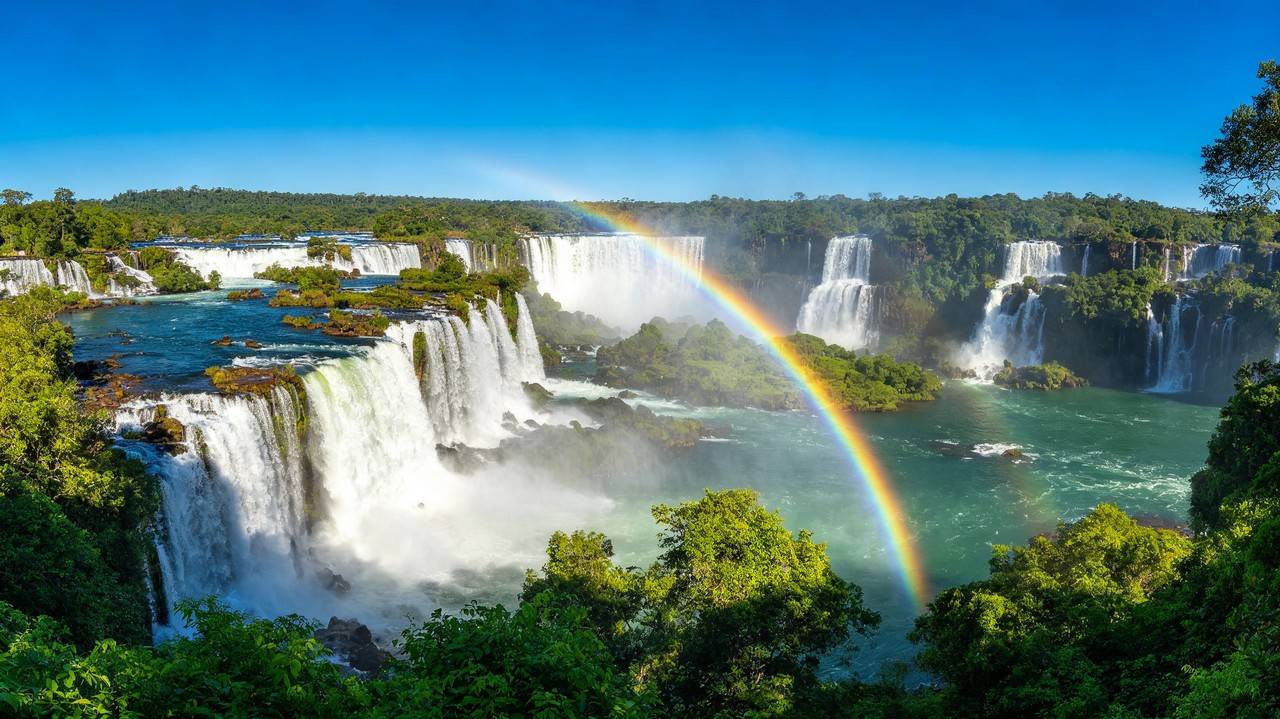
Foz do Iguacu
Waterfall,UNESCO,Nature
🔥 World's most spectacular waterfalls, natural wonder on the Brazil-Argentina border.

Salvador
Old Town,African Culture,UNESCO
🔥 The capital of Afro-Brazilian culture, with the colorful Pelourinho old town.

Florianópolis
Island,Beach,Surfing
🔥 Magic Island's 42 beaches and surfing paradise.

Bonito
Eco-tourism,Snorkeling,Cave
🔥 Crystal river snorkeling and blue caves, eco-tourism paradise.
Popular Attractions
More Attractions →
Pão de Açúcar📍 Rio de Janeiro
Sugarloaf Mountain (Pao de Acucar) is one of Rio de Janeiro's defining landmarks, a granite monolith rising from the entrance of Guanabara Bay to 396 metres, named for its sugarloaf shape. The classic way up is the two-stage cable car, the bondinho: from the Praia Vermelha base station in Urca to Morro da Urca at about 220 metres, then a second car to the summit. Each ride takes about three minutes, cars run every 20 minutes, and each cabin holds about 65 people. The second cable stretches roughly 750 metres across empty air over Urca Bay and is the most dramatic stretch of the trip. At the summit, open terraces circle the peak for 360-degree views over the bay, Copacabana and Botafogo beaches and the skyline, with Christ the Redeemer on Corcovado visible on clear days. The summit faces west-southwest, so the sun sets behind the Corcovado ridge and the city lights come up beneath you, Rio's signature viewing moment. Morro da Urca has a cafe, viewpoints and a small stage, plus a short trail included with your ticket; at the foot lie the 1.2 km Pista Claudio Coutinho path and the Mureta da Urca seawall where locals gather.

Museu de Arte de Sao Paulo📍 São Paulo
The Museu de Arte de Sao Paulo Assis Chateaubriand (MASP) stands at Avenida Paulista 1578 in Sao Paulo and is one of Latin America's most important art institutions. Founded in 1947 by the press magnate Assis Chateaubriand and the Italian critic Pietro Maria Bardi, it holds more than 11,000 works. Its European paintings, by Raphael, Titian, Rembrandt, Velazquez, Goya, Manet, Renoir, Cezanne and Van Gogh, are reckoned the finest systematic European collection in the Southern Hemisphere. The Brazilian side is equally strong, with Candido Portinari and Tarsila do Amaral alongside African, Asian and decorative arts. The building is itself a landmark: Lina Bo Bardi's 1968 concrete-and-glass structure lifts the galleries about eight metres on vivid red beams, leaving the Vao Livre, a fully public plaza below that becomes an antiques and crafts market on Sundays. Inside, the signature crystal easels hold paintings on transparent glass without conventional walls, a layout reinstalled in 2015 by curator Adriano Pedrosa and true to Bo Bardi's original idea of works floating in open space, with visitors choosing their own path.

Iguaçu Falls📍 Foz do Iguacu
Iguaçu Falls (Cataratas do Iguaçu) straddles Brazil's Paraná state and Argentina's Misiones province: roughly 275 drops spanning about 2,700 m, the largest waterfall system on Earth. Some 80% of the water falls on the Argentine side, but the Brazilian side offers the definitive head-on panorama. Iguaçu National Park on the Brazilian bank was created on 10 January 1939, covers about 185,000 hectares of Atlantic Forest, became a UNESCO World Heritage Site in 1986 and was voted one of the New 7 Natural Wonders of the World on 11 November 2011. First recorded by a Spanish expedition in 1542, the falls are explained in Guarani legend by the serpent god M'Boi. A boardwalk into the canyon faces the Devil's Throat, roughly 80–90 m high, where spray drenches visitors; average flow is about 1,800 m³/s. Park shuttles link the Cataratas Trail, the Poço Preto track and the Macuco Safari boat jetty.

Christ the Redeemer📍 Rio de Janeiro
Christ the Redeemer (Cristo Redentor) crowns Corcovado mountain in Rio de Janeiro's Tijuca National Park, 710 m above the sea — Brazil's best-known landmark. The statue is 30.1 m tall (38 m with its 8 m pedestal), spans 28.5 m and weighs about 1,145 tonnes, a reinforced-concrete frame clad in soapstone triangles. Engineer Heitor da Silva Costa led the design, French sculptor Paul Landowski shaped the body and Romanian Gheorghe Leonida modelled the face. Work began in 1922 and the monument was inaugurated on 12 October 1931, the feast day of Brazil's patron saint Nossa Senhora Aparecida, whose chapel sits inside the base. It was voted one of the New 7 Wonders of the World on 7 July 2007. The electric cog railway, running since 1884, climbs 3.82 km through the Tijuca Forest — replanted from 1862 on Emperor Pedro II's orders, one of the world's first large-scale reforestations. The 360-degree terrace frames Sugarloaf, Copacabana and Ipanema, Guanabara Bay and the Maracanã; dawn cloud seas and late golden light are the two finest hours.

Amazon Rainforest📍 Manaus
The Amazon Rainforest spans nine South American countries and territories across some 5.5 million square kilometres — over half of the planet's remaining rainforest and the largest on Earth, nicknamed the "lungs of the Earth"; roughly 60% lies in Brazil. Manaus, capital of Amazonas state with about 2.2 million people, is the easiest gateway: boats leave up the Rio Negro and the Amazon mainstream to jungle lodges, where guided parties trek the forest, canoe flooded woodland at high water, spot caimans by night, fish for piranha, look for pink river dolphins and giant otters, and visit indigenous villages. Two signature outings leave from town: the Meeting of the Waters, where the black Rio Negro and the ochre Solimões run side by side for about 6 km without mixing, and the Anavilhanas Archipelago of more than 400 islands. Hundreds of thousands of species are known from here — macaws, sloths, arapaima and electric eels among them — in a climate averaging about 27 °C with some 2,300 mm of rain a year. Manaus itself still shows its rubber-boom opulence in the Amazon Theatre, inaugurated in 1896.

Itaipu Dam📍 Foz do Iguacu
The Itaipu Dam spans the Paraná River on the border between Foz do Iguaçu, Brazil, and Paraguay, built and jointly run by the two countries under the 1973 treaty as Itaipu Binacional; its first unit entered service in 1984. With 20 generating units totalling 14,000 MW, it is one of the world's largest producers of clean renewable energy, officially supplying about 8.7% of Brazil's electricity and 86.4% of Paraguay's. "Itaipu" means "the singing stone" in Tupi-Guarani. The Visitor Reception Centre on Av. Tancredo Neves, about 12 km north of town, runs panoramic buses to the crest (225 m above sea level): on one side a reservoir of some 29 billion cubic metres, on the other the spillway and the river valley, whose maximum discharge of about 62,000 m³/s out-roars even the Iguazu Falls. On Friday and Saturday evenings the "Itaipu Illuminated" show takes over the Central Lookout with live music from the triple frontier. The plant sits about half an hour from Iguazu Falls, making an easy one-day pairing with the falls and the Three Borders Landmark.
Classic Experiences
Best Travel Seasons
🌤️
Dry season · Apr-Oct
Pleasant climate, best for sightseeing
☀️
Summer · Dec-Mar
Beach high season and Carnival
🌧️
Rainy season · Nov-Mar
Humid rainforest, high waterfall volume
📅
By region · Year-round
Large climate differences north and south, choose timing by region
The dry season (Apr-Oct) is best for sightseeing; the falls have more water in the rainy season, and Carnival is mostly in Feb-Mar.
Popular Guide Articles
More →
Búzios Travel Guide 2026: Beaches, Transport & Where to Stay
👁 8.3k
Brazil 6-Day Small Group Tour Guide: Sao Paulo, Rio, Iguazu
👁 7.8k
Brazil Tour Strategy on the 7th: São Paulo, Rio, Iguazu – including waterfalls on both sides of the mountains.
👁 7.0k

Manaus Travel Guide 2026: Amazon Gateway, Transport & Trips
👁 6.9k
Study in Brazil Guide 2026: Universities, Tuition & Student Visa
👁 6.6k

Fortaleza Solo Travel Guide and Local Group Tours Comparison 2026
👁 6.3k
Practical Info
Depends on passport/departure country; check the latest visa and entry policy before travel
Brazilian Real (BRL), cards widely accepted
Mainly UTC-3 (spans multiple time zones)
127/220V, Type C/N outlets
Intercity by domestic flights; within cities mainly rideshare apps
Obey local laws, mind personal belongings; emergency 190 (police)/192 (ambulance)
Free Consultation
Free Consultation
Tell us your departure city, travel dates and interests, and Zou Sifang will tailor a trip just for you.