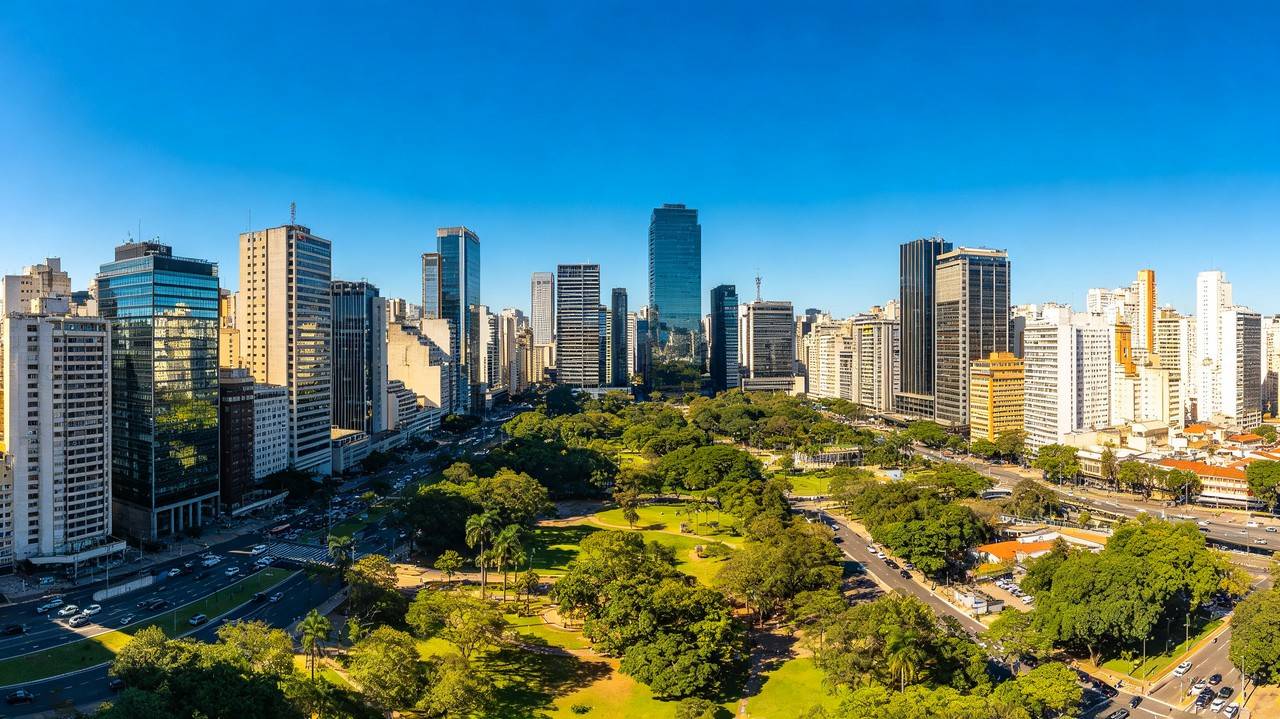
📍 Destination Overview
São Paulo is Brazil's largest city and the biggest metropolis in the Southern Hemisphere, its economic and culinary hub. Avenida Paulista holds MASP with rich Western art, and Ibirapuera Park is a green oasis. A melting pot, Liberdade is South America's largest Japanese enclave, and global cuisines make it Latin America's food capital. São Paulo captivates with art, diversity and food.
🏙️ Region
Brazil - Sao Paulo State - The largest metropolis in the Southern Hemisphere
🗓️ Best Season
Year-round
🕐 Time Difference
11 hours behind Beijing
💰 Currency / Language
Brazilian Real BRL / Portuguese
🕐 Recommended Duration
2-3 days - Avenue + museums + cuisine
🔌 Outlets / Voltage
Type N/C outlets - 127/220V - Different from China, bring an adapter
☀️ Best Time to Visit & Climate
🌤️ Autumn to Spring: Mar–May, Sep–Nov
The climate is pleasant and the city roaming is just right.
🎨 Year-round culture
Museums and cuisine are available in all seasons.
Jan
🌧️
28°/19°
Best
Feb
🌧️
28°/19°
Best
Mar
🌤️
27°/18°
Best
Apr
🍂
25°/16°
Best
May
🌥️
23°/13°
Best
Jun
🌤️
22°/12°
Best
Jul
🌤️
22°/11°
Best
Aug
🌤️
24°/12°
Best
Sep
🌸
24°/14°
Best
Oct
🌷
25°/15°
Best
Nov
🌤️
26°/17°
Best
Dec
🌧️
27°/18°
Best
📷 Top Attractions
More Attractions →
Museu de Arte de Sao Paulo
The Museu de Arte de Sao Paulo Assis Chateaubriand (MASP) stands at Avenida Paulista 1578 in Sao Paulo and is one of Latin America's most important art institutions. Founded in 1947 by the press magnate Assis Chateaubriand and the Italian critic Pietro Maria Bardi, it holds more than 11,000 works. Its European paintings, by Raphael, Titian, Rembrandt, Velazquez, Goya, Manet, Renoir, Cezanne and Van Gogh, are reckoned the finest systematic European collection in the Southern Hemisphere. The Brazilian side is equally strong, with Candido Portinari and Tarsila do Amaral alongside African, Asian and decorative arts. The building is itself a landmark: Lina Bo Bardi's 1968 concrete-and-glass structure lifts the galleries about eight metres on vivid red beams, leaving the Vao Livre, a fully public plaza below that becomes an antiques and crafts market on Sundays. Inside, the signature crystal easels hold paintings on transparent glass without conventional walls, a layout reinstalled in 2015 by curator Adriano Pedrosa and true to Bo Bardi's original idea of works floating in open space, with visitors choosing their own path.
Museum

São Paulo Metropolitan Cathedral
The São Paulo Metropolitan Cathedral (Catedral da Sé) is the seat of the Roman Catholic Archdiocese of São Paulo, standing on Praça da Sé at the city's historic zero point. Its foundation stone was laid in 1913 under the city's first archbishop, Duarte Leopoldo e Silva, to a neo-Gothic design by German architect Maximilian Emil Hehl; it was dedicated in 1954 for São Paulo's 400th anniversary, though the towers were only finished in 1967. The building runs 111 m long and 46 m wide, with 92 m towers and a 30 m dome inspired by Florence's cathedral, seating 8,000 and using over 800 tonnes of fine marble. Inside, the five-aisled basilica's capitals are carved with Brazilian motifs — coffee branches, pineapples and armadillos. The crypt below the main altar is an underground church in its own right, its marble reliefs telling the stories of Job and St Jerome; it holds the tombs of every archbishop plus the 16th-century cacique Tibiriçá, who welcomed the Jesuits, and regent Diogo Feijó, with the remains of the Jesuit airship pioneer Bartolomeu de Gusmão transferred here in 2004. The 1954 Balbiani & Rossi organ has 12,000 pipes, among the largest in Latin America, and the east tower's 61 Dutch bells form the continent's largest carillon. A full renovation ran from 2000 to 2002, and the cathedral anchors any old-town walking route.
Church & Religious Site

Parque Ibirapuera
Parque Ibirapuera on Av. Pedro Álvares Cabral in São Paulo's Vila Mariana district opened on 21 August 1954 for the city's 400th anniversary. Covering some 158 hectares with three artificial lakes, lawns and shaded paths, it is Latin America's most-visited urban green space, drawing around 14 million visitors a year and earning the nickname "São Paulo's Central Park"; "Ibirapuera" comes from Tupi, meaning "place of rotten trees". The architectural ensemble was designed by Oscar Niemeyer with landscaping by Roberto Burle Marx: the Bienal Pavilion (now home to the Museu Afro Brasil), the domed Oca pavilion, the Ibirapuera Auditorium and the sweeping Marquise canopy, alongside the Museum of Modern Art (MAM), the planetarium and the Japanese pavilion with its tea room and pond. The Monument to the Bandeiras flags stands by the main gate and an obelisk honours the heroes of the 1932 Constitutionalist Revolution. The park doubles as the city's living room for running, cycling, skateboarding, picnics and exhibitions, with open-air music at weekends and quiet mornings for joggers and birdwatchers (135+ bird species recorded).
Park & Garden

Museu do Futebol
The Football Museum sits beneath the stands of the historic Pacaembu Stadium—a modern interactive museum dedicated to Brazilian football history and culture. In the "country of football," the sport's history is woven with the nation's social change. Through images, objects, interactives and immersive exhibits, it presents Brazil's five World Cup triumphs, the glory of legends like Pelé, and how football is woven into Brazilians' lives and identity. Visitors relive classic goals, try shooting interactives and feel the stadium's passion. For fans, it is a shrine to understand Brazilian football's soul.
Museum

Museu Paulista
Better known as Museu do Ipiranga, the Museu Paulista crowns the end of Independence Park in São Paulo's Ipiranga district, commemorating Pedro I's 1822 proclamation of Brazilian independence on this very ground. Italian architect Tommaso Gaudenzio Bezzi designed the eclectic palace, begun in 1885 and opened in 1895, fronted by a symmetrical French-style garden and fountain promenade. Its most famous treasure is Pedro Américo's monumental canvas 'Independência ou Morte!'. After years of closure for renovation, the museum reopened in 2022 as the definitive starting point for São Paulo's story.
Museum

Avenida Paulista
Avenida Paulista is São Paulo's financial and cultural artery, flanked by skyscrapers, bank headquarters and art museums, most strikingly the São Paulo Museum of Art (MASP) whose glass body bridges the avenue on slender pillars. On Sundays the road becomes a car-free promenade and bike lane where citizens cycle, dance and browse book fairs; it is also Brazil's favoured stage for major protests and rallies. By day a showcase of urban bustle, by night a neon spectacle, it is the first stop to read São Paulo's modern pulse. The avenue's cafés and indie bookshops are daily windows into this immigrant city's diverse character.
Commercial District
🎯 São Paulo Experiences
Avenida Paulista
The city's pulse among skyscrapers.
Municipal Market
Sampling its abundant food.
Liberdade
The largest Japanese enclave in South America.
Graffiti Alley
The vibrancy of street art.
Diverse Cuisine
A culinary melting pot of Italian, Japanese and Arab flavors.
Seasons are reversed in the Southern Hemisphere. Sao Paulo's highland climate is milder than Rio's. Spring and autumn (Mar-May, Sep-Nov) are best. Summer (Dec-Feb) brings afternoon rains. This is Brazil's economic, cultural and culinary hub - mind your belongings.
📰 Travel Guides
More Guides →🚌 Transport & Stays
City Transport
✈️Varies by method (reference)
Guarulhos Airport
Airport bus / taxi to downtown
Varies by method (reference)
🚇Single fare varies by zone (reference)
Metro
Covers major downtown areas
Single fare varies by zone (reference)
🚗Starting fare varies by distance (reference)
Ride-hailing App
Getting around downtown
Starting fare varies by distance (reference)
🚶-
Walking
Avenida Paulista is best on foot
-
Recommended Stay Areas
🏙️ Avenida Paulista (top pick)
Near museums and business
🌳 Around Ibirapuera
Near the park, quiet
🎨 Vila Madalena
An artsy graffiti district
🏙️ Downtown
Transport hub, varied prices
Free Consultation
Want to plan your São Paulo trip in more depth?
Tell us your departure city, travel dates and interests, and Usitour will tailor a trip just for you.