📍 Destination Overview
Brussels, capital of Belgium and seat of the European Union, is called the heart of Europe. Its hallmark is the UNESCO-listed Grand Place, ringed by the Gothic town hall and grand guild houses, often called Europe's most beautiful square. The old town offers the Manneken Pis statue and endless chocolate and waffle shops, plus Tintin murals as the comic-book capital.
🏛️ Location
Belgium's capital, Brussels
🗓️ Best Season
May-Sep
🕐 Time Difference
6 hours behind Beijing (7 summer)
💰 Currency / Language
Euro (EUR) / French · Dutch
🕐 Suggested Duration
2-3 days
🔌 Outlet / Voltage
Type C/E · 230V
☀️ Best Time to Visit & Climate
🌞 Spring–summer: May–Sep
Sunny, outdoor markets
January
🌧️
6°/1°
February
🌧️
7°/1°
March
🌤️
11°/3°
April
🌦️
14°/5°
May
🌤️
18°/9°
Best
June
☀️
21°/11°
Best
July
☀️
23°/13°
Best
August
🌤️
23°/13°
Best
September
🌤️
19°/11°
Best
October
🌦️
14°/8°
November
🌧️
10°/4°
December
🌧️
6°/2°
📷 Top Attractions
More Attractions →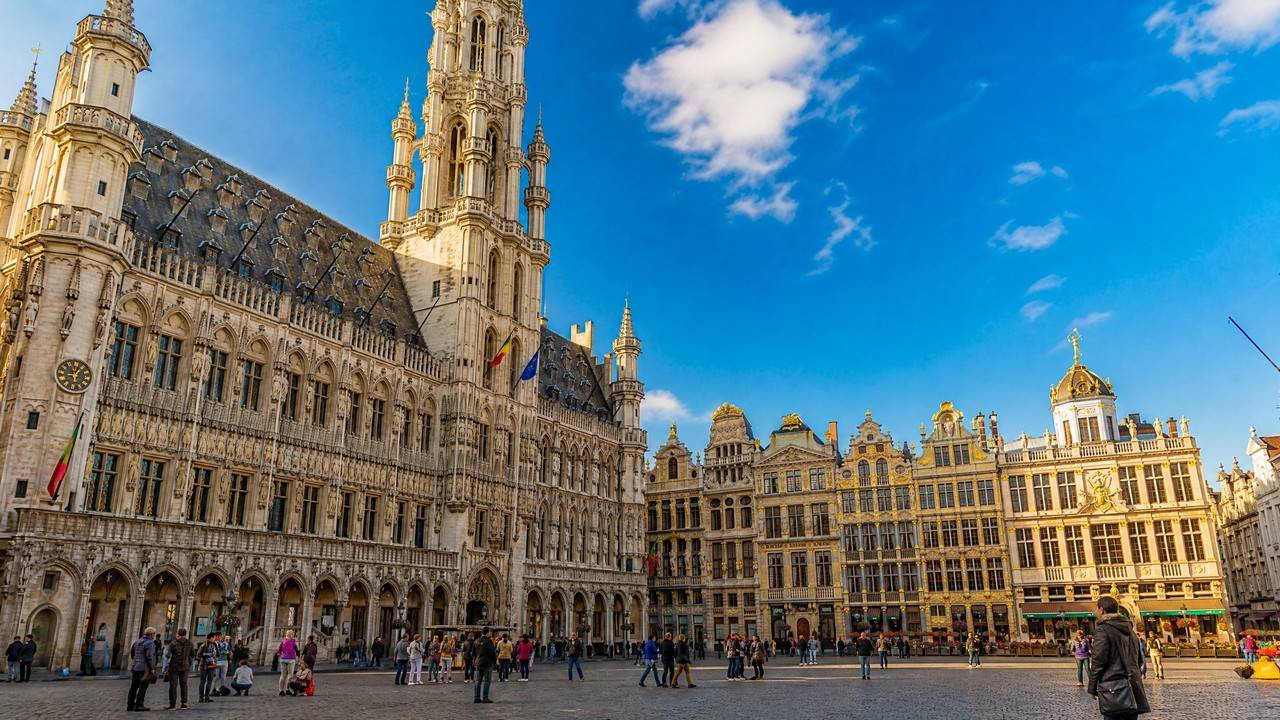
Grand-Place
The Grand Place is the heart of Brussels, the Belgian capital, hailed as one of the most beautiful squares in the world. Ringed by magnificent, richly carved Gothic town hall, the King's House and ornate guild houses, it is grand and exquisite, the pride of Brussels, and is listed as a UNESCO World Heritage Site. The square's history goes back to the Middle Ages, when it was the commercial and civic center of Brussels. Around it stand a series of architectural masterpieces: the towering Gothic town hall with its fine spire, opposite the neo-Gothic King's House (Bread House), and dozens of gilded, richly sculpted Baroque and Gothic mixed-style guild houses—once the seats of the trade guilds, their gables decorated with fine sculptures, gilding and emblems, row upon row, spectacular. Every two years, the square is covered with a spectacular flower carpet made of hundreds of thousands of flowers. Whether by day or under the evening lights, the Grand Place radiates an astonishing splendor and elegance. Strolling the Grand Place with admiration, you truly feel Brussels' deep history and extraordinary architectural art. Respect the world-heritage buildings, do not carve or climb; mind the crowds, watch your belongings, beware of pickpockets; visit civilly.
Square & Landmark

Atomium
The Atomium is a unique, futuristic landmark in Brussels, built for the 1958 Brussels World Expo. Modeled on an iron crystal structure enlarged about 165 billion times, it is made of nine giant metal spheres connected by tubes, shining silver and imposing—a modern symbol of Brussels. About 102 meters tall, its nine stainless-steel spheres, each over ten meters in diameter, represent the nine atoms of an iron crystal, connected by thick tubes with escalators and elevators inside, forming a three-dimensional space open to visitors. The Atomium is both an outstanding example of 1950s scientific optimism and modernist architecture and one of Brussels' iconic buildings. Visitors can enter the spheres and take an elevator to the top sphere, where a panoramic viewing platform overlooks Brussels' cityscape; other spheres house exhibitions and restaurants. Visiting the Atomium, you can admire this unique, imaginative architectural wonder, learn its scientific meaning and history, and look out over the city from above—a distinctive way to experience modern Brussels. Approach the Atomium with curiosity and enjoy the futuristic landmark. Follow the museum rules; be careful on the high lookout, watch children; respect the facilities; visit civilly.
Square & Landmark

Beguinage
The Groot Begijnhof in Leuven is one of the best-preserved beguinages in Flanders and forms part of a UNESCO World Heritage site. Founded around the thirteenth century as a community for beguines, it comprises dozens of houses, a Gothic church and green courtyards, with an arm of the River Dijle running through it. Its layout has survived largely intact since the Middle Ages, giving it quiet lanes and an intimate scale. Since the late twentieth century the buildings have been used by KU Leuven, mainly as student and staff housing, so visitors are asked to keep quiet and respect the residents.
Historic Ruins & Heritage
No.4 Brussels
Museé Garde-Robe de Manneken-Pis
GardeRobe MannekenPis is a small museum in central Brussels, a few steps from the famous Manneken Pis statue, dedicated to the figure's wardrobe. The statue has stood on its corner since the seventeenth century, and the tradition of dressing it has produced a collection of hundreds of costumes. The museum displays a rotating selection of these outfits by theme and explains the history of the statue and the custom of donating clothes. The space is modest and visits are short, so it is usually combined with seeing the statue itself and the Grand-Place. The costumes on show change over time, so the display depends on the current rotation.
Castle & Fortress
No.5 Brussels
Manneken Pis
Manneken Pis is one of Brussels' most famous and amusing city symbols—a tiny bronze boy urinating, just about half a meter tall, standing on a street corner near the Grand Place. Though small, with its long history, many legends and mischievous image, it has become the beloved first citizen of Brussels. This little bronze statue was created in the 17th century, and many interesting legends surround its origin, such as the boy putting out the fuse that set the city alight with his urine, saving Brussels. Over the centuries, the mischievous little figure has won the affection of Belgians and travelers worldwide. A fun tradition is that people often dress it in all kinds of costumes—from national dress of various countries to professional uniforms—and it has a surprisingly large wardrobe, much of it kept in a nearby museum. Though the statue itself is tiny and must be sought out carefully in the corner, the urban humor and cultural charm it carries make it an unmissable symbol of Brussels. Coming to see this playful little hero and feel Brussels' relaxed, witty character is a joy for many visitors. Approach Manneken Pis with a light heart and feel the city's humor. The statue is small and must be sought out; mind the crowds and traffic, watch your belongings, beware of pickpockets; visit civilly, yield when taking photos.
Square & Landmark
No.6 Brussels
Royal Museums of Fine Arts of Belgium (Musees Royaux des Beaux Arts)
The Royal Museums of Fine Arts of Belgium stand near the Place Royale in Brussels and form the country's largest grouping of art museums. The complex comprises several sections, among them the Old Masters Museum, the Magritte Museum and the Fin-de-Siècle Museum, with the Wiertz and Meunier museums located elsewhere. The collections span painting and sculpture from the fifteenth century to the present, with particular strength in Flemish and Belgian artists such as Pieter Bruegel the Elder, Rubens and Van Dyck, alongside an extensive holding of Magritte and surrealist works. The sections share an entrance area, but tickets and timings are usually arranged separately.
Museum
🎯 Brussels Experiences
Grand Place by night
See the square aglow.
Chocolate trail
Sample the famous pralines.
Beer tasting
Browse the brews in a tavern.
EU quarter
Parliament & modern icons.
Brussels is best from May to September, when the weather suits the square, open-air markets and street life; July brings the sunniest days. In December the Christmas markets and lights fill the old town with festive spirit. A classic plan explores the Grand Place and comic-strip murals by day, then returns at night to watch the town hall and guild houses light up; spare an afternoon for the metro ride to the Atomium and the European Parliament to see the 'capital of Europe' face. Don't skip a box of Belgian chocolates, a few trappist and lambic brews, and a roadside plate of moules-frites. The compact old town is walkable; trams and metro are handy. Prices sit at a typical European capital level. Rich architecture, great food and an unbothered pace let Brussels satisfy both sightseers and slow travellers.
🚌 Transport & Stays
City Transport
🛫varies
Flight
Brussels & Charleroi airports
varies
🚄varies
Rail / Eurostar
Paris, London, Amsterdam links
varies
🚗~€40–90
Car hire
Compact for touring the country
~€40–90
Recommended Stay Areas
🏨 Grand Place / old town
Sights on foot
🏢 EU quarter / Luxembourg
Quiet, business-friendly
Free Consultation
Planning a trip to Brussels?
Tell us your departure city and dates — USITrip will craft your journey.