📍 Destination Overview
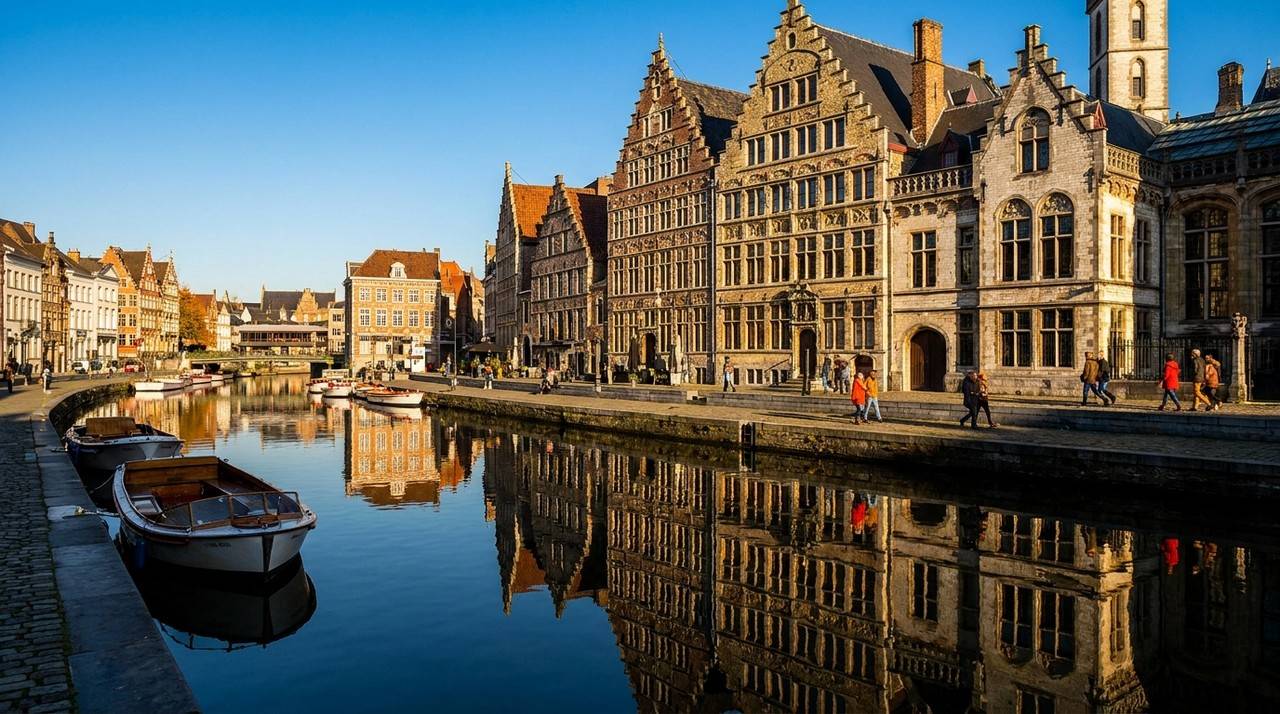
Ghent is Flanders' second city, a medieval wool-trade power second only to Paris. Gravensteen Castle, ringed by a moat, overlooks terracotta rooflines, while St Bavo's Cathedral holds the Van Eyck brothers' Ghent Altarpiece, a milestone of Western art. Along the canals medieval guild houses now shelter creative shops, and its lively university spirit keeps the old quarters young.
🏙️ Location
Belgium · Gent
🗓️ Best Season
Apr-Jun / Sep-Oct
💰 Currency / Language
Euro (EUR) / Dutch / French / German
🕐 Suggested Duration
2-3 days
🔌 Outlet / Voltage
Type C/E outlets · 230V · adapter needed
📶 Communication Note
Buy data SIM / eSIM on arrival (reference)
☀️ Best Time to Visit & Climate
🌸 Best Season: Apr–Jun
Fine late-spring weather suits the Ghent Altarpiece and the canal old town.
🍂 Best Season: Sep–Oct
Autumn thins the crowds — galleries and riverside streets feel more relaxed.
Jan
❄️
6°/1°
Feb
🌥️
7°/1°
Mar
🌤️
10°/3°
Apr
🌸
13°/5°
Best
May
🌷
17°/9°
Best
Jun
☀️
20°/11°
Best
Jul
🌡️
22°/13°
Aug
☀️
22°/13°
Sep
🍂
19°/11°
Best
Oct
🍁
15°/8°
Best
Nov
🌥️
10°/4°
Dec
🎄
7°/2°
📷 Top Attractions

St. Bavo's Cathedral
St. Bavo's Cathedral stands at the heart of Ghent's old town, a majestic church transitioning from Romanesque to Gothic, world-famous for housing 'The Adoration of the Mystic Lamb' (the Ghent Altarpiece) by the Van Eyck brothers—a summit of Netherlandish Renaissance art. Founded in the 12th century and enlarged over centuries, its soaring columns, stained glass and Baroque pulpit intertwine. Beyond the national-treasure altarpiece, the cathedral marks the baptism site of Emperor Charles V. Within the hushed nave, light moves across stone—solemn and sacred—making it a pilgrimage site for art lovers and one of Ghent's unmissable cultural landmarks.
Church & Religious Site

Gravensteen
The Castle of the Counts of Flanders, known as the Gravensteen ('Castle of Stone'), rises in central Ghent as one of the best-preserved medieval stone castles in Northern Europe. Built around 1180 by Count Philip of Alsace on the model of Crusader fortresses, its massive walls, moat and corner towers speak of feudal power and defense. Inside, exhibitions of torture devices and arms illustrate a darker past; from the ramparts you overlook Ghent's red-tiled roofs and canals. Walking the stern ramparts feels like stepping into the age of knights and lords—Ghent's most recognizable landmark and a vivid lesson in medieval military architecture.
Castle & Fortress

Belfry of Ghent
The Belfry of Ghent is a medieval tower about 91 meters high in the heart of the old town, a pride and symbol of freedom for Ghent. Climbing it offers a magnificent panorama of the old town, and together with Bruges' Belfry it is listed in the UNESCO World Heritage Belfries of Belgium and France. This majestic belfry was begun in the 14th century, a symbol of Ghent as a prosperous self-governing city; once used for watch and timekeeping, tolling alarms, and storing the city's privilege documents, guarding citizens' freedom and rights, with a gilded dragon weathervane atop the tower. Inside are historic carillon and great bells whose melodious chimes echo over the old town. Visitors take an elevator or stairs to the high viewing platform; from there the old town's endless red roofs, the spires of St. Bavo's and St. Nicholas' cathedrals, the winding Leie River and distant cityscape unfold—grand and charming. As part of the world-heritage belfries, Ghent's Belfry, together with the cathedral spires on either side, forms the famous Three Towers skyline of Ghent. Climb the belfry with a sense of history and overlook all of Ghent. Mind safety when climbing, watch children; respect the world-heritage monument; visit civilly.
Square & Landmark

Stadhuis van Gent
Ghent's Town Hall is a building of two eras in one: the High Gothic facade facing Hoogpoort was begun in 1519, but before its flame tracery and statued niches were finished, Renaissance taste arrived — and the rest of the complex continued in a completely different style, wrapping up in the 17th century. In 1576 the Pacification of Ghent, uniting the northern and southern Low Countries against Spain, was signed here. Guided tours open the historic halls and wedding chambers to the public, where Gothic and Renaissance rooms sit side by side — a living specimen of civic architecture in the Low Countries.
Square & Landmark

Saint Michael's Church
Saint Michael's Church is a landmark parish church in Ghent's old town, begun in the 13th century and built largely in Brabantine Gothic over centuries of on-and-off work, reaching completion only in the 16th. Its most famous quirk is the missing tower: the planned central spire was never built, a saga of money and structural disputes that locals affectionately call their 'unfinished beauty'. Inside are important altarpieces from the circle of Van Eyck and an exuberant Baroque pulpit, with stained glass pouring light across the nave in late afternoon. Beside the old grain market, it completes Ghent's riverside skyline.
Church & Religious Site
🎯 Gent Experiences
Gentse Feesten
July citywide carnival festival.
Flemish Stew
Local beef braised in beer specialty.
Canal Night Cruise
Illuminated medieval waterways.
Design Shop Hunting
Flemish creativity and vintage markets.
Gent has mild winters and pleasant weather; the best time to visit is Apr–Jun and Sep–Oct, with temperatures around 5–20°C. Other months range 1–22°C, with fewer crowds and better value.
🚌 Transport & Stays
City Transport
✈️Varies by route
Flights
Fly into nearest airport
Varies by route
🚗Rental varies
Self-Drive
Best flexibility for exploring
Rental varies
🚕Local rates
Local Transport
Taxi or shared rides
Local rates
Recommended Stay Areas
🏰 Near Gravensteen Castle
Castle-view boutique hotels
🌊 Old Port Werf
Design hotels and Airbnbs in creative quarter
⛪ St Bavo's Cathedral Area
Historic district inns
💰 Ghent St Pieters Station
Budget options, tram to center
Free Consultation
Free Consultation
1-on-1 travel consultant customizes your Gent trip for free based on your schedule and preferences.