📍 Destination Overview
Bruges, capital of Belgium's West Flanders, is the 'Venice of the North'—Europe's best-preserved medieval city and a UNESCO World Heritage Site. Canals ring cobblestone streets and Gothic brick houses; the Market Square belfry offers rooftop views, and the Church of Our Lady houses Michelangelo's Madonna and Child. Chocolate shops and canal rides complete the charm.
🏙️ Location
Belgium · Brugge
🗓️ Best Season
Apr-Jun / Sep-Oct
💰 Currency / Language
Euro (EUR) / Dutch / French / German
🕐 Suggested Duration
2-3 days
🔌 Outlet / Voltage
Type C/E outlets · 230V · adapter needed
📶 Communication Note
Buy data SIM / eSIM on arrival (reference)
☀️ Best Time to Visit & Climate
🌸 Best Season: Apr–Jun
Late spring greens the canals — perfect for boat rides and old-town strolls.
🍂 Best Season: Sep–Oct
Crisp autumn days are ideal for chocolate shops, beer halls and canal views.
Jan
❄️
6°/1°
Feb
🌥️
7°/1°
Mar
🌤️
10°/3°
Apr
🌸
13°/5°
Best
May
🌷
17°/8°
Best
Jun
☀️
20°/11°
Best
Jul
🌡️
22°/13°
Aug
☀️
22°/13°
Sep
🍂
19°/10°
Best
Oct
🍁
15°/7°
Best
Nov
🌥️
10°/4°
Dec
🎄
7°/2°
📷 Top Attractions
More Attractions →
Minnewater Park
Minnewater Park is a romantic park south of central Bruges, Belgium. Centered on the Lake of Love (Minnewater, aka Swan Lake), with swans gliding, weeping willows and the white Begijnhof, and named for the tale of the lovelorn knight Minne, it is Bruges' most romantic stroll and a poetic corner of the medieval city. The Lake of Love (Minnewater, West Flemish for "lake of love") is south of Bruges center — historically a regulating reservoir for the city canals. Swans glide year-round — hence "Swan Lake." Willows and a promenade line the shore — Bruges' most romantic walk. The adjacent Begijnhof (UNESCO World Heritage, founded 1245) has white houses and green courtyards — once an independent community of lay religious women. "Minnewater" derives from West Flemish "Minne" (love) — a knight named Minne is said to have died here of a broken heart. Visiting to feel medieval romance and tranquility among swans and the Begijnhof's white courtyards is a poetic, gentle urban corner experience.
Theme Park
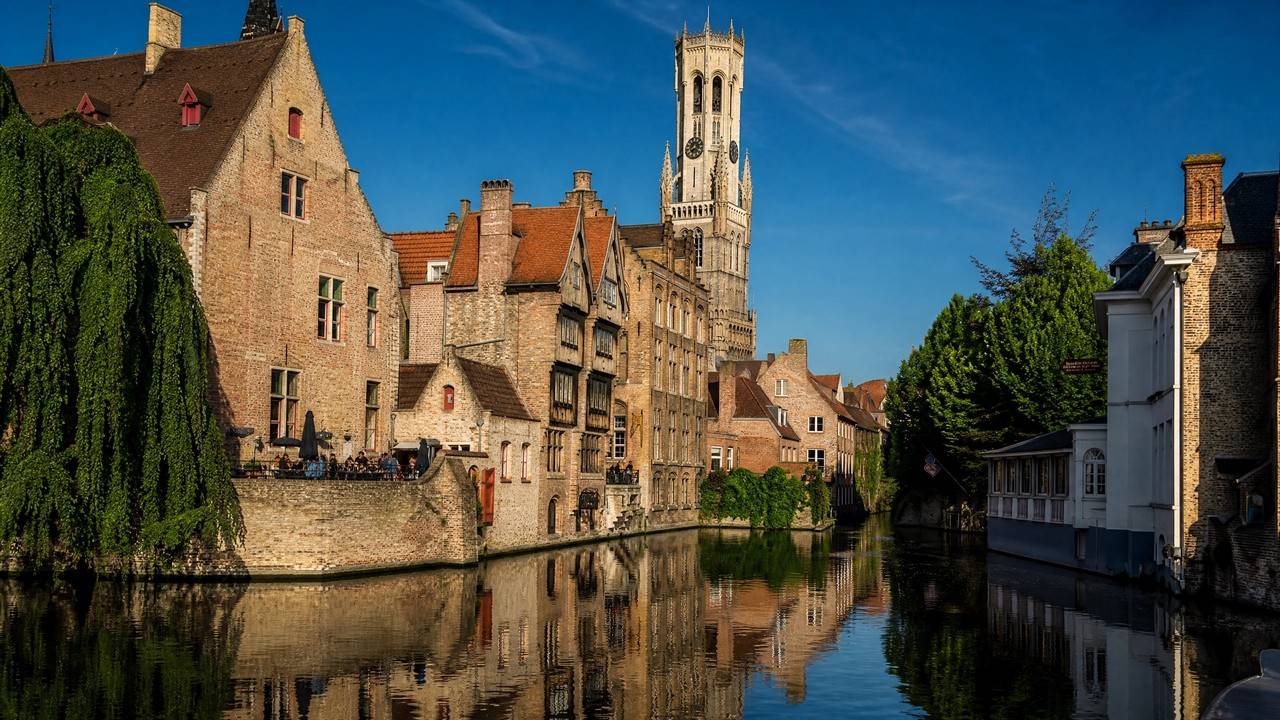
Belfry of Bruges
The Belfry of Bruges is a towering medieval bell tower on the Market Square, about 83 meters high, the city's most famous landmark and pride. Climbing to its top offers a view over the red-tiled roofs and charming scenery of the old town, and it is listed in the UNESCO World Heritage Belfries of Belgium and France. This towering stone-and-brick belfry was begun in the Middle Ages and built over centuries; a symbol of Bruges' past as a prosperous trading city, it was used for watch, timekeeping, and storing the city's treasures and documents. Majestic and grand, inside it holds a carillon of dozens of bronze bells whose melodious chimes still echo over the old town. Visitors climb the narrow, steep spiral staircase (hundreds of steps) to the top. From there, the old town's endless red roofs, ancient church spires, crisscrossing canals and distant fields unfold—a beautiful, intoxicating view. As part of the world-heritage belfries, Bruges' Belfry, with its majestic form, melodious bells and superb summit view, is an unmissable symbol of Bruges. Climb the belfry with a sense of history and overlook the watery city. The climb stairs are narrow and steep; pace yourself, mind your footing and watch children; respect the world-heritage monument; visit civilly.
Old Town & Historic District

Basilica of the Holy Blood
The Basilica of the Holy Blood stands on Burg Square in the heart of Bruges' old town, a two-level church combining Romanesque and Gothic architecture, famed for housing a relic believed to contain the blood of Jesus Christ. The lower chapel, built in the 12th century, is the best-preserved Romanesque building in Bruges; the upper chapel, rebuilt in the 15th century, is a Gothic space with stained glass and murals. After the Second Crusade in 1135, Thierry of Alsace, Count of Flanders, brought the relic from Jerusalem, turning the church into a major pilgrimage site. The annual Procession of the Holy Blood on Ascension Day is listed as UNESCO intangible heritage, making this one of Bruges' most spiritually and culturally significant sites.
Church & Religious Site

Béguinage
The Flemish Béguinages are a group of exceptionally well-preserved medieval courtyard complexes for lay religious women (beguines) in Belgium, inscribed as a UNESCO World Heritage Site in 1998. The most celebrated is the Princely Beguinage Ten Wijngaerde in Bruges, founded in 1245, composed of whitewashed, red-roofed houses around a tranquil green and a Gothic chapel, once home to beguines who sought an independent spiritual life. Today the grounds are still kept by Benedictine nuns, retaining a hushed, otherworldly calm. Wandering the lanes, visitors find clipped hedges, ancient brickwork and canal reflections—among the most poetic and soulful corners of Bruges, and a living witness to medieval civic piety and female self-organization in the Low Countries.
Historic Ruins & Heritage

Groeningemuseum
The Groeningemuseum is a temple of Flemish Primitives: panel paintings by Van Eyck, Hans Memling and Hugo van der Goes form a complete history of early Netherlandish art, anchored by Van Eyck's luminous 'Madonna with Canon van der Paele'. The narrative runs from 15th-century religious panels through 19th- and 20th-century Belgian Expressionism and Surrealism, with Magritte and Ensor anchoring the modern rooms. Compact and elegantly hung, the museum can be absorbed in a couple of hours — yet it condenses all of Bruges' medieval artistic authority into a single visit.
Museum

Gruuthuse Museum
The Gruuthuse Museum inhabits the 15th-century palace of Bruges' wealthiest family — and the building itself is half the visit: a spiral stone stair, a chapel gallery and a canal-facing tower preserve the spatial world of a medieval merchant dynasty. The collection zeroes in on secular life during Bruges' golden age — tapestries, silverwork, a famous music gallery with organs, lace and furniture — making the question of 'how the rich actually lived here' wonderfully concrete. A remarkable suspended passage once let the family walk straight into their private pew in the Church of Our Lady. After a 2018 renovation, the displays speak a fully modern language.
Museum
🎯 Brugge Experiences
Canal Cruise
Romantic ride through medieval waterways.
Chocolate Workshop
Handmake Belgian pralines.
Belgian Beer Tasting
Trappist and specialty brews.
Lace Workshop Visit
Traditional Bruges lace craft.
Brugge has mild winters and pleasant weather; the best time to visit is Apr–Jun and Sep–Oct, with temperatures around 5–20°C. Other months range 1–22°C, with fewer crowds and better value.
🚌 Transport & Stays
City Transport
✈️Varies by route
Flights
Fly into nearest airport
Varies by route
🚗Rental varies
Self-Drive
Best flexibility for exploring
Rental varies
🚕Local rates
Local Transport
Taxi or shared rides
Local rates
Recommended Stay Areas
🏘️ Market Square Area (Top Pick)
Belfry-view boutique hotels
🌊 Canal District / Rozenhoedkaai
Waterside hotels and canal inns
⛪ Church of Our Lady Area
Quiet lane B&Bs
💰 Near Train Station
Budget hotels, 10-min walk to center
Free Consultation
Free Consultation
1-on-1 travel consultant customizes your Brugge trip for free based on your schedule and preferences.