📍 Destination Overview
Copenhagen, Denmark's capital on the Øresund Strait, blends fairy-tale charm, Nordic design and hygge. The classic scene is Nyhavn, a 17th-century canal of colourful old houses where Andersen lived; the Little Mermaid bronze rests by the sea, and Tivoli Gardens is among the world's oldest amusement parks. Romantic and cosy.
🏙️ Location
Denmark · Zealand · Capital by the Øresund Strait
🗓️ Best Season
May-Aug
🕐 Time Difference
-6~-7 vs Beijing
💰 Currency / Language
Danish Krone DKK / Danish, English
🕐 Suggested Duration
2-3 days · Nyhavn + Little Mermaid + Tivoli
🔌 Outlet / Voltage
Type C / F / K outlets · 230V · adapter needed
☀️ Best Time to Visit & Climate
🌞 Spring: May
May blooms the Nyhavn and opens the cycling season.
🌞 Summer: Jun–Aug
Summer's long days suit Nyhavn, the Little Mermaid and bike rides.
Jan
❄️
3°/-1°
Feb
🌥️
3°/-1°
Mar
🌤️
6°/1°
Apr
🌷
11°/4°
May
🌞
16°/9°
Best
Jun
☀️
19°/12°
Best
Jul
☀️
22°/14°
Best
Aug
🌤️
21°/14°
Best
Sep
🍂
17°/11°
Oct
🍁
12°/8°
Nov
🌥️
7°/4°
Dec
🎄
4°/1°
📷 Top Attractions
More Attractions →
The Little Mermaid
The Little Mermaid sits quietly on a rock at Copenhagen's Langelinie promenade - Denmark's most famous city symbol. Cast by sculptor Edvard Eriksen and unveiled on 23 August 1913, she came from a commission by Carlsberg heir Carl Jacobsen after he saw the Royal Theatre's ballet of Andersen's tale. Ballerina Ellen Price was invited to model but declined to pose nude, so the body was modelled on Eriksen's wife Eline. The bronze stands just 1.25 m tall and weighs 175 kg, small and still, keeping company with gulls and tour boats. A century of mishaps has left its mark: beheaded in 1964 and 1998, an arm sawn off in 1984, blasted into the harbour by explosives in 2003 - restored each time, though the original head was never recovered. In 2010 she travelled to the Danish pavilion at Expo 2010 in Shanghai, her only official move from Copenhagen since 1913. At dawn or on quiet weekdays the rock is most peaceful - a good moment to be alone with her.
Square & Landmark
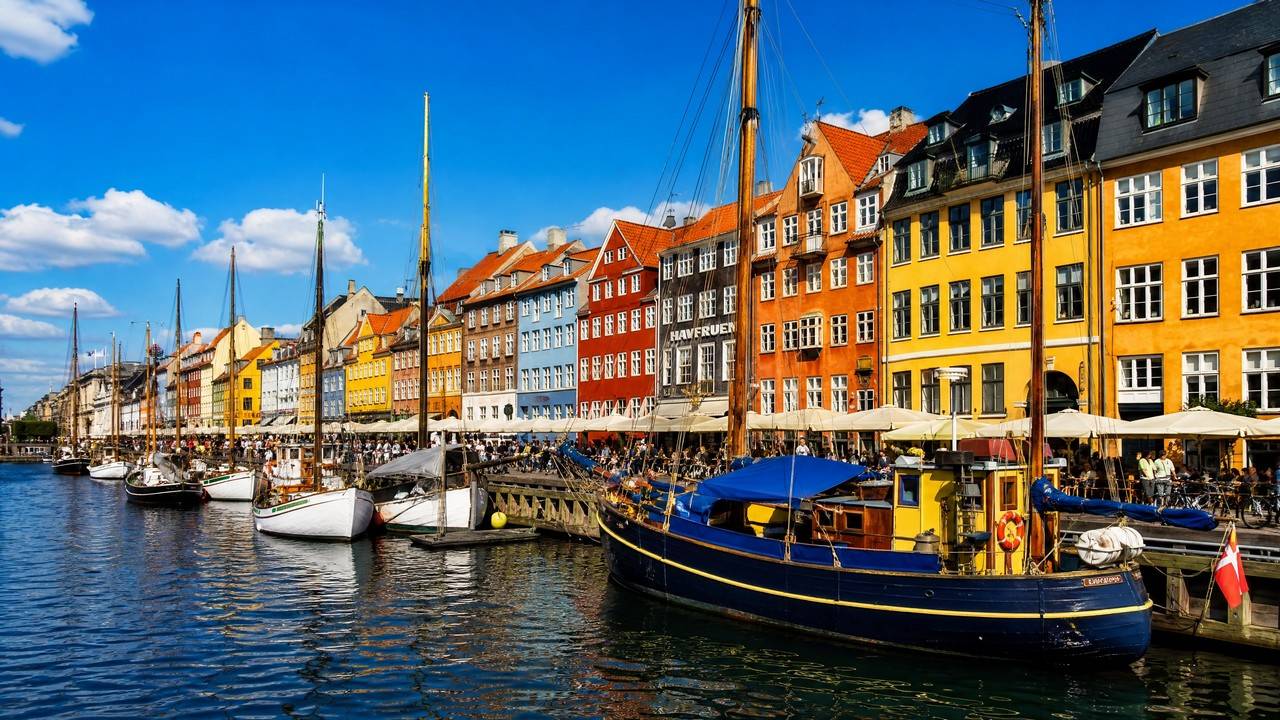
Nyhavn
Nyhavn (Danish for "new harbour") is a 17th-century canal in central Copenhagen, running about 500 m from Kongens Nytorv square to the inner harbour. Cut between 1670 and 1673 on King Christian V's orders by Swedish prisoners of the Dano-Swedish War, it was meant to bring sea trade directly into the city centre. The north side is lined with gabled townhouses in red, yellow, blue and green, mostly built between the 17th and early 18th centuries, mirrored in the water beside old wooden sailing ships - Copenhagen's most classic view. The south side historically held more substantial mansions, so the old social divide still reads across the canal. Once a quarter of sailors, taverns and brothels, it was revived by the Nyhavnsforeningen society in the 1960s and designated a museum harbour in 1977. Fairy-tale writer Hans Christian Andersen lived at Nyhavn 18, 20 and 67, and plaques on the facades still mark his years here. The Memorial Anchor at the canal mouth, from the 1872 frigate Fyn, honours more than 1,700 Danish seafarers lost in World War II. Today the quays are lined with open-air restaurants and cafés, and this is the main departure point for canal tours.
Old Town & Historic District

Rosenborg Castle
Rosenborg Castle is a red-brick Renaissance palace in central Copenhagen, begun by Christian IV in 1606 as a summer house and expanded into its present form by the 1630s; the king died here in 1648. It served as a royal residence until about 1710 and opened as a museum in 1838. Upstairs, twenty-four rooms are arranged chronologically from the early 1600s to the early 1900s, with furniture, tapestries and portraits largely left in place; Christian IV's Winter Room keeps its original 1620 oak panelling and painted ceiling, while the Long Hall holds the coronation throne of narwhal tusk - once believed to be unicorn horn - guarded by three life-size silver lions. In the basement treasury lie the Danish Crown Jewels and regalia, including Christian IV's crown of 1596 and the 15th-century Oldenburg Horn - the only crown jewels in the world both on public display and still used in royal ceremony. The castle is ringed by the King's Garden, laid out in 1606 as Denmark's oldest royal garden, with rose beds and avenues free to enter.
Castle & Fortress

Tivoli Gardens
Tivoli Gardens sits by Copenhagen Central Station, opened in 1843 as one of the world's oldest amusement parks and an inspiration for Disney's castle. A Chinese pagoda, lake-stage and dazzling night lights create romantic exoticism; roller coasters, carousels and gardens coexist, with concerts and Chinese-theatre shows through the seasons. At lamp-lighting the whole garden turns dreamlike — Copenhagen's all-ages happy heart and an unmissable stop.
Theme Park

Amalienborg Palace
Amalienborg is the Danish Queen's main residence, four Rococo palaces around an octagonal square crowned by the equestrian statue of founder Frederick V. The daily noon guard-changing is Copenhagen's favourite royal spectacle, bearskin-hatted guards marching in formation. From one side you see the Marble Church and the harbour — the concentrated expression of Denmark's 'approachable' monarchy, and the heart of a Frederiksstaden visit.
Castle & Fortress

Christiansborg Slot
Christiansborg Palace is the nerve centre of Copenhagen: the Danish Parliament, the Prime Minister's Office and the Supreme Court all share this small island, and the present building — the third palace on the site — was completed in 1928. Beneath your feet lie the ruins of the 12th-century bishop's castle; upstairs are the Royal Reception Rooms where state banquets are held; the courtyard stables house royal horses. The tower is free to climb and gives one of the finest views over the old town's rooftops and canals.
Castle & Fortress
🎯 Copenhagen Experiences
Nyhavn Colored Houses
Colorful houses by the canal.
Find the Little Mermaid
Seaside fairy-tale statue.
Tivoli Gardens
Lights dreamlike at night.
Palace Guard Change
The guard ceremony.
City Cycling
Be a Copenhagen local for a day.
Copenhagen has four distinct seasons with cold winters; the best time to visit is May–Aug, with temperatures around 9–22°C. January is coldest (down to -1°C), so bring warm layers.
📰 Travel Guides
More Guides →🚌 Transport & Stays
City Transport
✈️About 15 min (reference)
Airport Metro
Airport to city
About 15 min (reference)
🚲Rental (reference)
Bicycle
Daily life of the cycling capital
Rental (reference)
🚇One-way (reference)
Metro / Canal Boat
Covers city center
One-way (reference)
🚆About 40 min (reference)
Cross-sea Train
Towards Malmö
About 40 min (reference)
Recommended Stay Areas
🏘️ Nyhavn / City Center (recommended)
Near colored houses & Tivoli
🎡 Tivoli area
Near park & station
👑 Around the Palace
Near seaside & Mermaid
🚉 Around Central Station
Easy transit
Free Consultation
Want to plan your Copenhagen trip in more depth?
Tell us your departure city, travel dates and interests, and Usitour will tailor a trip just for you.