📍 Destination Overview
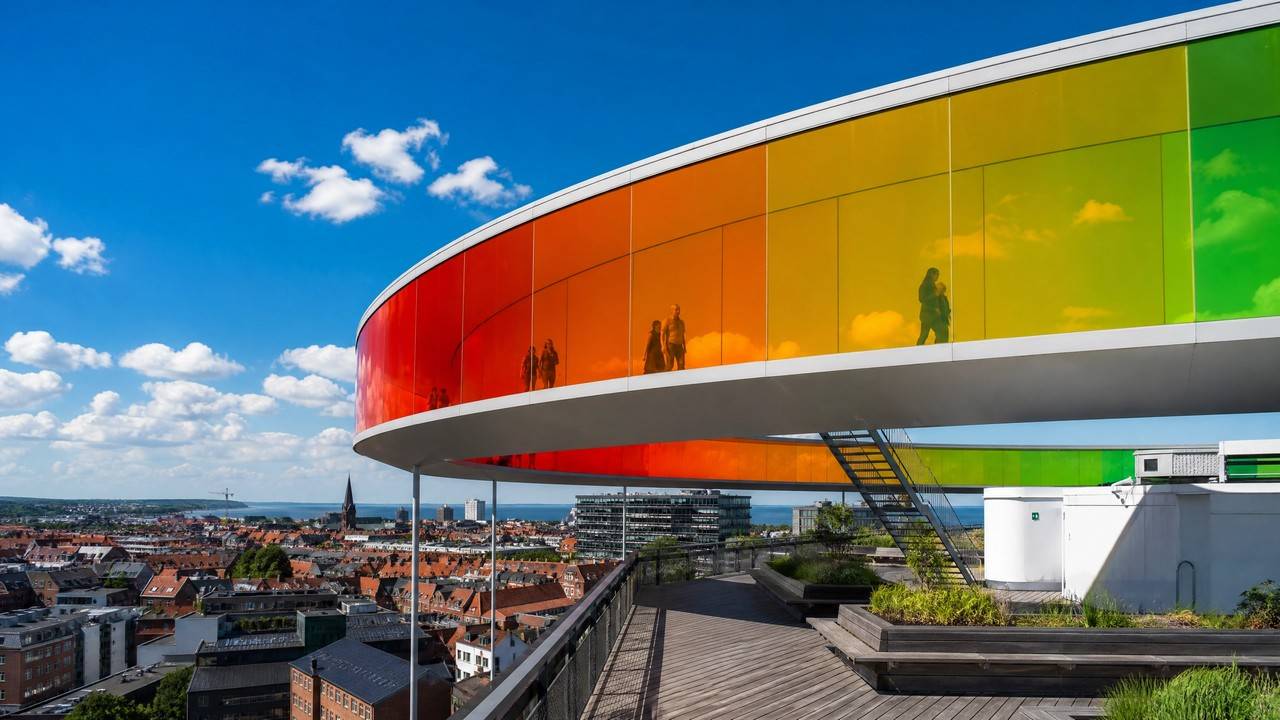
Aarhus, Denmark's second city on Jutland's east coast, is youthful and cultural, a former European Capital of Culture. Its landmark ARoS museum crowns the roof with the rainbow panorama, a circular glass walkway viewing the city in shifting tints. The open-air Old Town relocates historic Danish houses and streets into a living time-journey with costumed staff.
🎨 Location
Denmark · Jutland Peninsula · Second-largest city on the east coast
🗓️ Best Season
May-Sep (Summer)
🕐 Time Difference
-6~-7 vs Beijing
💰 Currency / Language
Danish Krone DKK / Danish, English
🕐 Suggested Duration
1-2 days · Rainbow museum + open-air Old Town
🔌 Outlet / Voltage
Type C / F / K outlets · 230V · adapter needed
☀️ Best Time to Visit & Climate
☀️ Summer: May–Sep
Long days and the best weather.
Jan
❄️
3°/-1°
Feb
🌥️
3°/-1°
Mar
🌤️
6°/0°
Apr
🌷
11°/3°
May
🌞
16°/8°
Best
Jun
☀️
19°/11°
Best
Jul
☀️
21°/13°
Best
Aug
🌤️
21°/13°
Best
Sep
🍂
17°/10°
Best
Oct
🍁
12°/7°
Nov
🌥️
7°/4°
Dec
🎄
4°/0°
📷 Top Attractions
More Attractions →
Aarhus Cathedral
Aarhus Cathedral (St Clement's) stands beside Store Torv at the centre of the old town, both the geographic and historical origin point of the city. Founded around 1190-1200 by Bishop Peter Vognsen as a Romanesque basilica - among Denmark's earliest large uses of red brick - it was extensively rebuilt in Late Gothic style between 1449 and 1500. At 93 m long with a 96 m tower it holds both Danish records, and the brick spire caps the old-town skyline. Inside, about 220 sq m of medieval frescoes (1470-1520), the largest group in Denmark, survived because reformers whitewashed them over during the Reformation; they were revealed again from the late 19th century. Treasures include the movable-winged altarpiece by Lübeck master Bernt Notke (1479), a 1481 bronze font, an 89-stop organ, and a 14 m stained-glass window by Emanuel Vigeland (1926). The most curious object is the votive ship Enhjørningen hanging in the nave: a 2.65 m Dutch model built in 1720 for Tsar Peter the Great, whose carrier wrecked off Skagen while the model drifted ashore intact and was bought at auction and donated by local fishermen. 2026 marks the cathedral's 825th anniversary with special forums and events, and the tower can be climbed for views over the old town when weather allows.
Church & Religious Site

The Old Town (Den Gamle By)
Den Gamle By, The Old Town, lies just north of central Aarhus beside the free Botanical Garden and opened in 1909 as the world's first open-air museum. Seventy-five historic half-timbered houses from across Denmark were moved here to recreate town lanes from the 1700s to the 1900s: the bakery exhales warm pastry, the smithy rings, the apothecary shelves century-old jars, and staff in period dress bring it all to life - and are happy to stop and tell you the stories. Try forging, baking, churning butter and old-style printing, and step into a 1974-style working-class flat for another slice of the past. In December the whole town becomes a fairy-tale market of candlelight and mulled wine, a Danish family tradition. Allow 3-4 hours; the 48-hour Aarhus Card covers this museum, ARoS and city transport, which makes a cultural day easy value.
Museum
ARoS Aarhus Art Museum
ARoS is among Northern Europe's largest art museums, in central Aarhus, designed by Schmidt Hammer Lassen; its icon is the rainbow panorama — a 150 m circular glass walkway where you stroll through the spectrum of the sky, overlooking the city. From Danish Golden Age painting to contemporary installations, with a Yayoi Kusama-like mirror room on permanent show, it is Aarhus's brightest contemporary-art calling card as a European Capital of Culture.
Museum

The Women's Museum
The Womens Museum is located in the center of Aalborg, Denmark, one of the few professional museums worldwide dedicated to womens history and culture. Operated by a dedicated volunteer team, the museum is committed to recording and showcasing the contributions and struggles of Danish and global women throughout history. The permanent exhibition uses rich artifacts, photographs, and documentary materials to present the evolving roles of women in family, workplace, politics, and social movements, covering the transformation from traditional homemakers to modern professional women. Rotating special exhibitions focus on contemporary womens issues such as gender equality, workplace breakthroughs, and artistic creation, offering inspiring and timely perspectives. The museum also houses a library and event space, regularly hosting lectures, workshops, and community activities. It serves as an important window into Nordic gender equality culture and an open platform for inspiring thought and dialogue about womens past, present, and future.
Museum

Den Gamle By
Den Gamle By ('The Old Town') is the world's first open-air town museum, in Aarhus, gathering 75 authentic historic buildings relocated from across Denmark to recreate town streets, workshops and homes from the 18th to 20th centuries. Visitors step into old grocers, post offices and flats; on festival days costumed guides revive daily life. Next to ARoS and the Viking museum, it is Aarhus's best stop for families and nostalgia, transplanting Danish urban life history into a city park.
Museum

Moesgaard Museum
Moesgaard Museum is famous for its sloping, grass-grown building whose roof doubles as a public viewing platform over woods and sea. Inside, theatrical scenography tells Denmark's prehistory: Iron Age sacrificial weapons, Viking warrior gear, and the star exhibit, the Grauballe Man — a bog body over 2,000 years old, preserved down to his fingerprints. Forest trails and the beach begin just behind the museum, so exhibition and hike connect seamlessly.
Museum
🎯 Aarhus Experiences
Rainbow Panorama Walk
See the city through color filters.
Open-Air Old Town
Costumed old-town life.
Latin Quarter Coffee
Cobblestone lanes.
Infinity Bridge
Circular pier by the sea.
Cathedral
Denmark's longest church.
Aarhus is four distinct seasons with cold winters; the best time to visit is May–Sep, with temperatures around 8–21°C. January is coldest (down to -1°C), so bring warm layers.
🚌 Transport & Stays
City Transport
✈️Varies (reference)
Airport Bus / Train
Aarhus Airport or direct train
Varies (reference)
🚆About 3 hrs (reference)
Intercity Train
Towards Copenhagen
About 3 hrs (reference)
🚲Rental (reference)
Bicycle / Walking
Compact city
Rental (reference)
🚋One-way (reference)
Light Rail
Covers city center
One-way (reference)
Recommended Stay Areas
🎨 City Center (recommended)
Near museum & old town
☕ Latin Quarter area
Artsy café district
🌊 Seaside & Harbor
Near sea views
🚉 Around Station
Easy transit
Free Consultation
Want to plan your Aarhus trip in more depth?
Tell us your departure city, travel dates and interests, and Usitour will tailor a trip just for you.