📍 Destination Overview
Toronto, Canada's largest city on Lake Ontario's northern shore, is known for diversity and inclusiveness. The 553-metre CN Tower, once the world's tallest, offers lakeside skyline views from its glass floor; the Royal Ontario Museum and Casa Loma enchant. Summer brings cool Toronto Islands, and Niagara Falls lies about an hour away, making Toronto the gateway to eastern Canada.
🏙️ Location
Canada · Ontario · the largest city on the northern shore of Lake Ontario
🗓️ Best Season
Jun-Sep / Oct fall foliage
🕐 Time Difference
12-13 hrs behind Beijing
💰 Currency / Language
CAD / English
🕐 Suggested Duration
3-4 days · downtown + island + Niagara
🔌 Outlet / Voltage
Type A/B outlets · 120V · adapter needed
☀️ Best Time to Visit & Climate
🌞 Summer: Jun–Sep
Pleasant weather — lake islands and outdoors at their best.
🍁 Autumn: Oct
Maple season — nearby hills ablaze with color.
Jan
❄️
-1°/-7°
Feb
🌨️
0°/-7°
Mar
🌤️
5°/-3°
Apr
🌷
12°/3°
May
🌸
19°/9°
Jun
☀️
24°/14°
Best
Jul
☀️
27°/17°
Best
Aug
☀️
26°/16°
Best
Sep
🍂
22°/12°
Best
Oct
🍁
14°/6°
Fall Foliage
Nov
🌥️
7°/1°
Dec
❄️
1°/-4°
Toronto Tours
View All →
6-Day Canada East: Toronto, Montreal, Ottawa, Quebec, Kingston, Niagara Falls, Thousand Islands
From $633

8-Day Canada East : Niagara Falls Depth Tour,Toronto City Tour,1000 Islands,Montreal,Outlet Collection at Niagara Shopping
From $473

6-Day Canada East : Niagara Falls ,1000 Islands, Montreal, Ottawa, Kingston, Quebec & Toronto Optional Tour
From $361

5-Day Canada East : Niagara Falls ,Ottawa, Quebec, Toronto Option Tour, YUL pick-up and YYZ drop-off
From $494
5-Day Canada East : Niagara Falls depth tour, Montreal, Quebec, Ottawa & Kingston
From $509

10-Day East Canada:Agawa Canyon,Mont Tremblant Village,Niagara Falls,Sudbury,Sault Ste. Marie,Quebec,Thousand Islands,Toronto & Niagara Falls
From $696
📷 Top Attractions
More Attractions →
University of Toronto
The University of Toronto began as King's College, chartered in 1827, was secularized in 1849 and became the non-denominational University of Toronto in 1850. It is Ontario's oldest and Canada's largest university, with more than 97,600 students across over 80 departments and three campuses — St. George, Scarborough and Mississauga — plus seven federated colleges. The Anglicans responded to secularization by founding Trinity College in 1851 (opening 1854); Victoria College and St Michael's joined in 1890, Knox in 1890, Wycliffe in 1889, and Trinity federated in 1904. The St. George campus has no walls and opens straight into the city, yet holds the richest group of historic campus buildings in Canada. University College was built 1856–1859 to designs by Frederick William Cumberland and William George Storm — Norman and Romanesque Revival with faint Byzantine and Italian palazzo traces, one of Canada's first great High Victorian Gothic buildings, and a National Historic Site. Beside it stand Gothic Revival Trinity College, the domed Convocation Hall, and the Soldiers' Tower memorializing alumni killed in the world wars. Robarts Library, completed 1973, is a 14-storey brutalist concrete landmark on an equilateral triangular plan, nicknamed "the turkey" by students. The quads, old trees and streets through campus make it the best place to read Toronto's architecture.
University & Campus
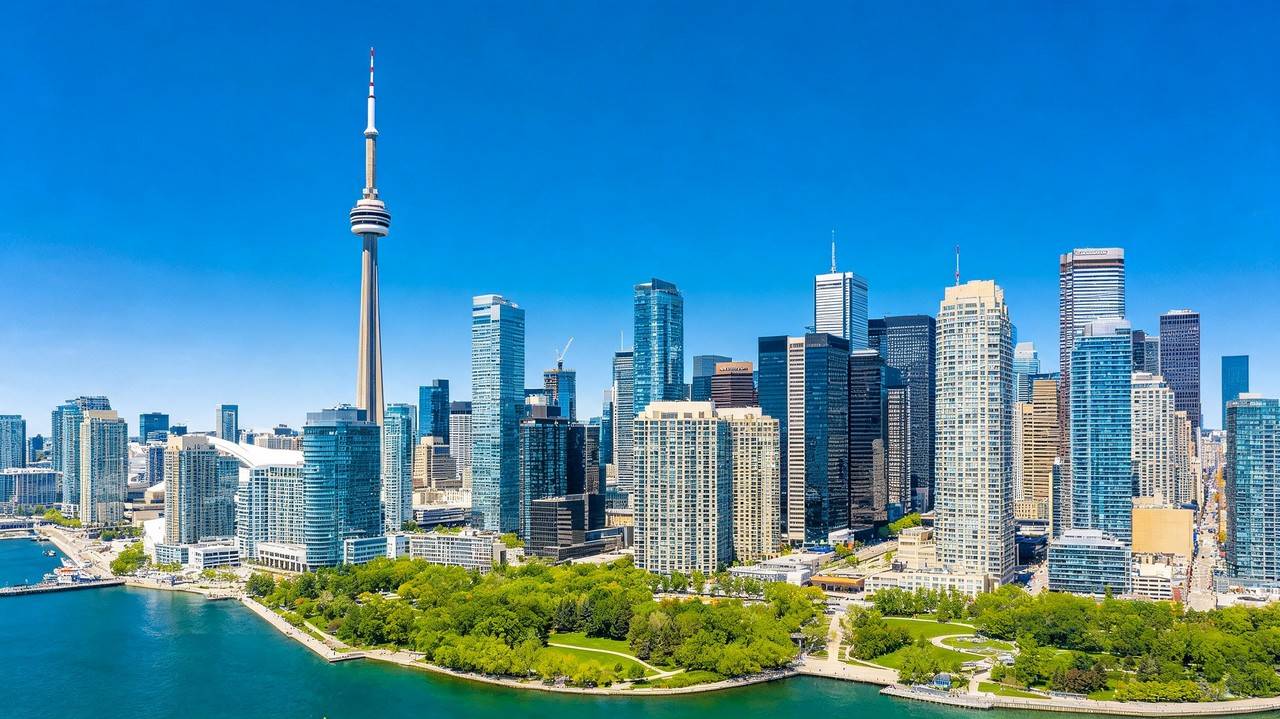
CN Tower
The CN Tower stands at 290 Bremner Boulevard in Toronto's Entertainment District, between the Rogers Centre and Ripley's Aquarium. The reason for building it was practical: by the early 1970s Toronto's skyline was already tall enough to bounce broadcast signals away from their intended audience, so the answer was to build something taller than everything in the way. Construction ran from February 1973 to April 1975 — about forty months and more than 1,500 workers — and the tower opened to the public on 26 June 1976. At 553.3 metres it held the record as the world's tallest freestanding structure for 32 years, until it was overtaken by Dubai's Burj Khalifa; it remains the tallest freestanding structure in the Western Hemisphere and is listed by the American Society of Civil Engineers as one of the seven wonders of the modern world. Six glass elevators travel at 22 km/h and reach the main LookOut at 346 metres in 58 seconds. The levels stack up: the outdoor SkyTerrace and Glass Floor at 342 m, the LookOut at 346 m, the revolving 360 Restaurant at 351 m (one turn every 72 minutes), EdgeWalk's hands-free ledge at 356 m, and The Top at 447 m — the highest observation platform in the Western Hemisphere. The tower still carries broadcast signal for more than 17 of Toronto's television and FM stations and draws over two million visitors a year. On clear days the view from The Top reaches about 160 kilometres to Niagara Falls. 2026 marks its 50th anniversary.
Square & Landmark

Royal Ontario Museum
The Royal Ontario Museum (ROM) sits beside Queen's Park on the northern edge of the University of Toronto's St. George campus — Canada's largest museum and among the largest museums of world cultures and natural history in North America. Established by the Government of Ontario in 1912, it opened to the public on 19 March 1914. Its collection of more than 18 million artworks, artifacts and natural history specimens fills over 40 permanent galleries and spans some 4.5 billion years of Earth and human history, from dinosaur fossils, minerals and meteorites to ancient Egypt, East Asian art and Indigenous Canadian history. The ROM is internationally known for its Chinese collection — more than 30,000 works, among the most complete assemblages of Chinese art outside Asia. In 2007 the Michael Lee-Chin Crystal, designed by architect Daniel Libeskind, added five interlocking glass and aluminium prisms that gave the century-old institution its most recognizable modern landmark. The current OpenROM project adds a bronze-canopied entrance and expanded public spaces.
Museum

Toronto City Hall
Toronto City Hall at 100 Queen Street West was designed by Finnish architect Viljo Revell, whose entry won the 1958 international competition from more than 500 submissions across 42 countries. It opened on 13 September 1965, replacing the 1899 Old City Hall (now courthouses). Two curved towers — the east 20 storeys and the west 27 — cradle a saucer-shaped council chamber, reading from above as an open eye; Revell described the form as "two hands cradling the city." It stands as one of the major works of international modernism in North America and is protected as an Ontario heritage building. The lobby, council chamber and public corridors are open to visitors on weekdays. In front, Nathan Phillips Square is the city's stage for gatherings and festivals: the three-metre TORONTO sign lights 24 hours a day, the reflecting pool carries three Freedom Arches, and from late November to mid-March the pool freezes into a free outdoor skating rink — the city's most iconic public ice. New Year's Eve, the Cavalcade of Lights and civic demonstrations all take place here.
Square & Landmark

David Dunlap Observatory
The David Dunlap Observatory (DDO) sits in Richmond Hill, Ontario, Canada, at 123 Hillsview Drive, about a 40-minute drive north of downtown Toronto. It is a public observatory and destination park in the Greater Toronto Area that combines scientific heritage, historic architecture and woodland.
History: the observatory was promoted by University of Toronto astronomer Clarence Chant and endowed by Jessie Donalda Dunlap, widow of the mining financier and keen amateur astronomer David Alexander Dunlap, in his memory. The main building was designed by the Toronto firm Mathers and Haldenby, and the steel dome was built by Grubb-Parsons in England. It was officially opened on 31 May 1935; Canada's prime minister, William Lyon Mackenzie King, called it 'a gift to science all over the world.'
Telescope and mirror: the 74-inch (1.88 m) reflector, completed in 1935, was then the second-largest optical telescope in the world (after the 100-inch telescope at Mount Wilson Observatory) and remains the largest optical telescope in Canada. Its primary mirror weighs 23 tonnes, was the first Pyrex mirror blank ever cast, and served as the test blank for the 5-metre telescope at Palomar Observatory. The tube is over 10 m long, and visitors climb a spiral stair inside the dome to see it up close.
Research: from 1935 to 2007 the site stood at the forefront of Canadian astronomy, with work in radio astronomy, the distance to globular clusters and the stability of Polaris. In 1972 astronomer Tom Bolton used the 1.88 m telescope to obtain the first direct evidence that Cygnus X-1 is a black hole. Notable Canadian astronomers such as Helen Sawyer Hogg also worked here.
Heritage status: in September 2009 Richmond Hill designated the property under the Ontario Heritage Act (By-law 100-09), and in 2019 the federal government recognised it as a National Historic Site.
From university to city: the University of Toronto sold the property to a developer in June 2008, prompting a long community and heritage battle. After Ontario Municipal Board mediation, Richmond Hill received about 40 hectares (99 acres) of parkland together with the dome and Administration Building in 2017; the whole property is about 76.5 hectares (189 acres).
Today: now run by the City of Richmond Hill for public education and outreach. Each spring, summer and fall (roughly late May to late October) visitors can take free self-guided tours of the Administration Building and dome. Stargazing parties are free and usually need no booking but are weather dependent. The RASC Toronto Centre also runs night-time observing and digital planetarium (Starlab) programmes, and there are summer science camps. Woodland trails around the observatory are open year-round for daytime walks.
Location note: this observatory is in Ontario, Canada, not David, Panama; the two share a Chinese translation but are in different countries, so check the itinerary carefully.
Museum

Casa Loma
Casa Loma is a Gothic Revival mansion-castle in downtown Toronto, built at the turn of the 20th century at huge cost by financier Sir Henry Pellatt, and is one of Canada's most famous castles. This mansion with nearly a hundred rooms is grand throughout—ornate halls, the Oak Room, a library, a conservatory garden, and even a roughly 240-meter underground tunnel connecting the castle to the stables—everywhere showcasing the luxury of its era. The towers overlook Toronto's skyline, and the tended gardens offer pleasant scenery in every season. The castle is also a popular film location. Strolling through this "sand-castle" noble residence and looking back on a Gilded Age rise-and-fall legend makes for a uniquely charming Toronto stop.
Castle & Fortress
🎯 Toronto Experiences
Ascend the CN Tower
Overlook the whole city from the glass floor.
Niagara Falls
See the falls up close on the Hornblower cruise.
Toronto Islands
View the city skyline from the lake.
Kensington Market
Diverse cuisine and arts.
Lakeside Cycling
The Lake Ontario waterfront trail.
Summer (Jun-Sep) has the best weather, and autumn (Oct) brings beautiful fall foliage. Winter (Dec-Feb) is severely cold with heavy snow. Niagara Falls can be done as a day trip or stay a night for the night view.
📰 Travel Guides
More Guides →East Canada 5-Day Group Tour Guide: Halifax to Toronto
Canada Tour · Spot👁 7.5k
Canada 6th Participation Guide 2026: Cuihu Mountain Five-Star Hotel and Niagara Falls
Canada Tour · Spot👁 2.7k
Canada East 7-Day Group Tour Guide: Quebec & Niagara
Canada Tour · Spot👁 1.4k
🚌 Transport & Stays
City Transport
🚆About CAD 12.4 (reference)
UP Express Airport Rail
Pearson Airport to downtown ~25 min
About CAD 12.4 (reference)
🚇Tap Presto card (reference)
Subway / Streetcar
Connects major downtown attractions
Tap Presto card (reference)
🚌Depends on route (reference)
Bus / Train
To Niagara
Depends on route (reference)
🚶—
Walking
Downtown attractions are clustered
—
Recommended Stay Areas
🗼 Downtown / Lakeshore (Top Pick)
Close to CN Tower and transit hub
🛍️ Kensington / Queen St. West
Arts district and nightlife
🏛️ Museum District
Elegant and quiet, near cultural venues
💧 Niagara Town
Stay a night to see the falls
Free Consultation
Want to plan your Toronto trip in more depth?
Tell us your departure city, travel dates and interests, and Usitour will tailor a trip just for you.