🌏 Destination Overview
Canada blends grand nature with livable cities across its vast territory. In the western Rockies, the snow-capped mountains and lakes of Banff and Jasper are almost unreal, and the Icefields Parkway is postcard scenery all the way; in the east, the Maple Route blazes with color each autumn, while Niagara Falls roars year-round. Add Vancouver and Toronto's urban character plus winter auroras and skiing, and Canada is superb for both natural scenery and family travel.
🗓️
Best Season
Jun-Sep / Sep-Oct (Maple)
🕐
Recommended Days
8-14 days
👪
Best For
Families / Road-trippers / Nature Lovers
🎯
Top Activities
Rockies · Maple leaves · Waterfalls · Road trips
🧳
Pre-trip Preparation
Visa/eTA + international driver's permit
Popular Cities
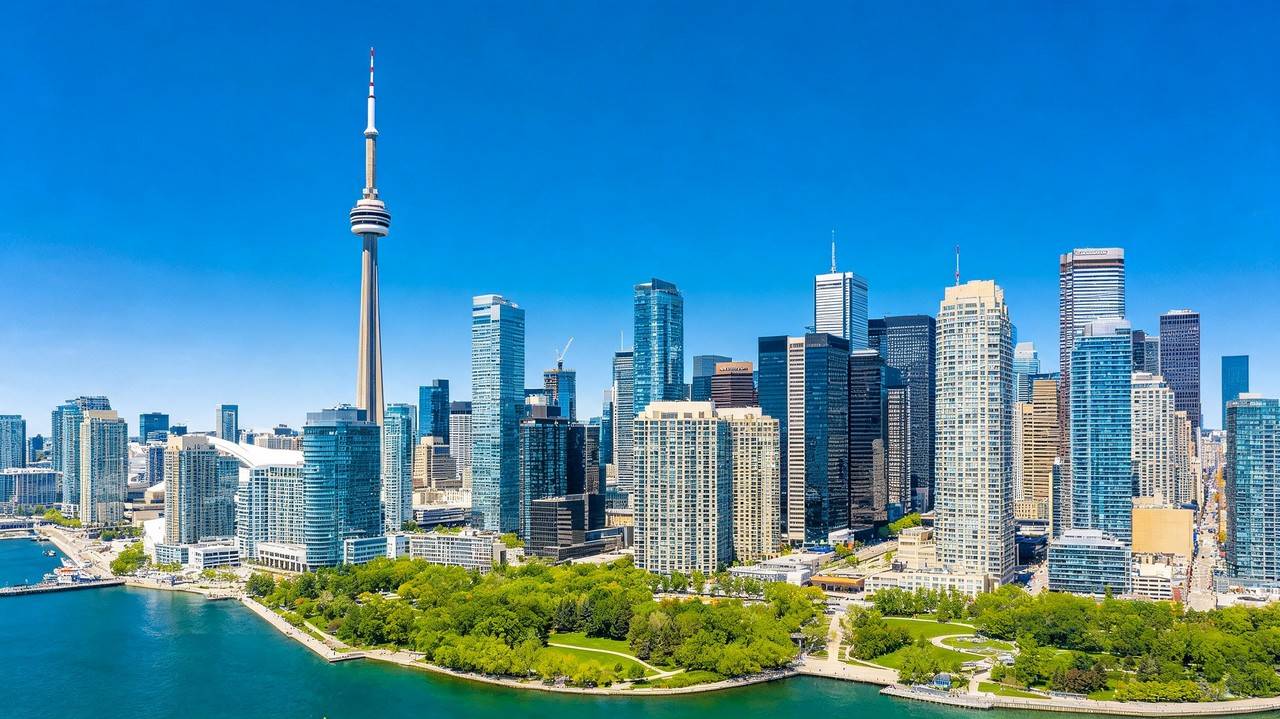
Toronto
Metropolis,Gateway,Landmark
🔥 Canada's largest metropolis, CN Tower and multicultural hub, gateway to Niagara.

Vancouver
Metropolis,Nature,Bay
🔥 Livable city embraced by snow mountains and bays, Stanley Park and seawall.

Montreal
French-style,Old Town,Arts
🔥 French-style city of North America, old town stone lanes and art festivals.

Quebec City
Old Town,UNESCO,French-style
🔥 North America's only walled old town, with European charm at Château Frontenac.

Whitehorse
Whitehorse,Canada,Yukon,Gold Rush History,Northern Lights,Midnight Sun
🔥 Capital of Canada's Yukon and a Klondike Gold Rush hub. Miles Canyon cuts turquoise through basalt; winters blaze with aurora and midsummer brings nearly 20 hours of daylight.

Banff
Banff,Canada,Alberta,Rocky Mountains,National Park,Spa Town
🔥 Banff is an Alberta Rockies resort town — Banff NP (1885) is Canada's first. Sulphur Mountain gondola and Upper Hot Springs are classic; Lake Louise and Moraine Lake are nearby. Banff is known for skiing, hot springs and alpine lakes.
Popular Attractions
More Attractions →
Banff National Park📍 Banff
Banff National Park lies on the eastern slopes of the Canadian Rockies in Alberta. Created in 1885, it was Canada's first national park and the world's third, after Yellowstone and Royal National Park in Australia, and covers 6,641 sq km. What fills up is a narrow corridor — the town of Banff, the Bow Valley and the Lake Louise end of Highway 1 some 55 km north — while Calgary lies just 128 km away, about ninety minutes by car. The signature scenery is the glacial lakes: Lake Louise, Moraine Lake and Peyto Lake take their unreal blue from rock flour suspended in the meltwater, which scatters short blue wavelengths. The park shelters grizzly and black bears, elk, bighorn sheep, mountain goats, wolves and caribou, and forms the core of the UNESCO-listed Rocky Mountain Parks inscribed in 1984. With 4,558,171 visits in the 2025–26 fiscal year, it is Canada's busiest national park.

Stanley Park📍 Vancouver
Stanley Park occupies a peninsula northwest of downtown Vancouver, British Columbia, covering roughly 405 hectares with water on three sides — Vancouver's largest urban park and its "green lung." It preserves one of the few remaining tracts of old-growth temperate rainforest in western Canada, with several-hundred-year-old western hemlock and Douglas fir, plus Beaver Lake, Lost Lagoon and a web of forest trails. The best-known feature is the Seawall, about 8.8 km around the peninsula with walking and cycling lanes kept separate, passing English Bay, Second Beach, Third Beach, the Lions Gate Bridge tunnel and Prospect Point, with views over the bridge, Burrard Inlet and the North Shore mountains. At Brockton Point on the east shore stand nine totem poles, among the most visited attractions in British Columbia. The poles are not Coast Salish work — they were collected from Kwakwaka'wakw, Haida and Nuxalk villages on Vancouver Island and the central coast from the 1920s; several originals have been repatriated and replaced with authorized replicas or newly commissioned works. The three cedar gateways beside them, People Among the People, were carved by Coast Salish artist Susan Point and installed in 2008. Also on site: the Vancouver Aquarium (opened 1956), the 1911 heritage pavilion, the Hollow Tree, and the Nine O'Clock Gun.

University of Toronto📍 Toronto
The University of Toronto began as King's College, chartered in 1827, was secularized in 1849 and became the non-denominational University of Toronto in 1850. It is Ontario's oldest and Canada's largest university, with more than 97,600 students across over 80 departments and three campuses — St. George, Scarborough and Mississauga — plus seven federated colleges. The Anglicans responded to secularization by founding Trinity College in 1851 (opening 1854); Victoria College and St Michael's joined in 1890, Knox in 1890, Wycliffe in 1889, and Trinity federated in 1904. The St. George campus has no walls and opens straight into the city, yet holds the richest group of historic campus buildings in Canada. University College was built 1856–1859 to designs by Frederick William Cumberland and William George Storm — Norman and Romanesque Revival with faint Byzantine and Italian palazzo traces, one of Canada's first great High Victorian Gothic buildings, and a National Historic Site. Beside it stand Gothic Revival Trinity College, the domed Convocation Hall, and the Soldiers' Tower memorializing alumni killed in the world wars. Robarts Library, completed 1973, is a 14-storey brutalist concrete landmark on an equilateral triangular plan, nicknamed "the turkey" by students. The quads, old trees and streets through campus make it the best place to read Toronto's architecture.

Niagara Falls
Niagara Falls sits on the Niagara River between Lake Erie and Lake Ontario, straddling the Canada–US border, and consists of three falls: Horseshoe, American and Bridal Veil. The combined drop is about 51 metres with an average flow near 2,400 cubic metres per second — by volume the largest waterfall in North America. Roughly 90 percent of the water goes over Horseshoe Falls, whose 790-metre arc is seen head-on from the Canadian side and compares unfavourably with the American viewpoint. American Falls and Bridal Veil are lower, about 21–30 metres, and are split into sections by Goat Island on the US side. The public viewing areas are free and open around the clock year-round; ticketed attractions sit inside the Table Rock Centre or run seasonally as boat cruises. The falls have been floodlit in colour nightly since 1925, and in winter host North America's largest free light festival. One thing many visitors miss: there is no blanket park admission on the Canadian side — the promenades, trails and Queen Victoria Park are all free.

Butchart Gardens📍 Victoria
Butchart Gardens sits at Brentwood Bay on the southern tip of the Saanich Peninsula on Vancouver Island, beside Tod Inlet, about 23 km and thirty minutes from downtown Victoria. In 1904 Jennie Butchart planted her first sweet peas in the spent limestone quarry of her husband Benjamin's cement works; a century on, the gardens cover 55 acres (22 hectares) with more than 900 plant varieties and were designated a National Historic Site of Canada in 2004. The Sunken Garden is the centrepiece — the quarry pit terraced into flowerbeds with the Ross Fountain at its foot. The Italian, Rose and Japanese gardens and the Mediterranean garden opened in 2021 each have their own character, and 26 on-site greenhouses raise all the planting. The calendar drives the visit: tulips and cherries from March to May, close to 300 rose varieties from June to September, maples and chrysanthemums from late September, and Christmas lights through December and early January. Saturday-night fireworks and Wednesday-to-Sunday evening concerts make summer nights the island's best-known outdoor events.
CN Tower📍 Toronto
The CN Tower stands at 290 Bremner Boulevard in Toronto's Entertainment District, between the Rogers Centre and Ripley's Aquarium. The reason for building it was practical: by the early 1970s Toronto's skyline was already tall enough to bounce broadcast signals away from their intended audience, so the answer was to build something taller than everything in the way. Construction ran from February 1973 to April 1975 — about forty months and more than 1,500 workers — and the tower opened to the public on 26 June 1976. At 553.3 metres it held the record as the world's tallest freestanding structure for 32 years, until it was overtaken by Dubai's Burj Khalifa; it remains the tallest freestanding structure in the Western Hemisphere and is listed by the American Society of Civil Engineers as one of the seven wonders of the modern world. Six glass elevators travel at 22 km/h and reach the main LookOut at 346 metres in 58 seconds. The levels stack up: the outdoor SkyTerrace and Glass Floor at 342 m, the LookOut at 346 m, the revolving 360 Restaurant at 351 m (one turn every 72 minutes), EdgeWalk's hands-free ledge at 356 m, and The Top at 447 m — the highest observation platform in the Western Hemisphere. The tower still carries broadcast signal for more than 17 of Toronto's television and FM stations and draws over two million visitors a year. On clear days the view from The Top reaches about 160 kilometres to Niagara Falls. 2026 marks its 50th anniversary.
Classic Experiences
Best Travel Seasons
🌷
Spring · Apr-May
Snow melts and nature comes alive
☀️
Summer · Jun-Aug
Best at the Rockies and lakes
🍁
Autumn · Sep-Oct
The eastern Maple Route is splendid
❄️
Winter · Dec-Mar
Great time for skiing and auroras
The Rockies and lakes are best from Jun-Sep; the eastern maple season peaks late Sep to mid-Oct, so book lodging early.
Recommended Tours
View All →
6-Day Canada East: Toronto, Montreal, Ottawa, Quebec, Kingston, Niagara Falls, Thousand Islands
From $633

7-Day Rocky Mountain TourFree Vancouver City Tour:4 National Parks & LakesOptional: Vancouver/Whistler/VictoriaAirport transfer, 1 night Banff, Ice Explorer
From $661

8-Day Rockies Highlights | Free Vancouver Tour|4 Parks+3 Lakes+3 Optional Tours: Vancouver / Whistler / Victoria (Choose 2)|Airport Transfers+1nt Banff
From $802

5-Day Rocky Mountain Highlights Tour4 National Parks • Moraine Lake • Lake Louise • Peyto Lake • Ice Explorer • Airport Transfer • 1 Night in Banff • Free Vancouver City Tour
From $448

7-day Canada West: Banff, Rockies, Icefield, Lake Louise, Victoria
7 days 6 nights
From $627

4-Day Canada West: Banff National Park, Jasper National Park, Columbia Icefield, Glacier National Park & Gingeng City Kamloops
4 days 3 nights
From $265
Popular Guide Articles
More →US & Canada East 8-Day Group Tour Guide 2026: 8 Cities
👁 8.7k
East Canada 5-Day Group Tour Guide: Halifax to Toronto
👁 7.5k
Canada Travel Guide 2026: Visa, Transport & 3-7 Day Plans
👁 4.6k
Canada 6th Participation Guide 2026: Cuihu Mountain Five-Star Hotel and Niagara Falls
👁 2.7k

Calgary Group Tour Guide 2026: Days, Stays & Lake Day Trip
👁 2.3k
Canada East 7-Day Group Tour Guide: Quebec & Niagara
👁 1.4k
Practical Info
Depends on passport/departure country; check the latest visa and entry policy before travel
Canadian Dollar (CAD), cards widely accepted
UTC-3.5 to -8, spanning multiple time zones
120V, Type A/B outlets
Mainly self-drive; intercity flights and VIA Rail available
Obey local laws, mind personal belongings; emergency 911 (general)
Free Consultation
Free Consultation
Tell us your departure city, travel dates and interests, and Zou Sifang will tailor a trip just for you.