📍 Destination Overview
Turin, on the Po plain in northwest Italy, was the capital of the Savoy kingdom and of unified Italy, famed for Baroque planning and grand boulevards. The 167-meter Mole Antonelliana, the city's emblem, looks out to the Alps. Its Egyptian Museum is second only to Cairo, and the converted Lingotto factory reflects its role as the Fiat motor city.
🗓️ Best Season
May-Aug
🕐 Duration
3-5 days
👪 Best For
Photo · Couples · Family
🎯 Highlights
Culture · Food · Nature
💰 Budget
Moderate
🧳 Preparation
Passport · Visa · Insurance
☀️ Best Time to Visit & Climate
☀️ Spring: May
May greens the Baroque palaces and gardens.
☀️ Summer: Jun–Aug
Summer peaks the Egyptian Museum and royal city.
January
🌤️
6°/-3°
February
🌤️
9°/-1°
March
🌷
14°/3°
April
🌷
18°/7°
May
☀️
23°/11°
Best
June
☀️
27°/15°
Best
July
☀️
30°/18°
Best
August
☀️
29°/17°
Best
September
🍂
24°/13°
October
🍂
18°/8°
November
🌤️
11°/2°
December
🌤️
7°/-2°
📷 Top Attractions
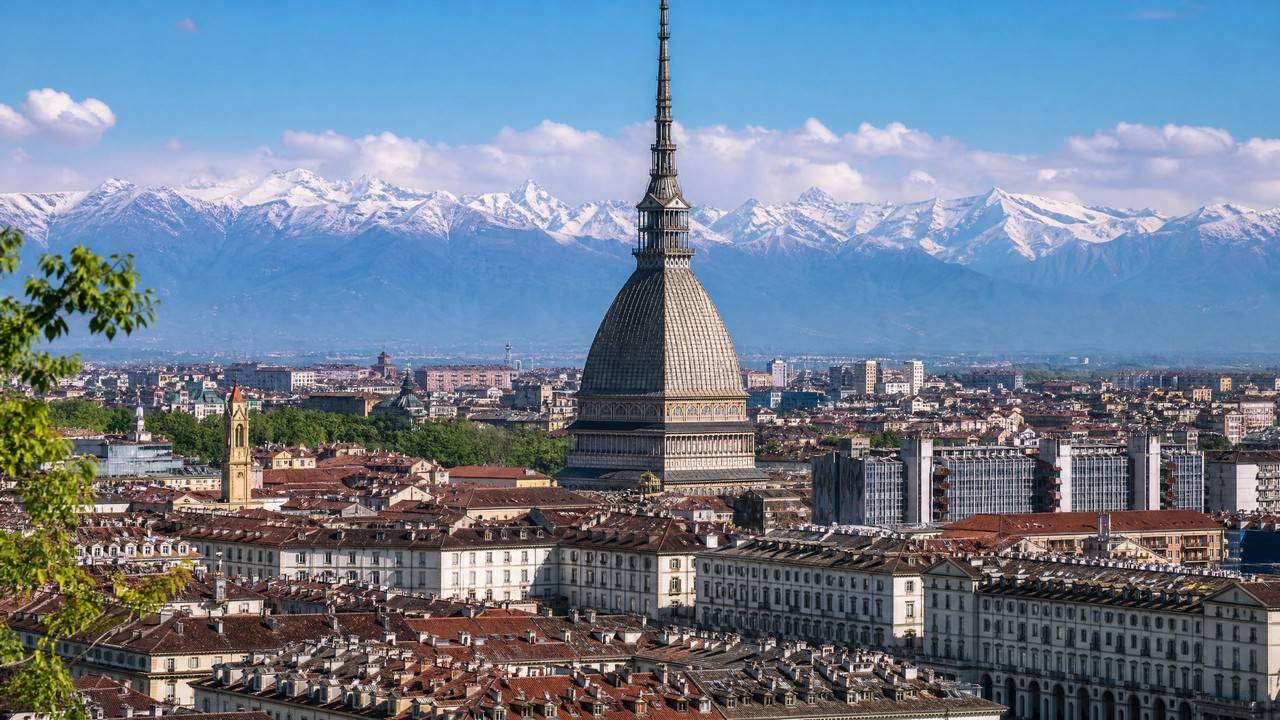
Mole Antonelliana
The Mole Antonelliana dominates Turin's skyline; designed in the 19th century by Alessandro Antonelli, it was first planned as a synagogue and became the city's symbol. Its 167-metre aluminium spire was once the world's tallest brick building; today it houses the National Cinema Museum, and a spiral ramp to the top surveys the Alps and all of Turin. It is the most photogenic silhouette of the city of cinema.
Square & Landmark
No.2 Turin
Museo Egizio
The Egyptian Museum of Turin is the world's oldest museum devoted to Egyptology, its collection second only to Cairo's, spanning from the pharaohs to the Coptic period. Spacious galleries stage reconstructed temples, Abu Simbel reliefs and thousands of artefacts, making it a European stronghold for the study of Nile civilisation and easy to lose a whole day inside.
Museum
No.3 Turin
Palazzo Reale
The Royal Palace of Turin was the power centre of the House of Savoy, remodelled in the 17th century and home to Italy's kings before unification. Gilded mirror galleries, an armoury and the queen's gardens display utter opulence; the adjoining Royal Armoury holds the fabled Turin Shroud. Inscribed as part of the 'Residences of the Royal House of Savoy' in 1997, it witnessed Italy's unification drama.
Historic Ruins & Heritage
No.4 Turin
Piazza San Carlo
Piazza San Carlo stands at the centre of Turin's old town, with Via Roma running straight through it, and is the largest Baroque square in Piedmont, long known as Turin's drawing room. Rectangular and some 168 by 76 metres, about 12,700 square metres in all, it was laid out by Carlo di Castellamonte in the mid-seventeenth century and later revised by Benedetto Alfieri, with continuous arcades on all four sides. The space marked the point where the Savoy capital pushed south to open Via Roma, and under French rule it served as a parade ground renamed Place Napoleon.
At its centre stands Carlo Marochetti's 1838 bronze equestrian monument to the Savoy duke Emanuele Filiberto, shown sheathing his sword after the Battle of San Quentin as a gesture of peace; Turinese call it Caval 'd Brons, the bronze horse, and it is among Italy's oldest equestrian monuments. At the south end, facing each other across Via Roma, stand two near-identical Baroque churches: San Carlo, begun in 1619 with a facade completed in 1834, and Santa Cristina, commissioned by the regent Christine Marie in 1639 with a facade by Filippo Juvarra between 1715 and 1718. The Galleria Subalpina sits at the north-west corner, and small frescoes of the Holy Shroud still show on the facades at the street corners.
Through the nineteenth and early twentieth centuries the square's cafes hosted political and literary figures such as Camillo Benso di Cavour and Giovanni Giolitti; Caffè San Carlo, Caffè Torino, opened in 1903, and the Pasticceria Stratta, founded in 1836, still set the tone of daily life. The square also carries the 2006 Winter Olympics marker and is a gathering place for Juventus fans; on the evening of the 3 June 2017 Champions League final a serious crush occurred here.
Square & Landmark
🎯 Turin Experiences
Cultural Deep Dive
Historic sites, museums & local culture of Turin.
Food Discovery
Taste authentic Italian cuisine and specialities, from street food to fine dining.
Outdoor Adventure
Natural scenery & outdoor activities around Turin.
Shopping
Local markets, crafts & brand shopping for unique souvenirs.
Nightlife
Bars, shows & nightlife in Turin.
Turin has four distinct seasons with cold winters and hot summers; the best time to visit is May–Aug, with temperatures around 11–30°C. January is coldest (down to -3°C), so bring warm layers.
🚌 Transport & Stays
City Transport
🚆€20-150
Train
Dense rail network, high-speed between cities, Eurail Pass.
€20-150
🚗€30-60/day
Car Rental
Flexible, scenic countryside, mind left-hand drive (UK/IE).
€30-60/day
✈️€20-100
Budget Air
Ryanair/EasyJet, very cheap if booked early.
€20-100
Recommended Stay Areas
🏨 City Center / Old Town
Central Turin hotels, convenient & close to attractions.
🏡 B&B / Guesthouse
Local-style B&Bs for an authentic stay.
🏕️ Resort / Estate
Resorts, estates & design hotels for a unique stay.
🏠 Apartment / Rental
Self-catering apartments, great for families & longer stays.
Free Consultation
Planning a trip to Turin?
Tell us your departure city and dates — USITrip will craft your journey.