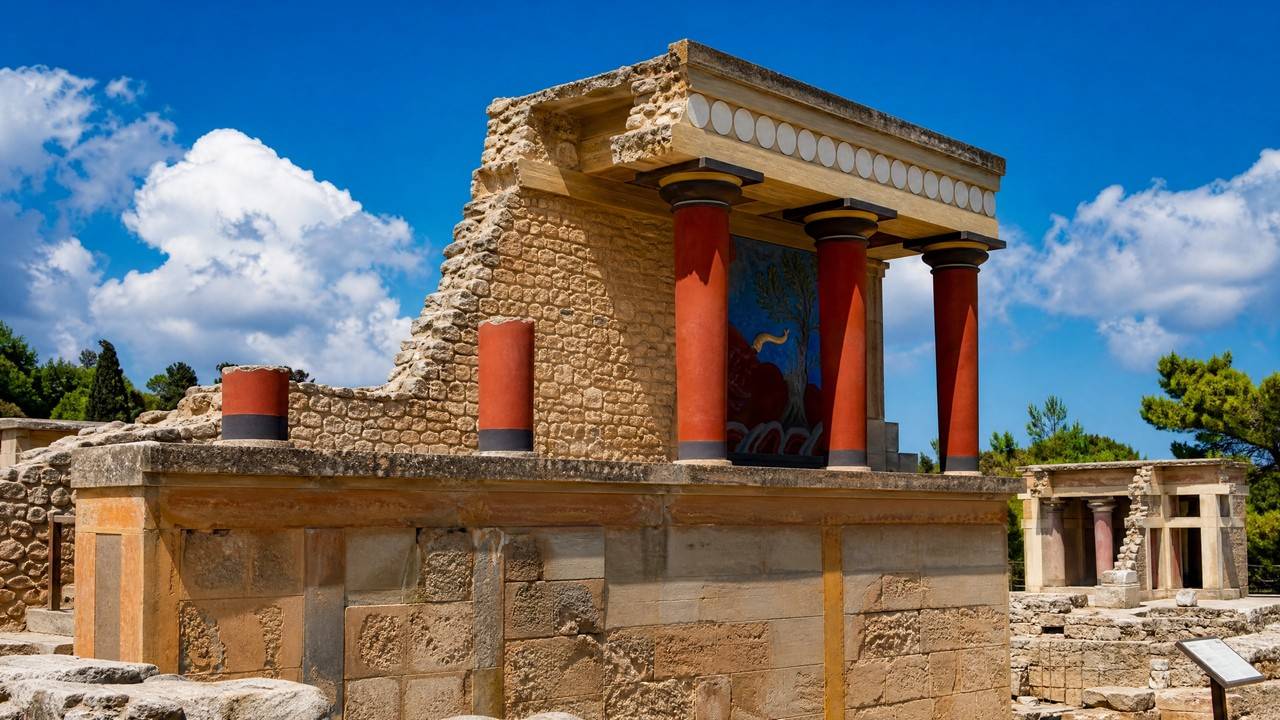
Palace of Knossos

Quick Facts
- Location
- Greece, Crete
- Category
- Historic Ruins & Heritage
- Duration
- 1.5–2 hours; 2–3 hours in high season with queues.
- Opening Hours
- Apr-Aug daily 08:00-20:00; Sep 1-15 08:00-19:30, Sep 16-30 08:00-19:00, Oct 1-15 08:00-18:30, Oct 16-31 08:00-18:00; Nov-Mar 08:30-17:00, last admission 16:45.
- Ticket Price
- Adult: EUR20 · Full EUR 20, reduced EUR 10 (the over-65 reduced rate only runs 1 October to 31 May). The official Knossos and Heraklion museum combined ticket has been discontinued - buy the two sites separately.
- Address
- Knossos 714 09, Heraklion, Crete, Greece
- Coordinates
- 35.2979, 25.1632
Introduction
The Palace of Knossos stands about 5 km south of Heraklion, Crete, the ceremonial and administrative heart of Minoan civilisation (c. 2000–1400 BC) and the core of one of Europe's oldest cities. The palace complex covers some 20,000 square metres across multiple storeys and wings, with light wells and plumbing, and may have housed 1,000–2,000 people. The labyrinth of Greek myth — home of the bull-headed Minotaur — is widely identified with this sprawling palace; the word labyrinth may link to the labrys double axe, the Minoans' most common sacred emblem. From 1900 the British archaeologist Sir Arthur Evans excavated here for over three decades and partly rebuilt the palace in reinforced concrete: bright fresco copies (the Bull-Leaping and Lily Prince) decorate reconstructed colonnades, the Throne Room's gypsum seat is widely called Europe's oldest throne with griffins painted either side in Evans' restoration, and the magazines still line up giant pithoi jars for oil, wine and grain. Linear B tablets found here are the earliest writing in Greek. The overlap of genuine antiquity and modern reconstruction — and the controversy around it — is what makes Knossos so compelling.
✨ Highlights
🛈 Practical Info
Ticket Information
| Adult | EUR20 |
|---|
Full EUR 20, reduced EUR 10 (the over-65 reduced rate only runs 1 October to 31 May). The official Knossos and Heraklion museum combined ticket has been discontinued - buy the two sites separately.
💡 Tips
FAQ
What are the opening hours of Palace of Knossos?
Apr-Aug daily 08:00-20:00; Sep 1-15 08:00-19:30, Sep 16-30 08:00-19:00, Oct 1-15 08:00-18:30, Oct 16-31 08:00-18:00; Nov-Mar 08:30-17:00, last admission 16:45.
How much is the admission for Palace of Knossos?
Adult: EUR20; Full EUR 20, reduced EUR 10 (the over-65 reduced rate only runs 1 October to 31 May). The official Knossos and Heraklion museum combined ticket has been discontinued - buy the two sites separately.
Any practical tips for visiting Palace of Knossos?
Enter at the 8 a.m. opening: tour groups arrive after 10 and the site turns into an oven by midday. Keep telling original from reconstruction: the red columns, fresco copies and concrete floors are Evans-era work.
How long should I spend at Palace of Knossos?
A typical visit takes 1.5–2 hours; 2–3 hours in high season with queues..