📍 Destination Overview
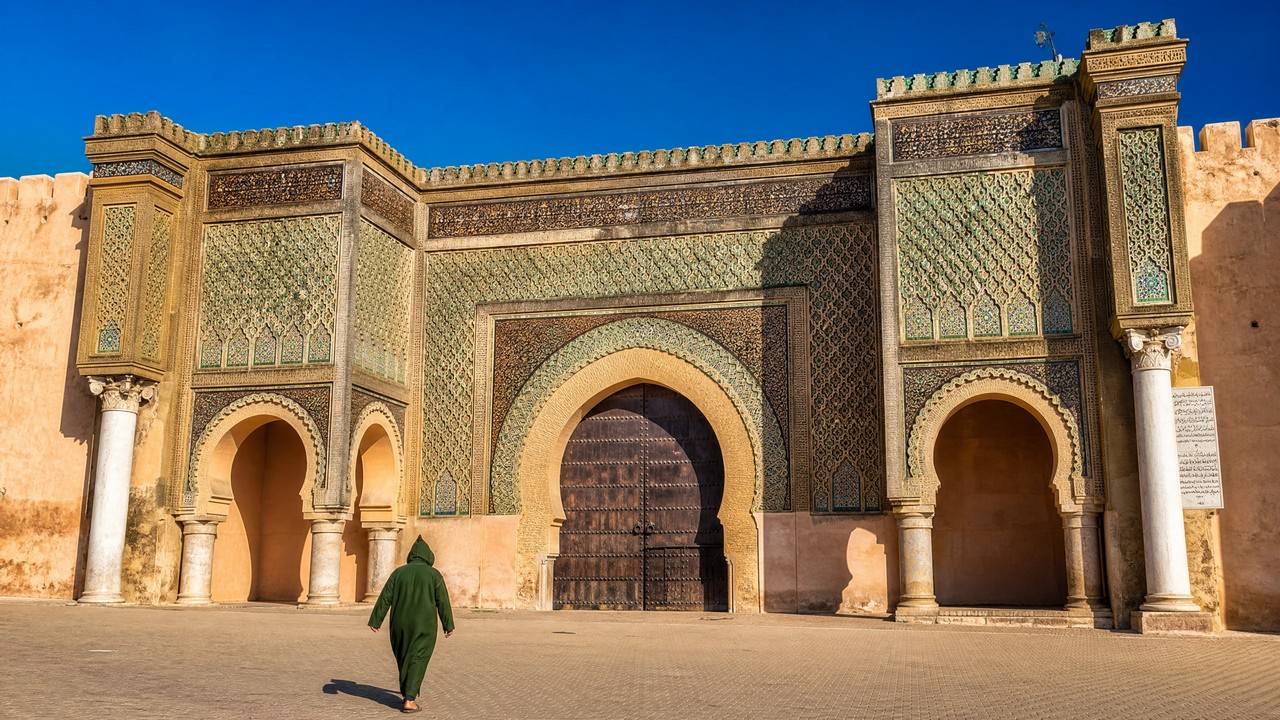
Meknes, one of Morocco's four imperial cities, owes its glory to the 17th-century Sultan Moulay Ismail. Grand ramparts hold the tiled, horseshoe-arched Bab Mansour gate, while the royal stables and granary reportedly housed ten thousand horses. Freer of crowds than the capital, it rewards unhurried strolling through a living imperial city, with the Roman ruins of Volubilis nearby.
🏰 Location
Inland Morocco
🗓️ Best Season
Mar-Jun & Sep-Nov
🕐 Time Difference
7-8h behind Beijing
💰 Currency / Language
Dirham (MAD) / Arabic, French
🕐 Suggested Duration
1-2 days
🔌 Outlet / Voltage
Type C/E · 220V
☀️ Best Time to Visit & Climate
🌸 Spring: Mar–Jun
Blooms & mild.
🍂 Autumn: Sep–Nov
Great outdoors.
January
🌤️
15°/5°
February
🌤️
17°/6°
March
🌸
20°/8°
Best
April
🌸
22°/10°
Best
May
🌸
26°/13°
Best
June
☀️
30°/16°
Best
July
☀️
34°/19°
August
☀️
34°/20°
September
🍂
30°/17°
Best
October
🍂
25°/13°
Best
November
🌦️
19°/8°
Best
December
🌤️
16°/6°
Meknes Tours
View All →![[Pleasant 5-day trip to Morocco] Marrakech + Ouarzazate + Merzouga + Ifrane Town + Ancient City of Fes + Chefchaouen | Exploring the Dream Sahara](https://qiniu.usitour.com/images/picture/2019/08/detail_80_5d42a46e01368.jpg?imageView2=2&w=1920&q=70&format=webp)
[Pleasant 5-day trip to Morocco] Marrakech + Ouarzazate + Merzouga + Ifrane Town + Ancient City of Fes + Chefchaouen | Exploring the Dream Sahara
From $909
![[Pleasant 6-day trip to Morocco] Marrakech + Ouarzazate + Merzouga Sahara Desert + Ancient City of Fez + Chefchaouen | Enjoy colorful Morocco](https://qiniu.usitour.com/images/picture/2019/08/detail_81_5d42b2a1cbbdb.jpg?imageView2=2&w=1920&q=70&format=webp)
[Pleasant 6-day trip to Morocco] Marrakech + Ouarzazate + Merzouga Sahara Desert + Ancient City of Fez + Chefchaouen | Enjoy colorful Morocco
From $1011
![[Morocco 6-day tour] Casablanca + Marrakech + Ouarzazate Cinema City + Merzouga Sahara Desert + Fez + Meknes + Chefchaouen + Tangier | Enjoy the back garden of North Africa](https://qiniu.usitour.com/images/picture/2019/08/detail_90_5d42ad7521510.jpg?imageView2=2&w=1920&q=70&format=webp)
[Morocco 6-day tour] Casablanca + Marrakech + Ouarzazate Cinema City + Merzouga Sahara Desert + Fez + Meknes + Chefchaouen + Tangier | Enjoy the back garden of North Africa
From $1011
![[Panorama Morocco 7-day tour] Casablanca + Marrakech + Ouarzazate + Merzouga Sahara Desert + Fes + Meknes + Chefchaouen | A unique trip to North Africa](https://qiniu.usitour.com/images/picture/2019/08/detail_65_5d42ad206abd9.jpg?imageView2=2&w=1920&q=70&format=webp)
[Panorama Morocco 7-day tour] Casablanca + Marrakech + Ouarzazate + Merzouga Sahara Desert + Fes + Meknes + Chefchaouen | A unique trip to North Africa
From $1114
📷 Top Attractions
No.1 Meknes
Meknes Medina
The medina of Meknes is the historic core of one of Morocco's four imperial cities. Planned in the 17th century by Sultan Moulay Ismail, it is known for its maze-like streets, traditional crafts souks and imperial gates such as the famous Bab Mansour, and the entire old town is a UNESCO World Heritage Site.
Old Town & Historic District
No.2 Meknes
Mausoleum of Moulay Ismail
The Mausoleum of Mouley Ismail in Meknes is the burial place of the Alawite sultan Mouley Ismail (ruled 1672-1727, famous for making Meknes his capital and building a vast army). Built in 1703 and restored in 1960, it is known for its fine zellige (mosaic tile), stucco carving and woodwork, and is one of the few religious sites in Morocco where non-Muslims are allowed to enter, with proper dress and removing shoes required.
Church & Religious Site
No.3 Meknes
Medersa Bou Inania de Meknes
Medersa Bou Inania is one of Meknes' finest and best-preserved Islamic schools. Built in the 14th century Marinid era, it features exquisite Moroccan craftsmanship — cedar woodcarving, zellige mosaics, stucco relief and Arabic calligraphy — an outstanding example of Moroccan Islamic architecture. Built 1351-1356 by Sultan Abu Inan Faris as both an Islamic school and mosque. A tranquil courtyard surrounded by student rooms. Exquisite decoration — lower walls with zellige tiles, upper walls with stucco and calligraphy, wooden eaves with cedar carvings. One of Morocco's few religious buildings open to non-Muslims. Visiting to admire the craftsmanship of Moroccan Islamic architecture is a beautiful Meknes experience.
University & Campus
No.4 Meknes
Bab Mansour
Bab Mansour is one of Morocco's grandest and finest gates and Meknes' most iconic landmark. Built in the early 18th century by Sultan Moulay Ismail (completed 1732), it features magnificent scale, exquisite zellige mosaics and stucco — considered Morocco's most beautiful gate. At about 16 m high and 8 m wide, one of Morocco's largest. Decorated with white and green zellige tiles, stucco relief and Quranic inscriptions. Faces Place el-Hedim — Meknes' main square. Now a small exhibition space. Visiting to admire Morocco's grandest gate is an impressive Meknes experience.
Historic Ruins & Heritage
🎯 Meknes Experiences
Gate gaze
Pause at Bab Mansour.
Stable walk
Through the vaults.
Rampart walk
Stroll the walls.
Ruins visit
Roman columns & mosaics.
Meknes is mild winters and hot summers; the best time to visit is Mar–Jun and Sep–Nov, with temperatures around 8–30°C. July is hottest (up to 34°C), so pack sun protection and drink plenty of water.
🚌 Transport & Stays
City Transport
✈️varies
Flight
Via Fes or Rabat
varies
🚄varies
High-speed rail
To Fes/Rabat/Casablanca
varies
🚗varies
Car / taxi
Best for ruins day-trip
varies
Recommended Stay Areas
🕌 Medina riads
Atmosphere & ease
🏨 New town
Modern & quiet
Free Consultation
Planning a trip to Meknes?
Tell us your departure city and dates — USITrip will craft your journey.