📍 Destination Overview
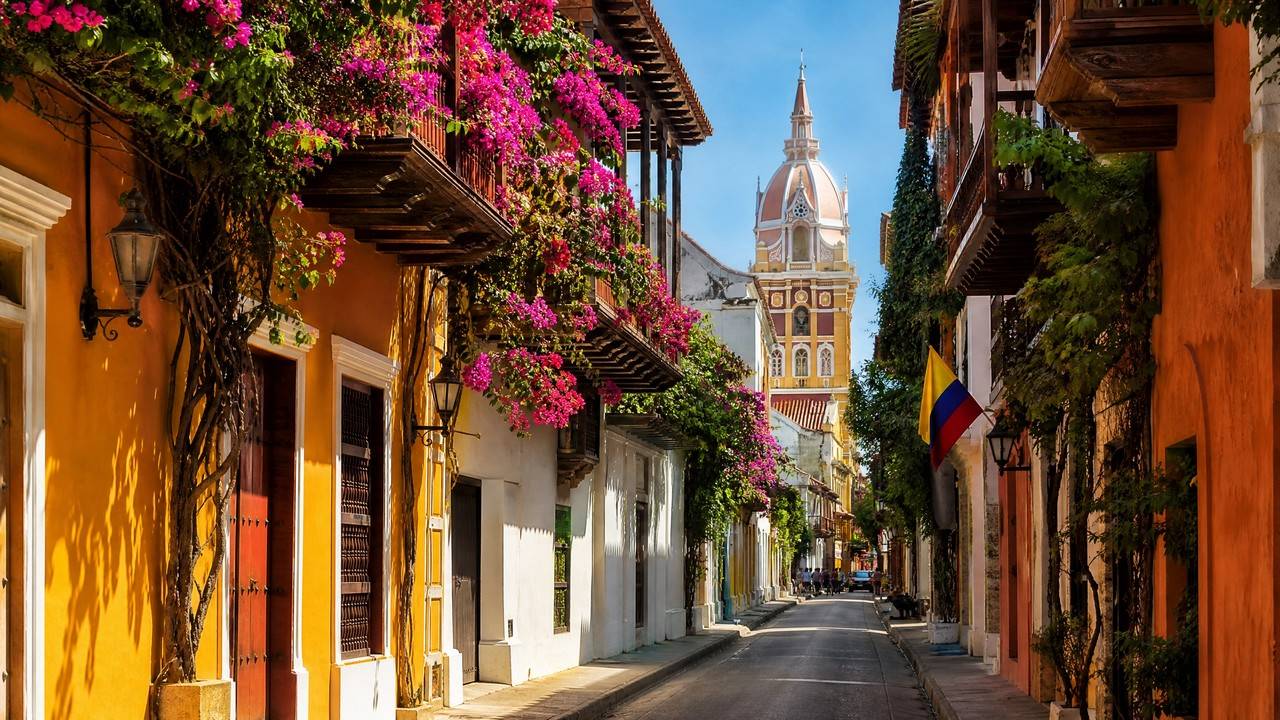
Cartagena, Colombia's jewel on the Caribbean coast, is a historic city whose colonial old town, ringed by sturdy stone walls, is a UNESCO World Heritage Site. Cobblestone streets wind past vividly coloured houses and bougainvillea-cascading balconies, while the Clock Tower Gate and San Felipe fort tell a storied past. A gateway to the Rosario Islands, it is romantic and hospitable.
🌴 Location
Colombia · Caribbean Coast · UNESCO Colonial Old City
🗓️ Best Season
Nov-Apr Best (hot year-round)
🕐 Time Difference
-13 hrs vs Beijing
💰 Currency / Language
Colombian Peso COP / Spanish / English in tourist areas
🕐 Suggested Duration
2-3 days · Old Town + Walls + Islands
🔌 Outlet / Voltage
Type A/B outlets · 110V · adapter needed
☀️ Best Time to Visit & Climate
🌤️ Dry Season: Nov–Apr
Relatively dry and pleasant for sightseeing.
Jan
☀️
31°/24°
Best
Feb
☀️
31°/24°
Best
Mar
☀️
31°/25°
Best
Apr
🌤️
32°/25°
Best
May
🌧️
32°/26°
Jun
🌧️
32°/26°
Jul
🌦️
32°/26°
Aug
🌦️
32°/26°
Sep
🌧️
31°/26°
Oct
🌧️
31°/25°
Nov
🌤️
31°/25°
Best
Dec
☀️
31°/24°
Best
📷 Top Attractions
Walled City of Cartagena
The walled old town of Cartagena is the jewel of Colombia's Caribbean coast, inscribed as a UNESCO World Heritage Site in 1984 as the 'Port, Fortresses and Monuments of Cartagena.' From the 16th century this colonial port, prey to pirates, threw up miles of stone walls, bastions and fortresses shielding the city. Today ochre and indigo façades, flower-draped balconies, convent plazas and bell towers intertwine within the walls, with clip-clopping carriages and street music. Wandering the San Pedro, Santo Domingo and Getsemaní districts, every step treads centuries of maritime history—among Latin America's most romantic, cinematic cities.
Old Town & Historic District

Castillo San Felipe de Barajas
Castillo de San Felipe de Barajas is Cartagena's most majestic military fortress, and the largest, strongest castle the Spanish built in the Americas—listed as World Heritage with the old city in 1984. Built in the 17th century and expanded, it towers on San Lazaro hill by the old city, commanding and hard to attack—the military core that defended the wealthy city of Cartagena against pirates and the British, impregnable in many sieges. The castle has thick stone walls, layered bastions, hidden batteries and a clever, complex underground tunnel system—used to move troops and supplies, ingeniously designed with echo conduction, a castle feature. From the top you overlook all of Cartagena, the old city and the Caribbean panorama. Visiting this majestic fortress, walking the mysterious tunnels, overlooking the city—San Felipe is Cartagena's unmissable historic landmark.
Castle & Fortress

Palace of the Inquisition
The Palace of the Inquisition stands on the east side of Plaza de Bolivar in Cartagena's old town, completed around 1770 as the seat of the Spanish Inquisition on the mainland. After the tribunal was abolished in 1821 it served as a university and government offices; today it is the Museo Historico de Cartagena de Indias. The building is late-colonial architecture at its finest: two storeys of intricately carved wooden balconies, a Baroque stone portal with coats of arms, and a serene interior patio. Inside, colonial paintings, maps and navigation instruments share space with chilling instruments of torture, alongside exhibits on Caribbean trade, pirates and the city's defences. Outside, the pigeons and coffee aroma of the plaza bring you gently back to the present.
Museum

Islas del Rosario
The Islas del Rosario are a cluster of coral-fringed paradise islets in the Caribbean, about 45 km southwest of Cartagena, within the Rosario and San Bernardo Corals National Natural Park. Waters here are glass-clear; corals, tropical fish and turtles coexist, making it prime for snorkeling, diving and dolphin watching, and the top island escape from the mainland. Some islands host marine research stations and an aquarium to meet Caribbean ecology up close. Speedboats make an easy day trip from Cartagena; among white sand and turquoise, it is Colombia's most enchanting Caribbean postcard.
Beach & Island

Convento de la Popa
The Convento de la Popa crowns the only real hill above Cartagena — the roughly 150 m Cerro de la Popa — where Augustinians founded a priory in 1607, beginning as a humble wooden chapel. The whitewashed complex today encloses a flower-filled courtyard, and its chapel honors a deeply venerated image of the Virgin. This is the city's premier viewpoint: the walled old town, the tower-studded Bocagrande peninsula and the Caribbean bay all resolve in a single glance. The convent survived pirate extortions and raids in centuries past; modern visitors need only manage the entrance fee — walking up the hill road is generally not advised.
Church & Religious Site

Volcán de Lodo del Totumo
Volcán del Totumo stands near the village of Galerazamba, roughly 50 minutes northeast of Cartagena — a 'volcano' barely 15 meters tall whose crater brims with dense, warm volcanic mud. Because the mud is so dense, you float effortlessly, Dead-Sea style; sinking is physically impossible. The village runs a well-oiled ritual: climb the wooden stairs into the crater, submit to a mud 'massage', then let local women rinse you off in the adjacent lagoon. Many day trips combine the mud bath with the nearby pink salt lake, making this the quirkiest and most popular half-day excursion from Cartagena.
Leisure & Entertainment
🎯 Cartagena de Indias Experiences
Colorful Old Town
Colorful streets.
Walls at Sunset
Romantic sunset.
Castillo San Felipe
Grand fortress.
Rosario Islands
Blue sea & white sand.
Getsemani
Vibrant murals.
Cartagena de Indias is hot year-round; the best time to visit is Nov–Apr, with temperatures around 24–32°C. April is hottest (up to 32°C), so pack sun protection and drink plenty of water.
📰 Travel Guides
More Guides →🚌 Transport & Stays
City Transport
✈️About 15-20 min (reference)
Cartagena Airport
Caribbean gateway
About 15-20 min (reference)
🚶—
Walking
Old town best on foot
—
🚕Per ride (reference)
Taxi
City travel
Per ride (reference)
⛴️Seasonal (reference)
Boat trips
To Caribbean islands
Seasonal (reference)
Recommended Stay Areas
🏘️ Walled Old Town (first choice)
Colonial boutique ambiance
🎨 Getsemani District
Vibrant & good value
🌊 Bocagrande
Modern seaside
🏝️ Rosario Islands
Island resort
Free Consultation
Want to plan your Cartagena de Indias trip in more depth?
Tell us your departure city, travel dates and interests, and Usitour will tailor a trip just for you.