📍 Destination Overview
Santa Marta, a historic Caribbean port in northern Colombia, is among the oldest Spanish colonial cities in South America. Behind it rises the Sierra Nevada de Santa Marta, one of the highest coastal ranges, where beaches meet snowcaps. From here travelers reach the Lost City, an ancient Tayrona settlement in the jungle, reached only by demanding hikes, a dream for adventurers.
⛰️ Location
Colombia · Caribbean Coast · Old Port Where Snow Meets Sea
🗓️ Best Season
Dec-Mar Best (hot year-round)
🕐 Time Difference
-13 hrs vs Beijing
💰 Currency / Language
Colombian Peso COP / Spanish / English in tourist areas
🕐 Suggested Duration
2-3 days · Old City + Lost City Gateway
🔌 Outlet / Voltage
Type A/B outlets · 110V · adapter needed
☀️ Best Time to Visit & Climate
🌤️ Dry Season: Dec–Mar
Relatively dry and pleasant for sightseeing.
Jan
☀️
31°/23°
Good
Feb
☀️
31°/23°
Good
Mar
☀️
31°/24°
Good
Apr
🌤️
32°/25°
May
🌧️
32°/25°
Jun
🌦️
32°/25°
Jul
🌦️
33°/25°
Aug
🌦️
32°/25°
Sep
🌧️
32°/25°
Oct
🌧️
31°/24°
Nov
🌧️
31°/24°
Dec
🌤️
31°/23°
Good
📷 Top Attractions
More Attractions →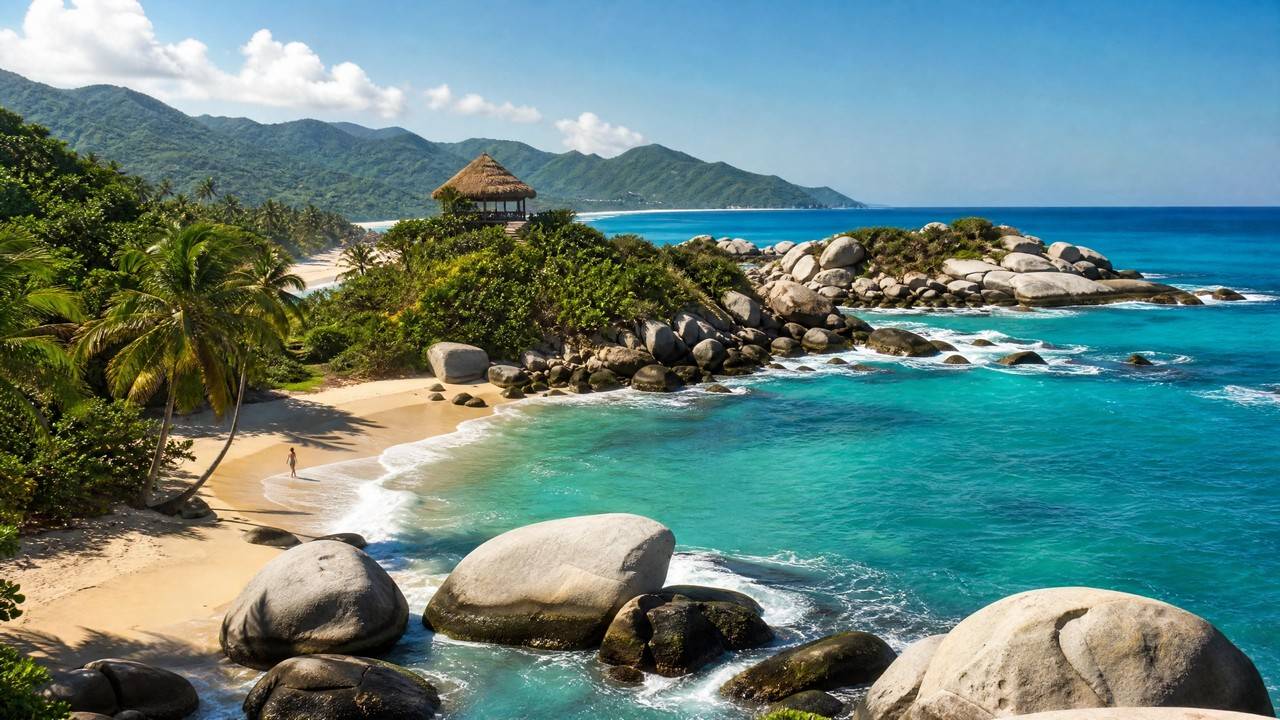
Parque Nacional Natural Tayrona
Parque Nacional Natural Tayrona sits at the foot of the Sierra Nevada de Santa Marta on the Caribbean, a national park (IUCN II) of about 225 km² including ~3,000 ha of sea. Its signature is the world's highest coastal range tumbling straight into turquoise water: rainforest runs down to white-sand bays, with corals and turtles in clear water. The park preserves the ancient Tayrona stone ruins of Pueblito (Chairama), and forest and coast trails meet howler monkeys, toucans and iguanas. It is the celebrated natural and cultural treasure of the Santa Marta region — ecotourism and beach holiday in one.
National Park & Nature

Ciudad Perdida (Lost City)
Ciudad Perdida, the Lost City (called Teyuna by indigenous peoples, also Buritaca 200), hides in the cloud forests of the Sierra Nevada de Santa Marta in northern Colombia—one of the largest pre-Columbian sites in the Americas. Built by the Tayrona around 800 CE, some 650 years before Machu Picchu, it comprises 169 circular terraces and about 1,200 stone steps climbing to the ridge the Kogi still call the heart of the world. Lost to jungle for centuries, it was stumbled upon in 1972 when a local looter family, Los Sepúlvedas, followed a fallen wild turkey to an exposed staircase; gold figurines and urns soon surfaced on the black market, drawing anthropologists who reached and cleared the site between 1976 and 1982. It remains sacred to the Kogi, Wiwa, Arhuaco and Kankuamo, who once numbered 2,000–8,000 people here. There is no shortcut: from Santa Marta, a 4–6 day trek with licensed guides crosses rivers and ridges, camping by the streams, before you climb those steps to look down on the terraces—sweat and mud are the price of Colombia's Machu Picchu. Along the way, macaws, tree frogs and orchids thread through the rainforest, making the route a rare blend of living ecology and ancient stone. The Sierra Nevada de Santa Marta is the world's highest coastal mountain range; the Kogi regard the whole massif as the 'heart of the world' and a trust placed in humanity to protect it. Only 30–40% of the region's archaeological sites have been explored, and new 'lost cities' keep emerging through LiDAR surveys. For many travellers who have done both, Ciudad Perdida feels rawer and more authentic than its Peruvian counterpart—there are no trains or buses, only mud, river and stone.
Historic Ruins & Heritage

Cathedral Basilica of Santa Marta
The Santa Marta Cathedral (Basilica of Santa Marta, formally Catedral Basílica Menor de Santa Marta) stands on Plaza de la Catedral in the historic centre of the Caribbean port of Santa Marta—the present cathedral of one of South America's earliest dioceses (approved by Charles V in 1529). Santa Marta itself, founded by Rodrigo de Bastidas in 1525, is among the oldest colonial cities on the continent. The existing white church is not the original colonial chapel: it was founded on 8 December 1766 at the initiative of Bishop Nicolás Gil Martínez Malo and Governor Andrés Pérez, designed by architect Juan Cayetano Chacón and engineered by Antonio Marchante, completed in 1786, and raised to a Minor Basilica by Pope Pius XI in 1930. The façade is a Renaissance-Neoclassical compromise with a left rectangular bell tower and a rear central dome; heavy square columns support a three-aisled basilica nave that casts dappled shadow in the tropical sun. Two poignant histories of 'resting' define the church: the tomb of the city's founder Rodrigo de Bastidas, reinterred here from the Dominican Republic in 1953; and the remains of Liberator Simón Bolívar, who died in 1830 and lay in the crypt here until 1842, when they were moved to Caracas. Free and open to the public today, the cathedral is quietly kept, with bilingual plaques around the plaza—an ideal starting point for Santa Marta's old town and its colonial and independence story. From the church, a short walk through the old town's colourful Caribbean-colonial streets reaches the Tairona Gold Museum and the seafront promenade, where the white façade stands out sharply in the afternoon sea breeze.
Church & Religious Site

Ciudad Perdida
The 'Lost City' of Teyuna was built by the ancestors of the Tayrona around the 9th century, deep in the Sierra Nevada de Santa Marta, hidden in cloud and jungle—older than Machu Picchu. Hundreds of stone steps, circular plazas and terraced settlements climb along the Buritaca River, reachable only after a 4–6 day trek. The journey crosses indigenous territory, fording streams and waterfalls—among South America's most demanding yet awe-inspiring archaeological expeditions. On the return, local guides chant blessings, and one feels the millennia-old spirituality of this sacred place.
Old Town & Historic District

Minca
Tucked into the foothills of the Sierra Nevada de Santa Marta at about 650 m, Minca sits just 15 km of winding road from the Caribbean yet feels worlds cooler than the coast. This former coffee village has become the mountain base of choice for birders and backpackers: the Sierra Nevada is among the world's highest coastal ranges, with hundreds of bird species recorded, and Minca's coffee farms, blue swimming holes and mountaintop lookouts stitch together a perfect eco day trip. Morning mist climbs out of the valley; at dusk the whole Santa Marta coastline glitters far below — northern Colombia at its most restorative.
Old Town & Historic District

Taganga
Taganga is a fishing village reached only by crossing a dry headland north of Santa Marta, its crescent bay crowded with wooden boats and dive shops. It is famous as one of the cheapest places on earth to earn open-water certification: the water stays warm year-round, teaching reefs sit close to shore, and prices undercut most of the Caribbean. The village keeps a rough-and-ready fishing-town character, with hostels and hammock beds scattered up the hillside; at dusk boats return and beach grills light up in a pace best described as weightless. Nearby Playa Grande, reached by coastal path or boat, outshines the village bay for sand and water.
Old Town & Historic District
🎯 Santa Marta Experiences
Lost City
Ancient city in the jungle.
Sierra Nevada Snow Mountain
Snow peaks by the sea.
Colonial Old Town
Ancient port city.
Taganga Fishing Village
Colorful fishing village.
Jungle Trek
Unforgettable expedition.
Santa Marta is hot year-round; the best time to visit is Dec–Mar, with temperatures around 23–31°C. July is hottest (up to 33°C), so pack sun protection and drink plenty of water.
🚌 Transport & Stays
City Transport
✈️About 20-30 min (reference)
Santa Marta Airport
Caribbean gateway
About 20-30 min (reference)
🥾About 4-5 days (reference)
Lost City Trek
Depart with guided group
About 4-5 days (reference)
🚗Per ride (reference)
Taxi / Private Car
Suburbs & parks
Per ride (reference)
🚌By schedule (reference)
Bus
To Cartagena etc.
By schedule (reference)
Recommended Stay Areas
🏘️ Santa Marta Old Town (first choice)
Near seaside sights
🌊 Rodadero Beach
Seaside resort area
🎣 Taganga
Fishing village, good value
🌿 In Minca mountains
Near the Sierra Nevada
Free Consultation
Want to plan your Santa Marta trip in more depth?
Tell us your departure city, travel dates and interests, and Usitour will tailor a trip just for you.