📍 Destination Overview
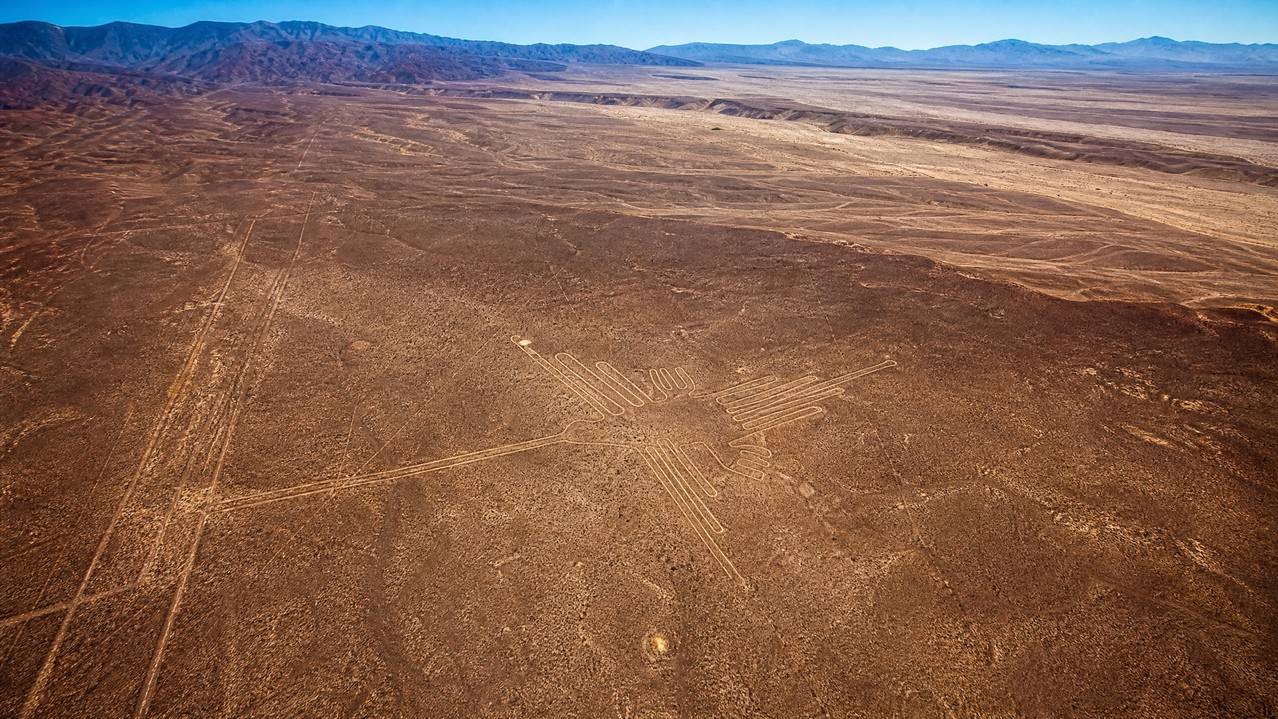
Nazca, in the coastal desert of southern Peru, is famed for the mysterious giant geoglyphs across the plain. The Nasca civilization carved hundreds of immense animal and geometric figures that stretch for kilometres and can only be seen from the air; their purpose and construction remain an enigma. Flying over these millennia-old masterpieces is the most breathtaking experience.
🛩️ Location
Peru · Ica Region · enigmatic town in the southern coastal desert
🗓️ Best Season
Apr-Oct
🕐 Time Difference
13 hrs behind Beijing
💰 Currency / Language
Peruvian Sol (PEN) / Spanish
🕐 Suggested Duration
1 day · scenic flight + Inca aqueducts
🔌 Outlet / Voltage
Type A/C outlets · 220V · most Chinese two-pin plugs fit
☀️ Best Time to Visit & Climate
🌤️ Dry Season: Apr–Oct
Outdoor activities
🌤️ Rainy Season: Nov–Mar
Nov–Mar sees some rain — the desert lines are best on dry days.
Jan
☀️
30°/17°
Feb
☀️
31°/18°
Mar
☀️
30°/17°
Apr
🌤️
29°/14°
Best
May
🌤️
27°/12°
Best
Jun
🌤️
25°/11°
Best
Jul
🌤️
24°/10°
Best
Aug
🌤️
25°/11°
Best
Sep
🌤️
26°/11°
Best
Oct
☀️
27°/12°
Best
Nov
☀️
28°/13°
Dec
☀️
29°/15°
📷 Top Attractions
Nazca Lines
The Nazca Lines are giant geoglyphs on the Nazca plateau of southern Peru, etched by the Nazca culture (c. 500 BC – 600 AD) into the arid desert — over 800 straight lines, geometric figures and biomorphic images like the hummingbird, spider, monkey and 'astronaut.' Their scale demands viewing from a small plane.
Historic Ruins & Heritage

Didactic Museum Antonini
The Antonini Museum, located in the Chiado district of Lisbon, Portugal, is the former residence of the 18th-century Portuguese nobleman Antonini, now a museum displaying Lisbon urban life and Portuguese noble culture. The building was rebuilt in the Pombal style after the 1755 earthquake, with the interior retaining the original appearance of an 18th-century noble residence. It displays antique furniture, Portuguese painted tiles, silver, porcelain, and family portraits. Though small in scale, the museum is exquisite and elegant, offering a glimpse into the lifestyle of Lisbon's nobility during the Pombal era. It is an important stop on the Chiado cultural walking route, providing visitors with an intimate look at Portuguese aristocratic life and the decorative arts that defined the era.
Museum

Cantalloc Aqueduct
The Cantalloc Aqueducts sit on the Nasca plateau of Peru, a subterranean water system engineered by the Nasca culture around 1,500 years ago. Along the buried channels the builders raised spiral ventilation shafts — still-visible funnel-shaped wells — that drew groundwater from the aquifer and allowed crews to descend for cleaning and repair. Parts of the system still irrigate oasis farmland today. Wandering among the great funnel mouths scattered like stars across the desert reveals the hydraulic genius with which the Nasca tamed aridity to sustain a civilization, and helps explain the water logic behind the famous Nasca lines.
Historic Ruins & Heritage

Chauchilla Cemetery
Chauchilla Cemetery lies deep in the Nazca desert of southern Peru, a pre-Inca burial ground famed for its naturally mummified remains. The hyper-arid climate desiccated the bodies so completely that they survived for nearly a millennium, and visitors walking the wooden boardwalks can see fetal-positioned mummies with hair and burial wrappings still intact, alongside scattered ceramics. In the hushed silence of the dunes, the site speaks of how the Nazca and neighboring cultures understood death, the afterlife and the natural world.
Historic Ruins & Heritage
🎯 Nazca Experiences
Scenic Flight
Overlook the millennia-old geoglyphs from the air.
Viewing Tower
See the patterns from the ground.
Inca Aqueducts
The wisdom of ancient waterworks.
Chauchilla Cemetery
Mummies of the desert.
Huacachina
Sandboarding at the desert oasis.
In the Southern Hemisphere, Nazca's coastal desert climate is dry year-round with little rain. Scenic flights are best in the early morning when the air is stable and light is good (small planes can be bumpy; bring remedies if prone to motion sickness). Day-night temperature swings are large. You can combine with the Huacachina Oasis.
🚌 Transport & Stays
City Transport
🛩️Varies by package (reference)
Small Plane
Sightseeing flight over the geoglyphs
Varies by package (reference)
🚌Varies by class (reference)
Long-distance Bus
Connects Lima and Ica
Varies by class (reference)
🚗Starting fare varies by distance (reference)
Taxi / Private car
Town and surroundings
Starting fare varies by distance (reference)
🚶—
Walking
Walk to the viewing tower
—
Recommended Stay Areas
🛩️ Nazca Town (Recommended)
Near the airport, convenient for scenic flights
🌴 Huacachina
Resort at the desert oasis
🏜️ Ica
City near the oasis
🚌 Around the Station
Convenient for trips
Free Consultation
Want to plan your Nazca trip in more depth?
Tell us your departure city, travel dates and interests, and Usitour will tailor a trip just for you.