🌏 Destination Overview
At the heart of Peru lies the lost city suspended in the clouds—Machu Picchu. As morning mist lifts from the mountains, the Inca citadel unfolds before your eyes, a lifelong dream for countless travelers. Cusco's Inca capital overlaps with colonial churches, the Rainbow Mountain's colorful bands astonish, and on Lake Titicaca float islands built of reeds. World heritage and classic hikes converge here, and Peruvian cuisine has surged in global popularity—making it a must-visit for any South American cultural journey.
🗓️
Best Season
May-Sep (Dry season)
🕐
Recommended Days
8-12 days
👪
Best For
Culture Lovers / Hikers / In-depth Travel
🎯
Top Activities
Ruins · Highlands · Hiking · Cuisine
🧳
Pre-trip Preparation
Visa + Altitude Sickness Prevention
Popular Cities

Cusco
Old Town,Inca,UNESCO
🔥 Inca ancient capital, UNESCO city where colonial and Inca layers overlap.
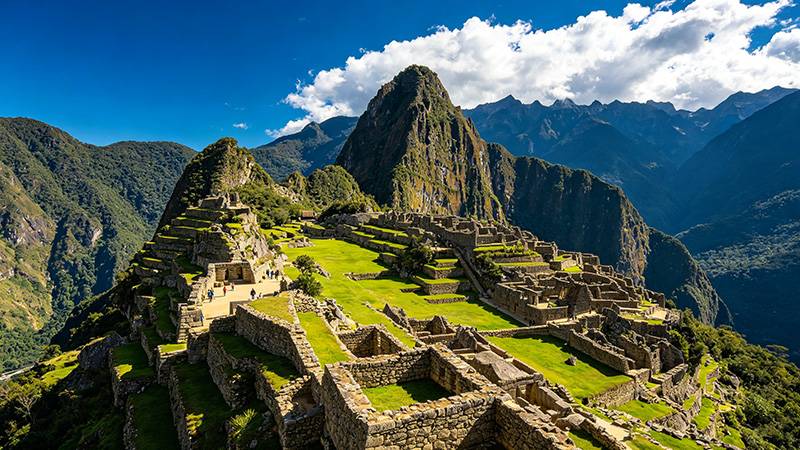
Machu Picchu
Inca,UNESCO,Landmark
🔥 The lost Inca city in the clouds, South America's most iconic wonder.

Lima
Capital,Food,Gateway
🔥 Peru gateway and food capital, colonial old town and waterfront.

Arequipa
White City,Volcano,UNESCO
🔥 White volcanic stone city, Colca Canyon and condor gateway.

Sacred Valley
Inca,Terraces,Ruins
🔥 The Sacred Valley of the Incas, with Ollantaytambo terraces and Pisac market.

Nazca
Geoglyphs,UNESCO,Mystery
🔥 Mysterious Nazca Lines, giant geoglyphs best viewed from the air.
Popular Attractions
More Attractions →
Plaza de Armas📍 Lima
Lima's Plaza de Armas, also called Plaza Mayor, is the birthplace of the Peruvian capital: on 18 January 1535 Pizarro laid out the city here, and the square and its radiating streets survive in that layout today. On 28 July 1821 San Martin proclaimed Peru's independence from this square. It is the core of the Historic Centre of Lima, a World Heritage Site inscribed in 1988 and extended in 1991.
Each side of the square has something. The Government Palace on the north side, also called the House of Pizarro, takes a whole block with an intense yellow neocolonial facade built in 1938 over Pizarro's original 1535 residence. The Archbishop's Palace of 1924 on the east side carries the most elaborate carved wooden balconies in the historic centre. The Municipal Palace sits on the southeast.
The bronze fountain at the centre was cast in 1650 and is Lima's oldest public sculpture as well as the oldest fountain in the Americas still standing in its original location.
The Cathedral of Lima to the east was begun in 1535, rebuilt after the earthquakes of 1687 and 1746, and took its present form by 1797, with twin towers about 40 metres high. Inside are fourteen side chapels, gilded colonial altarpieces and a seventeenth-century carved wooden choir stall, among the finest colonial woodwork in the Americas.
The most interesting story here is a correction. For nearly a century the church displayed the wrong mummy. In 1977 workers found a lead box in the crypt containing Pizarro's skull and the hilt of his sword, with an inscription identifying him. DNA analysis completed in 1984 now puts the remains at roughly a ninety per cent chance of being authentic, meeting Peru's legal standard for verification. They lie in a glass case beside the main altar.
The two best moments of the day are around midday and after dark. The guard change at the Government Palace starts with a trumpet call at about 11:45 and runs thirty to forty minutes with infantry, cavalry and a military band, free but needing a spot fifteen to thirty minutes early. After dark the facades are lit and the colonial arcades plus the fountain give Lima's classic image. Half a block away the Convent of San Francisco holds catacombs where some 25,000 remains are stacked in geometric patterns.

Islas Ballestas📍 Pisco
The Islas Ballestas are a cluster of rocky islets off the Paracas Peninsula in Peru, protected alongside the Paracas National Reserve. Three main islands covering just 0.12 square kilometres host dense colonies of guanay cormorants, Peruvian boobies and pelicans, thousands of South American sea lions, and endangered Humboldt penguins—hence the nickname 'the Poor Man's Galapagos'. En route the boat passes El Candelabro, a geoglyph about 170 metres tall and 78 metres wide carved into the cliff, its origin a mystery and possibly an ancient sailors' marker. Wind and waves have sculpted natural arches, caves and bridges—the islands' most photogenic features. To protect the habitat, landing and swimming are forbidden: you view everything from the boat over about two hours. Guano mining in the 19th century brought Peru enormous wealth, and deposits still pile tens of metres deep.

Qorikancha📍 Cusco
Qorikancha (Quechua for 'golden courtyard') was the most important religious temple of the Inca Empire, in the heart of historic Cusco. In Inca times its walls and floors were sheathed in gold plates, its garden held gold statues of animals, plants and corn, and a golden sun disc cast light into chambers aligned to the solstices — all dedicated to Inti, the sun god, alongside Mama Killa and the lightning god. The Spanish stripped the gold in 1533, dismantled the temple and raised the Santo Domingo convent on the Inca foundations. The church was rebuilt after the 1650 earthquake, yet the Inca base survived intact — the 1950 quake cracked the colonial building and re-exposed the temple chambers visitors walk through today. The layered Inca-and-colonial fabric, plus a small solar observatory in the courtyard, makes Qorikancha the clearest witness to Cusco's intertwined past. A flat 5–8 minute walk from Plaza de Armas, an hour covers it comfortably.

Machu Picchu
Machu Picchu, the 15th-century Inca 'lost city', rides an Andean ridge about 80 km northwest of Cusco at roughly 2,430 metres, wrapped in cloud forest. The city follows the mountain's contours: temples of mortarless masonry — the Temple of the Sun, the Intihuatana and the Temple of the Three Windows — have survived centuries of earthquakes without a crack, and more than 200 structures spread across terraces and stairways until the outside world rediscovered it in 1911. On clear mornings, when the mist lifts, the stone city seems to float above the Urubamba gorge. A UNESCO World Heritage Site and New Seven Wonder, it enforces named, time-slotted entry with daily caps (4,500 low season, 5,600 high season). Book tickets and trains well ahead — 3–4 months for peak dates, 5–6 months for Huayna Picchu — and only through the official portal, tuboleto.cultura.pe.

Lake Titicaca📍 Puno
Lake Titicaca is a highland giant on the Peru–Bolivia border at 3,812 metres — the largest lake in South America and the highest navigable lake on Earth. More than 80 Uros floating islands are woven from totora reed, 1–2 metres thick and constantly renewed on top, springing like a damp mattress underfoot; on Taquile, islanders still weave on Inca belt looms, men knitting as they walk, in a tradition UNESCO has listed as intangible heritage; Amantani opens homestays where quinoa, lake trout and unpolluted stars come with the room. Between water and distant mountains lies a living museum of millennia-old Indigenous lake life — and, in Andean belief, the lake of creation itself. Afternoon chop builds on the water, so take the early boats.

Rainbow Mountain📍 Cusco
Vinicunca — Rainbow Mountain, or Montana de Siete Colores ('mountain of seven colours') — is one of Peru's most startling natural wonders. At about 5,200 metres, oxidised iron and sulfur in the rock paint the ridge in red, yellow, green and white bands, like a spilled palette; viral since 2016, it is now Cusco's hottest nature attraction. The round trip from the trailhead runs 7–8 km, one and a half to two hours uphill, with horses covering part of the way. Colours peak between 5:00 and 10:00, entry closes at 14:00, and once afternoon clouds settle the view is gone. Register online with the Cusipata municipality a few days ahead and bring cash — and respect the altitude: acclimatise in Cusco or the Sacred Valley for two or three days before going up.
Classic Experiences
Best Travel Seasons
🌤️
Dry season · May-Sep
Clear and dry, best for hiking
📅
Transition · Apr/Oct
Fewer crowds and better prices, occasional showers
🌧️
Rainy season · Nov-Mar
Rainy, Inca Trail closed in February
📅
Highlands · Year-round
Large day-night temperature swings, keep warm
The dry season (May-Sep) is clear and dry, ideal for hiking; the Inca Trail closes each February for maintenance.
Popular Guide Articles
More →Practical Info
Depends on passport/departure country; check the latest visa and entry policy before travel
Peruvian Sol (PEN), USD accepted
Peru time UTC-5
220V, Type A/C outlets
Cusco reached by train/bus up the mountain; intercity flights available
Obey local laws, mind personal belongings; emergency 105 (police)/106 (ambulance)
Free Consultation
Free Consultation
Tell us your departure city, travel dates and interests, and Zou Sifang will tailor a trip just for you.