📍 Destination Overview
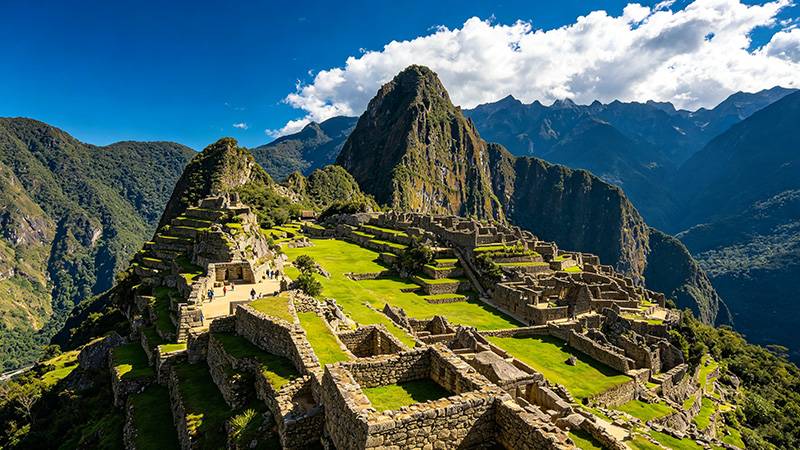
Machu Picchu sits on a misty Andean ridge some 2,400 meters up, the Incas' most magnificent legacy, known as the lost city, a dual UNESCO site and New Seven Wonder. Terraces, stone temples and the Intihuatana show Inca architecture at its peak, with Huayna Picchu behind. Reachable by train to Aguas Calientes then bus, or via the Inca Trail.
🏔️ Location
Peru · Cusco Region · Inca ruins atop the misty Andes
🗓️ Best Season
Feb / May-Sep
🕐 Time Difference
13 hrs behind Beijing
💰 Currency / Language
Peruvian Sol (PEN) / Spanish & Quechua
🕐 Suggested Duration
1-2 days · ruins + Huayna Picchu
🔌 Outlet / Voltage
Type A/C outlets · 220V · most Chinese two-pin plugs fit
☀️ Best Time to Visit & Climate
🌤️ Dry Season: May–Sep
Sunny with little rain — clear views.
🌧️ Feb
Inca Trail usually closed for maintenance.
Jan
🌧️
22°/12°
Feb
🌧️
22°/12°
Good
Mar
🌦️
22°/11°
Apr
🌤️
23°/11°
May
☀️
23°/10°
Best
Jun
☀️
22°/9°
Best
Jul
☀️
22°/8°
Best
Aug
☀️
23°/9°
Best
Sep
🌤️
23°/10°
Best
Oct
🌦️
23°/11°
Nov
🌦️
23°/11°
Dec
🌧️
22°/12°
Machu Picchu Tours
View All →![[Peru·Private Small Group Exploration 7-Day Tour] Lima + Cusco + Amazon | Chinese private tour in Lima city | Four-star hotel | Full breakfast | Scenic train (English charter)](https://qiniu.usitour.com/images/picture/2019/09/detail_45_5d805743a86c8.jpg?imageView2=2&w=1920&q=70&format=webp)
[Peru·Private Small Group Exploration 7-Day Tour] Lima + Cusco + Amazon | Chinese private tour in Lima city | Four-star hotel | Full breakfast | Scenic train (English charter)
From $2544
![[Peru - Private Small Group In-Depth 9-Day Tour] Lima City Tour + Amazon + Cusco Old Town Tour + Machu Picchu + Sacred Valley | 4-Star Hotel | Sightseeing Train | Whole Breakfast (English Charter)](https://qiniu.usitour.com/images/picture/2019/08/detail_88_5d66b49256836.jpg?imageView2=2&w=1920&q=70&format=webp)
[Peru - Private Small Group In-Depth 9-Day Tour] Lima City Tour + Amazon + Cusco Old Town Tour + Machu Picchu + Sacred Valley | 4-Star Hotel | Sightseeing Train | Whole Breakfast (English Charter)
From $2802
![[Peru - Private High-End Small Group Panorama 11-Day Tour] Lima + Cusco + Machu Picchu + Sacred Valley + Amazon + Lake Titicaca | Lima City Chinese Private Group | 4-Star Hotel | Whole Breakfast (English Charter)](https://qiniu.usitour.com/images/picture/2017-10/detail_47_1507679896.jpg?imageView2=2&w=1920&q=70&format=webp)
[Peru - Private High-End Small Group Panorama 11-Day Tour] Lima + Cusco + Machu Picchu + Sacred Valley + Amazon + Lake Titicaca | Lima City Chinese Private Group | 4-Star Hotel | Whole Breakfast (English Charter)
From $3275
[Peru - Private High-End Small Group Fun 10-Day Tour] Lima + Cusco + Machu Picchu + Sacred Valley + Iquitos Amazon | Lima City Chinese Private Group | 4-Star Hotel | Whole Breakfast (English Charter)
From $3082
![[Peru - Private Small Group Luxury 9-Day Tour] Lima + Cusco + Machu Picchu + Sacred Valley + Lake Titicaca | Lima City Chinese Guide | 4-Star Hotel | Whole Breakfast | Sightseeing Train (English Charter)](https://qiniu.usitour.com/images/picture/2019/09/detail_69_5d850cfb7399f.jpg?imageView2=2&w=1920&q=70&format=webp)
[Peru - Private Small Group Luxury 9-Day Tour] Lima + Cusco + Machu Picchu + Sacred Valley + Lake Titicaca | Lima City Chinese Guide | 4-Star Hotel | Whole Breakfast | Sightseeing Train (English Charter)
From $2313
![[Peru·High-end small group classic 8-day tour] Lima + Cusco + Machu Picchu + Sacred Valley | Lima city is chartered in Chinese | Four-star hotel | Full breakfast | Scenic train (Chartered in English)](https://qiniu.usitour.com/images/picture/2019/09/detail_31_5d83c4db3d940.jpg?imageView2=2&w=1920&q=70&format=webp)
[Peru·High-end small group classic 8-day tour] Lima + Cusco + Machu Picchu + Sacred Valley | Lima city is chartered in Chinese | Four-star hotel | Full breakfast | Scenic train (Chartered in English)
From $2120
📷 Top Attractions
More Attractions →
Machu Picchu
Machu Picchu, the 15th-century Inca citadel perched on an Andean ridge 80 kilometres northwest of Cusco at 2,430 metres, is Peru's greatest wonder. The dry-stone walls of the Temple of the Sun, the Intihuatana and the Temple of the Three Windows still fit so tightly that no mortar was needed. Arrive at dawn to watch the mist lift over the Urubamba Valley, and book your timed, name-dated ticket well in advance.
Historic Ruins & Heritage

The Temple of the Sun
The Temple of the Sun is the most sacred structure at Machu Picchu, crowning the Inca citadel with its curved, perfectly fitted stone walls—no mortar was used. On the June solstice, sunlight enters through a window and illuminates the altar, evidence of the Incas' astronomical mastery. Inside is a carved rock thought to mark the winter solstice, while below lie the Royal Tomb's ceremonial caves. Seen against the surrounding peaks, the temple embodies Inca reverence for the sun and the Andean landscape.
Historic Ruins & Heritage
Machu Picchu Mountain
Machu Picchu, meaning 'Old Peak' in Quechua, is the most iconic citadel of the Inca Empire, perched about 2,430 m above sea level in the Andes of Cusco, Peru. Built in the 15th century and later abandoned, this 'Lost City of the Incas' is famed for its masterful dry-stone walls, terraces and ceremonial structures. A UNESCO World Heritage Site since 1983 and one of the New Seven Wonders of the World, its highlights include the Intihuatana (hitching post of the sun), the Temple of the Three Windows and the Royal Sector. Arrive via scenic train from Cusco or Aguas Calientes and enter through the Sun Gate (Intipunku) for a sweeping view of the terraces above the Urubamba Valley. Plan at least half a day to explore.
Historic Ruins & Heritage

Temple of the Condor
The Temple of the Condor is one of Machu Picchu's most symbolic structures, carved into a single boulder in the Sacred Rock district. Its outspread "wings" and a grooved basin form the outline of a condor in flight — the bird Andean peoples revered as the lord of the sky. A cave beneath is thought to have held prisoners or served sacrificial rites. Watch your footing on the steep Inca stairs. Best appreciated with a guide who explains the site's religious significance.
Historic Ruins & Heritage
The Sacred Rock
The Sacred Rock is a boulder at the north end of Machu Picchu, its outline mirroring Huayna Picchu, a symbol of Inca mountain worship.
Historic Ruins & Heritage

Huayna Picchu/Wayna Picchu
Huayna Picchu is the iconic peak behind Machu Picchu; the steep climb rewards hikers with a full view of the Inca citadel and the Urubamba valley, plus little-known ruins at the summit.
National Park & Nature
🎯 Machu Picchu Experiences
Ruins Tour
The awe of the cloud-top Inca city.
Climb Huayna Picchu
Overlook the whole ruins.
Morning Mist
Mysterious misty views.
Inca Trail
Arrive via the classic trek.
Temple of the Sun
The exquisite Inca stonemasonry.
In the Southern Hemisphere, Machu Picchu's dry season (May-Sep) is clear and dry with the best views. Early morning mist is the most mysterious. Tickets must be booked in advance with daily limits, and Huayna Picchu requires a separate ticket. The Inca Trail is often closed for maintenance in February.
🚌 Transport & Stays
City Transport
🚆Varies by class (reference)
Sightseeing Train
Cusco to Aguas Calientes
Varies by class (reference)
🚌Varies by schedule (reference)
Shuttle Bus
Aguas Calientes to the ruins entrance
Varies by schedule (reference)
🥾Varies by itinerary (reference)
Inca Trail
Multi-day trek requires advance booking
Varies by itinerary (reference)
🚶—
Walking
Walk within the ruins
—
Recommended Stay Areas
🏘️ Aguas Calientes (Recommended)
Gateway at the foot of the mountain, convenient for sunrise
🌿 Sacred Valley / Ollantaytambo
Transfer point for the train
⛲ Cusco
Base city for round trips
⭐ Hotels by the ruins
Upscale, near the entrance
Free Consultation
Free Consultation
1-on-1 travel consultant customizes your Machu Picchu trip for free based on your schedule and preferences.