📍 Destination Overview
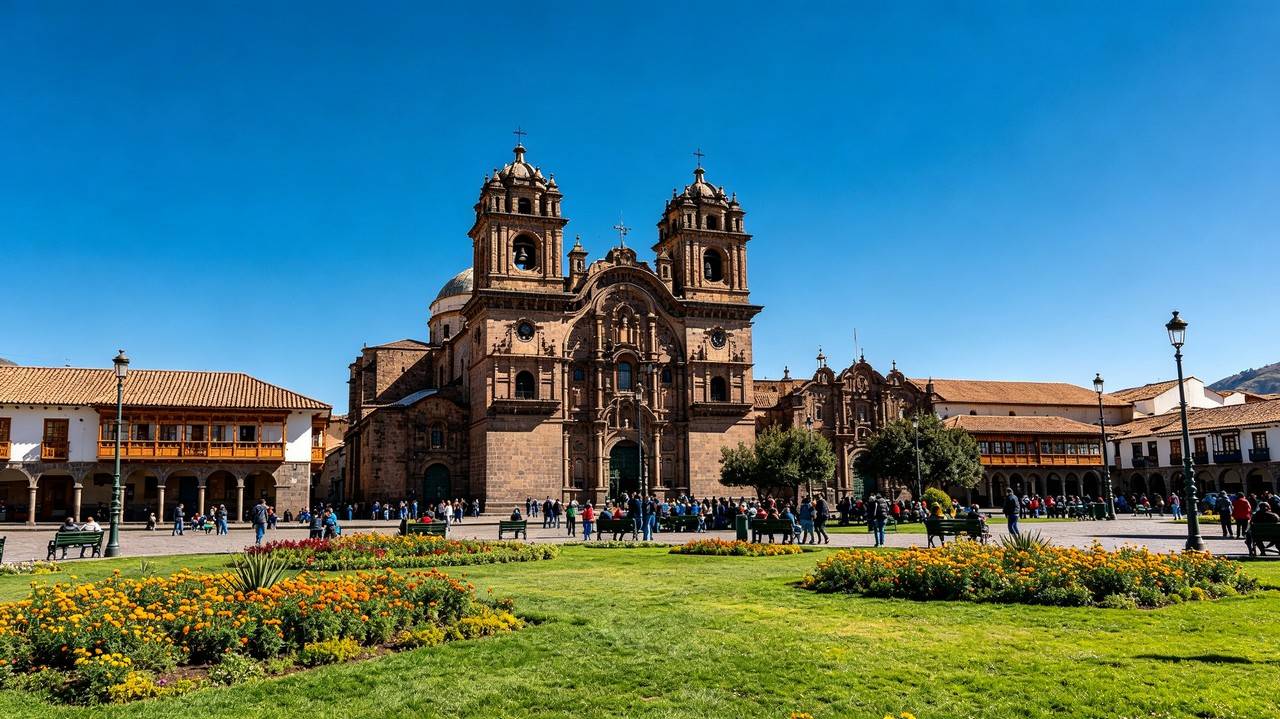
Cusco, on the Andean plateau at about 3,400 metres, was the Inca capital, 'navel of the world' in Quechua, now a UNESCO city and gateway to Machu Picchu. Spanish colonists raised churches on Inca foundations, so grand cathedrals beside the Plaza de Armas stand next to seamlessly fitted walls and the famed twelve-angled stone, while Sacsayhuaman's giant blocks command the hillside.
⛰️ Location
Peru · Cusco Region · Inca ancient capital at ~3,400 m
🗓️ Best Season
May-Sep (Dry season)
🕐 Time Difference
13 hrs behind Beijing
💰 Currency / Language
Peruvian Sol (PEN) / Spanish & Quechua
🕐 Suggested Duration
2-3 days · old town + Sacsayhuaman + acclimatization
🔌 Outlet / Voltage
Type A/C outlets · 220V · most Chinese two-pin plugs fit
☀️ Best Time to Visit & Climate
☀️ Dry season: May–Sep
Blue skies and almost no rain, with days near 20°C and nights down to 0°C—the prime window for the Inca Trail and Machu Picchu.
🌧️ Rainy season: Nov–Mar
Heavy afternoon downpours—the Inca Trail closes in February for maintenance—but valleys glow green, crowds thin and prices drop.
Jan
🌧️
20°/7°
Feb
🌧️
20°/7°
Mar
🌦️
20°/6°
Apr
🌤️
21°/5°
May
☀️
21°/3°
Best
Jun
☀️
21°/1°
Best
Jul
☀️
21°/0°
Best
Aug
☀️
22°/2°
Best
Sep
🌤️
22°/4°
Best
Oct
🌤️
22°/6°
Nov
🌦️
22°/6°
Dec
🌧️
21°/7°
📷 Top Attractions
More Attractions →
Qorikancha
Qorikancha (Quechua for 'golden courtyard') was the most important religious temple of the Inca Empire, in the heart of historic Cusco. In Inca times its walls and floors were sheathed in gold plates, its garden held gold statues of animals, plants and corn, and a golden sun disc cast light into chambers aligned to the solstices — all dedicated to Inti, the sun god, alongside Mama Killa and the lightning god. The Spanish stripped the gold in 1533, dismantled the temple and raised the Santo Domingo convent on the Inca foundations. The church was rebuilt after the 1650 earthquake, yet the Inca base survived intact — the 1950 quake cracked the colonial building and re-exposed the temple chambers visitors walk through today. The layered Inca-and-colonial fabric, plus a small solar observatory in the courtyard, makes Qorikancha the clearest witness to Cusco's intertwined past. A flat 5–8 minute walk from Plaza de Armas, an hour covers it comfortably.
Historic Ruins & Heritage
Rainbow Mountain
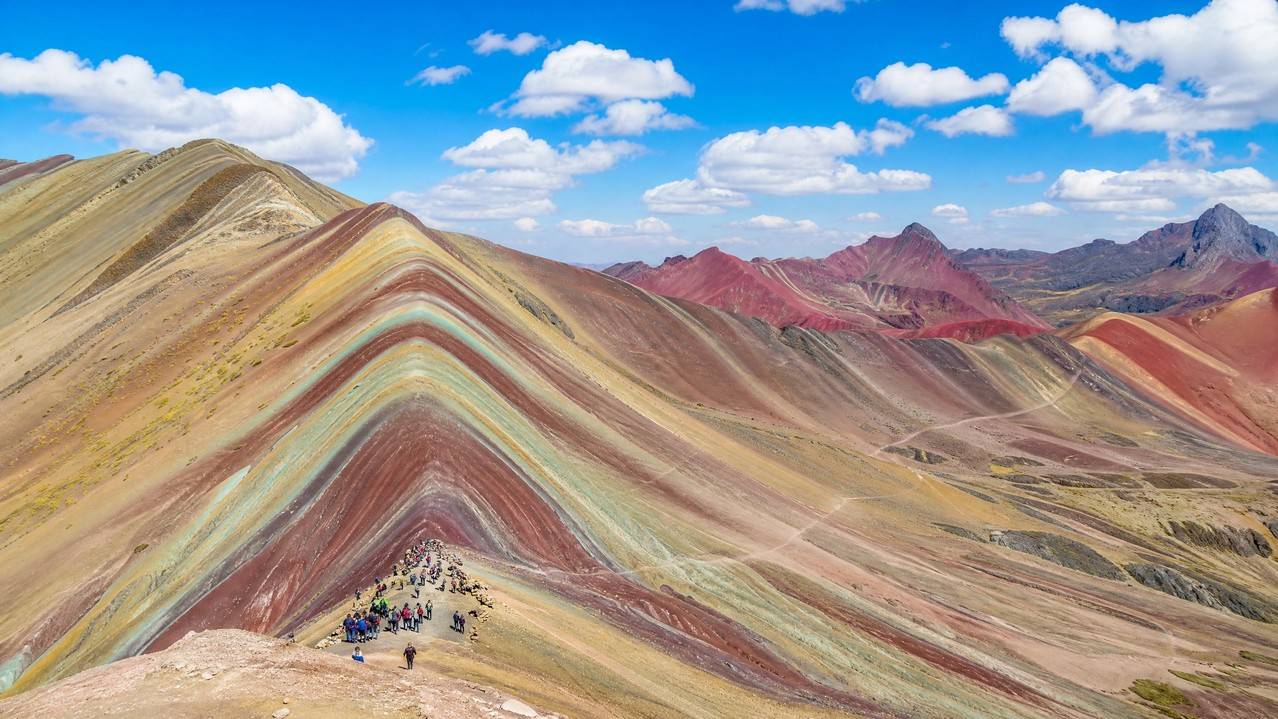
Vinicunca — Rainbow Mountain, or Montana de Siete Colores ('mountain of seven colours') — is one of Peru's most startling natural wonders. At about 5,200 metres, oxidised iron and sulfur in the rock paint the ridge in red, yellow, green and white bands, like a spilled palette; viral since 2016, it is now Cusco's hottest nature attraction. The round trip from the trailhead runs 7–8 km, one and a half to two hours uphill, with horses covering part of the way. Colours peak between 5:00 and 10:00, entry closes at 14:00, and once afternoon clouds settle the view is gone. Register online with the Cusipata municipality a few days ahead and bring cash — and respect the altitude: acclimatise in Cusco or the Sacred Valley for two or three days before going up.
National Park & Nature

Sacsayhuaman
Sacsayhuaman crowns a ridge north of Cusco, Peru, as the most awe-inspiring military fortress of the Inca Empire, famed for its zigzagging walls built of gigantic stones. Individual blocks weigh tens of tonnes — some over a hundred — yet were cut to fit so precisely, without mortar, that the masonry has withstood centuries of earthquakes and conflict. Each June solstice, thousands in traditional dress re-enact the ancient Inti Raymi festival on these ramparts. The site is at once a defensive stronghold and an open-air museum of Inca engineering and cosmology.
Castle & Fortress

Plaza de Armas
Plaza de Armas de Cusco is the historic center of Cusco, Peru. Built on the Haukaypata square of the Inca capital, redesigned by Spanish colonists, with a central fountain, surrounded by the Cathedral and Iglesia de la Compañía, colonial arcades, restaurants and cafes, and as the heart of the Inca capital overlaid with colonial center, it is Cusco's most important public space and witness to Inca-colonial history. The plaza was originally the Haukaypata of the Inca capital — political and religious center of the Inca Empire — redesigned as a colonial Plaza de Armas after the conquest. A fountain stands at center, surrounded by the Cathedral of Cusco (1559-1654, built on Inca Viracocha's palace) and Iglesia de la Compañía (built on Inca Amarucancha palace). Colonial arcades, restaurants, cafes and shops line the square — Cusco's busiest public space. At night, lights illuminate the church facades — pleasant for strolling and dining. Visiting to feel Cusco's dual identity as Inca capital and colonial city in the overlay of Inca heart and colonial square is a historic, lively urban experience.
Square & Landmark

Ollantaytambo
Ollantaytambo is a historic town in Peru's Sacred Valley that is both an Inca archaeological site and a living Inca village. At ~2,800 m elevation in the Andes, it features the imposing hillside Inca temple fortress, well-preserved Inca town layout and water channels, and its role as a key train stop en route to Machu Picchu — one of the Sacred Valley's most popular destinations. The most awe-inspiring feature is the hillside Inca temple — massive red granite blocks perfectly fitted into terraces, temples and a Sun Temple structure, some weighing tens of tons, their transport and precise fitting still an Inca engineering mystery. From the top, views over the town and the Urubamba River in the Sacred Valley. The town below retains its Inca-era grid layout and flowing water channels — one of the few continuously inhabited Inca towns. Ollantaytambo is also a key train departure point for Machu Picchu. Visiting to overlook the Sacred Valley from Inca stonework and step back in time in a living Inca village is an awe-inspiring, unforgettable Peru experience.
Historic Ruins & Heritage

Center for Traditional Textiles of Cusco
The Center for Traditional Textiles of Cusco (CTTC) is a non-profit museum and workshop run by a cooperative of indigenous weavers. It documents the Andean tradition of spinning and weaving alpaca and llama wool, natural dyes and the meanings behind regional patterns. Visitors can watch backstrap-loom weaving in person and buy directly from the communities.
Museum
🎯 Cusco Experiences
Plaza de Armas
The blend of Inca and colonial.
Sacsayhuaman
The awe of the megalithic fortress.
Twelve-angled Stone
The exquisite Inca stonemasonry.
San Pedro Market
The vibrancy of the highlands.
Old Town Stroll
The alleys of Inca stone walls.
In the Southern Hemisphere, Cusco's highland dry season (May-Sep) is clear and dry, best for hiking and sightseeing; the rainy season (Nov-Mar) brings afternoon rain. At about 3,400 m altitude, altitude sickness is common on arrival—move slowly, drink water, avoid strenuous activity, and acclimatize first in the Sacred Valley.
🚌 Transport & Stays
City Transport
✈️Taxi fare varies by distance (reference)
Cusco Airport
About 15 min from downtown
Taxi fare varies by distance (reference)
🚆Varies by class (reference)
Sightseeing Train
To Machu Picchu
Varies by class (reference)
🚗Starting fare varies by distance (reference)
Taxi / Private car
Old town & Sacred Valley
Starting fare varies by distance (reference)
✈️Varies by class (reference)
Domestic Flight
About 1.5 hrs flight from Lima
Varies by class (reference)
Recommended Stay Areas
⛲ Around Plaza de Armas (Recommended)
Close to old town attractions
🏘️ San Blas
Artists' old quarter
🌿 Sacred Valley
Lower altitude, helps acclimatization
🚉 Around the train station
Convenient for Machu Picchu trips
Free Consultation
Want to plan your Cusco trip in more depth?
Tell us your departure city, travel dates and interests, and Usitour will tailor a trip just for you.