📍 Destination Overview
Montevideo, Uruguay's capital on the north bank of the Rio de la Plata, ranks among Latin America's best cities for quality of life. Without Sao Paulo's clamour or Buenos Aires' glamour, it charms with a relaxed mood. The Old Town holds the Legislative Palace and century-old cafes; the Rambla seafront suits strolling. Unhurried and safe, its cafe culture suits real South American life.
🏙️ Location
Uruguay's capital, by the Río de la Plata
🗓️ Best Season
October-March
🕐 Time Difference
11 hours behind Beijing
💰 Currency / Language
Uruguayan Peso (UYU) / Spanish
🕐 Suggested Duration
2-3 days
🔌 Outlet / Voltage
Type C/F · 220V
☀️ Best Time to Visit & Climate
🌞 Spring to Autumn: Oct–Mar
Pleasant, outdoors-friendly
🍂 Autumn to Spring: Apr–Sep
Cooler, wetter
January
🌤️
29°/18°
Best
February
🌤️
28°/18°
Best
March
🌦️
26°/16°
Best
April
🌦️
22°/12°
May
☁️
18°/9°
June
☁️
15°/6°
July
☁️
15°/5°
August
🌤️
17°/6°
September
🌤️
19°/8°
October
🌞
22°/11°
Best
November
🌞
25°/14°
Best
December
🌞
28°/16°
Best
📷 Top Attractions

Plaza Independencia
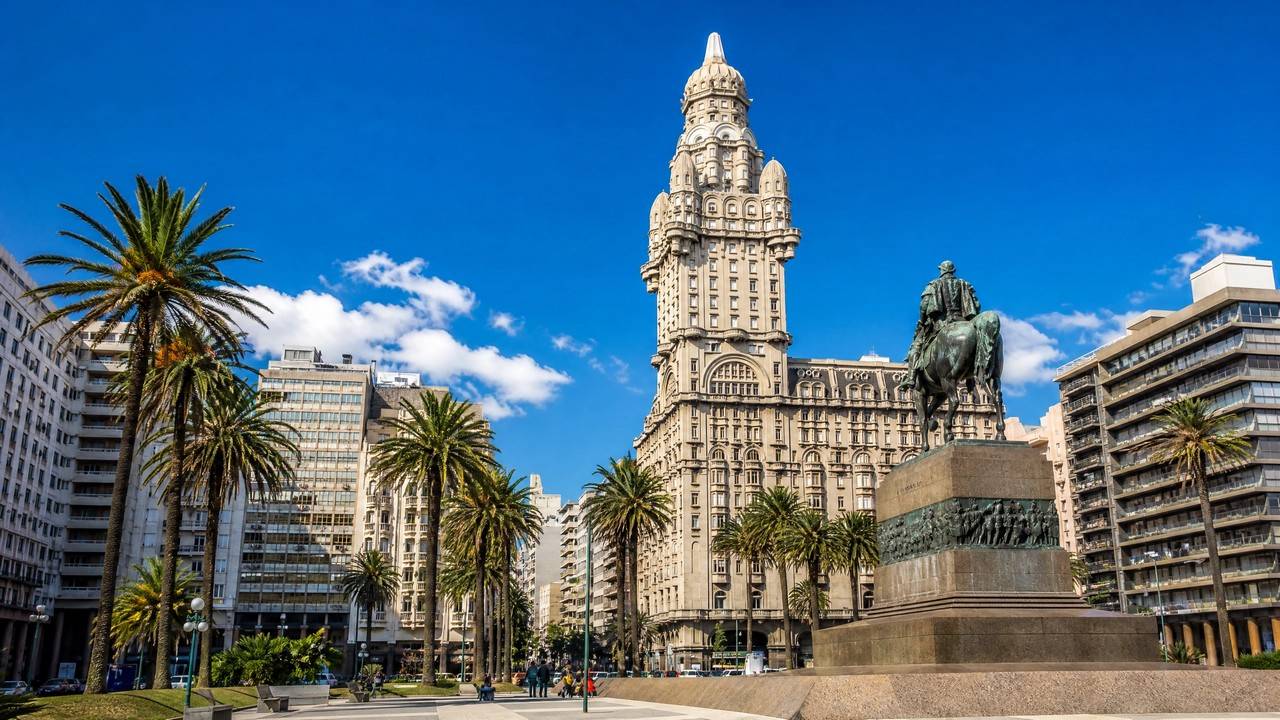
Plaza Independencia is Montevideo's civic heart and historic axis, laid out in 1837 by Italian architect Carlo Zucchi in the plan for the Ciudad Nueva, reportedly inspired by Paris's Rue de Rivoli. It sits exactly on the seam between the Ciudad Vieja and Centro, its pavement marked with the 'one-peso coin' of the city's Km 0. At the centre rises the 1923 Artigas monument: a 17-metre bronze equestrian statue on a granite base flanked by allegories of Law, Liberty, Work and Culture. Directly below, the founding father's mausoleum opened on 19 June 1977 - Artigas's birthday and a national holiday - free to enter down twin granite staircases to the chamber holding Artigas, his mother and his sister, watched by an honour guard from the Cuerpo de Blandengues, his first regiment; the changing of the guard is an attraction in itself. In the early 1900s French landscape architect Carlos Thays laid out four French parterres and rows of palms standing for the Thirty-Three Orientals of 1825. Each side of the square carries a chapter of national history: west, the last citadel gateway and the start of Peatonal Sarandi; east, the 1928 Palacio Salvo, briefly South America's tallest building, and the head of Avenida 18 de Julio; south, the Executive Tower and Estevez Palace; and on the southwest corner the 1856 Solis Theatre. Since 2010 the presidential sash has been handed over here.
Square & Landmark

Ciudad Vieja
Ciudad Vieja is the historic core of Montevideo and one of South America's best-preserved colonial districts. In January 1724 the Spanish governor Bruno Mauricio de Zabala expelled the Portuguese garrison and began settlement, with 24 December 1726 taken as the official founding date; inside the walls of the old Ciudadela fortress, with Plaza Independencia as its landward gate, the old town grew layer by layer over two centuries. Cobbled lanes are lined with neoclassical, art-deco and colonial buildings - the 1928 Palacio Salvo, briefly South America's tallest building, the 1856 Teatro Solis, the Metropolitan Cathedral begun in 1804, the 1812 Cabildo and the 1745 citadel gate - while the harbour-side Mercado del Puerto, a century-old iron arcade, remains the veteran address for asado. Sarandi's pedestrian street, extended in 2005, strings together independent bookshops, antique dealers, cafes and street tango, with craft markets at weekends. Fifteen minutes on foot from the citadel gate to Plaza Matriz is the classic first hour of any visit.
Old Town & Historic District

Museo Torres Garcia
The Museo Torres Garcia at Peatonal Sarandi 683 in Montevideo's old city, just inside the Ciudadela gate, is the first stop for understanding Uruguayan modern art. It is dedicated to Joaquin Torres-Garcia (1874-1949), the artist who moved between Barcelona, Paris and Montevideo and founded Universal Constructivism, fusing European constructivism with pre-Columbian Latin American symbols - his best-known image being a map of South America turned upside down. Founded by his widow Manolita Pina and family, the museum opened on 28 July 1955, his birthday, and since 1990 has occupied a five-storey art-deco building, the former Broqua & Scholberg bazaar. Over 150 oils, drawings, carved wooden toys, manuscripts and thousands of archival documents are laid out by period across the floors, from Barcelona modernisme through Parisian abstraction to his late Montevideo return; a ground-floor library and a basement theatre space host events. Do not miss the rooftop terrace, a quiet corner above the abstract art with views over the red rooftops.
Museum

La Rambla (Montevideo)
Montevideo's La Rambla stretches about 22 km along the Rio de la Plata, from the old port east through Pocitos, Punta Carretas and Ramirez to Carrasco beach - one of the world's longest urban waterfront promenades and the true backbone of Uruguayan life. Joggers and cyclists take the morning breeze; by dusk the lawns and seawall belong to anglers, dog-walking families and locals with their mate gourds. Tired legs can stop at a waterfront bar for a medio y medio - dry white topped with sparkling - and watch the sun sink into the muddy, gentle river. The water is too silty for swimming, but the avenue is a stage for walking, cycling, skating and picnics, and some sections close to cars on Sundays, the moment the city's cyclists wait for all week.
Square & Landmark
🎯 Montevideo Experiences
Old-town stroll
Plazas, murals & lanes.
Asado feast
Grill at the port market.
Riverside sunset
Catch the glow on the water.
Café hopping
Old-school cafés & sunshine.
Montevideo is mild winters and pleasant weather; the best time to visit is Oct–Mar, with temperatures around 11–29°C. Other months range 5–22°C, with fewer crowds and better value.
📰 Travel Guides
More Guides →🚌 Transport & Stays
City Transport
🛫varies
Flight
Carrasco ~20km from downtown
varies
🚌varies
Bus
Links Buenos Aires & beyond
varies
🚢~US$40–70
Ferry
Fast boat to BA / Colonia
~US$40–70
Recommended Stay Areas
🏨 Old town / centro
Close to sights & dining
🏨 Pocitos / coastal
Near beach & the Rambla
Free Consultation
Planning a trip to Montevideo?
Tell us your departure city and dates — USITrip will craft your journey.