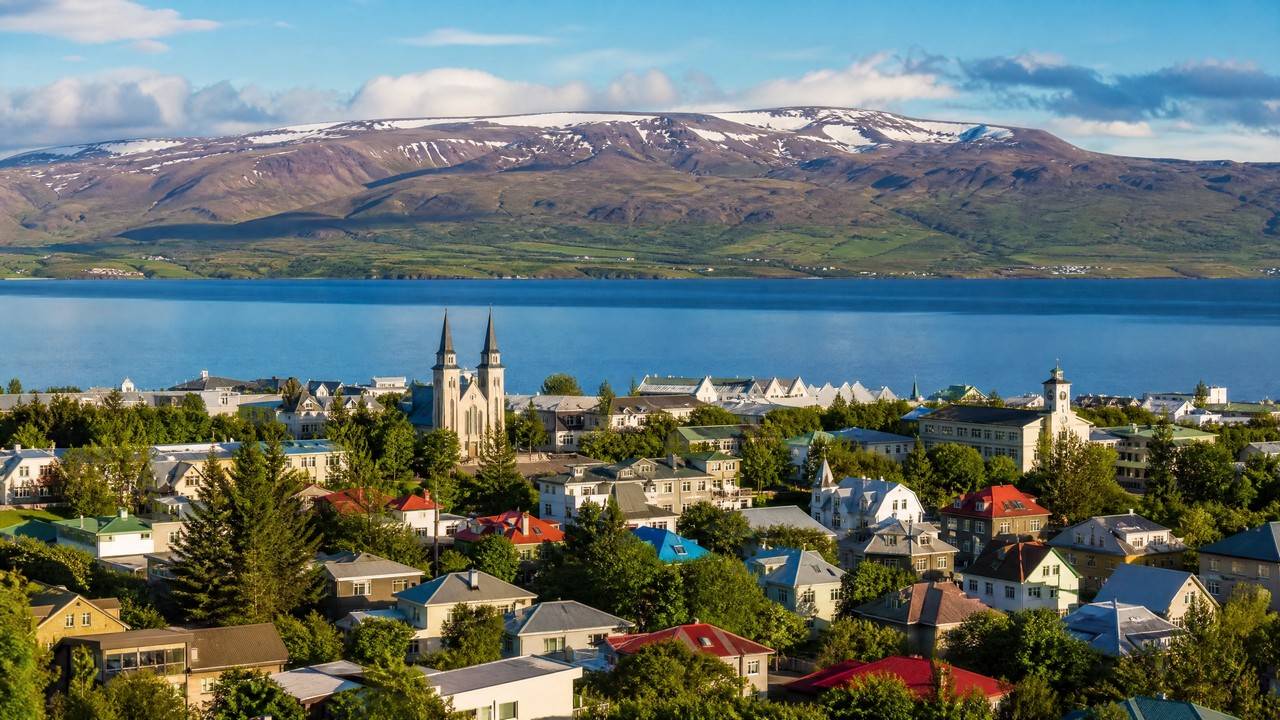
📍 Destination Overview
Akureyri, northern Iceland's largest city and its capital of the North, sits at the head of Iceland's longest fjord, ringed by mountains. It has heart-shaped red traffic lights, a hillside church and one of the world's northernmost botanical gardens. It is the gateway to Godafoss waterfall, the steaming Myvatn volcanic lake and whale-watching Husavik, while winters bring the aurora.
🏔️ Location
Iceland · North · Capital at the End of Eyjafjörður
🗓️ Best Season
Jun-Aug (Summer) / Sep-Mar (Aurora)
🕐 Time Difference
-8 vs Beijing
💰 Currency / Language
Icelandic Króna ISK / Icelandic, English
🕐 Suggested Duration
1-2 days · Fjord City + Goðafoss + Mývatn
🔌 Outlet / Voltage
Type C / F outlets · 230V · adapter needed
☀️ Best Time to Visit & Climate
🌌 Winter: Sep–Mar
Great aurora hunting in the north.
☀️ Summer: Jun–Aug
Long days — fjords and Lake Mývatn at their best.
Jan
❄️
1°/-5°
Aurora
Feb
🌌
2°/-5°
Aurora
Mar
🌌
3°/-4°
Aurora
Apr
🌤️
6°/-1°
May
🌷
10°/3°
Jun
☀️
13°/6°
Best
Jul
☀️
15°/8°
Best
Aug
🌤️
14°/8°
Best
Sep
🌌
10°/4°
Aurora
Oct
🍂
6°/1°
Aurora
Nov
🌌
3°/-3°
Aurora
Dec
❄️
1°/-4°
Aurora
📷 Top Attractions

Akureyrarkirkja
Akureyrarkirkja (the Church of Akureyri) crowns the highest point of Akureyri, the 'capital of northern Iceland', designed by the noted Icelandic architect Gudjon Samuelsson - architect of Reykjavik's Hallgrimskirkja - and completed in 1940. Its stepped concrete facade evokes Iceland's volcanic basalt columns and stands out sharply against the town's low roofline; a long flight of outdoor concrete steps leads to the door, with views over Eyjafjordur and the 'capital of flowers' from the top. Entry is free, with voluntary donations welcomed. Highlights include a large organ of 3,200 pipes; a central stained glass window from Coventry Cathedral in England, given after that cathedral was bombed in the Second World War; bas-reliefs on the nave balcony by the Icelandic sculptor Asmundur Sveinsson; an 1863 altarpiece; a baptismal font modelled on Bertel Thorvaldsen's work; and a traditional model ship hanging from the ceiling, reflecting Iceland's seafaring tradition and the old custom of praying for family at sea. An information sheet near the entrance hall covers the history of the window and the organ. Opening hours are not fixed and shift with services, weddings, funerals and concerts, so follow the notice board at the door; for step-free access there is a side entrance by the rear car park.
Church & Religious Site

Lystigarðurinn Akureyri
Lystigarðurinn, the Akureyri botanical garden, sits in central Akureyri between Þórunnarstræti and Eyrarlandsvegur, south of Akureyri Junior College and north of the district hospital, about a fifteen-minute walk from the centre. It is regarded as the world's northernmost botanical garden, roughly 50 km south of the Arctic Circle. Anna Cathrine Schiöth and her daughter-in-law Margrethe Schiöth drove its creation as a public garden in 1912, and a botanical section was added in 1957. The 3.6-hectare site now holds over 7,000 plant species, around 400 of them native to Iceland and the rest drawn from cold-temperate and alpine regions. The sheltered microclimate of Eyjafjörður and Akureyri's unusually mild summers for its latitude let many species survive here that struggle elsewhere in the country. Gravel paths link native alpine beds, perennial borders and a rock garden, around several of the town's oldest timber buildings including Stórð Eyrarland, once the county council. The LYST café and restaurant at the centre serves year-round, though the toilets close for winter.
Park & Garden

Forest Lagoon
Forest Lagoon sits in the Vaðlaskógur woods just south of Akureyri in northern Iceland, among birch and pine, looking out over Eyjafjörður — one of Iceland's longest and narrowest fjords. It opened in 2022, but the water is not a natural spring: it comes from a hot spring struck unexpectedly while drilling the Vaðlaheiði tunnel in 2015, and nothing chemical is added to the bathing pools. Two infinity-edged pools face the fjord — the main one is 530 sq m at about 37°C with three swim-up bars and an indoor entrance, the smaller one quieter. Beside them sit a Finnish dry sauna (around 80°C, 20% humidity) and an 11°C cold plunge. The valley is free of light pollution, making this one of the easiest northern-Iceland lagoons for aurora watching in winter. Visitor numbers are capped, so it stays far calmer than the Blue Lagoon further south, and opening hours run late through the aurora season.
Leisure & Entertainment

Öxnadalur
Half an hour south of Akureyri, the Ring Road dives into Öxnadalur, a glacier-carved valley whose flanks rise in knife-edge ridges and rock spires, most photogenic being the 1,075-metre Hraundrangi. This is the birthplace of Jónas Hallgrímsson, Iceland's beloved Romantic poet, who appears on the 5,000 króna banknote beside the valley that raised him. Farms are few and services essentially nonexistent — the scenery is the attraction, and most travellers pause at roadside pull-offs for photographs before rolling on, winter visits depending entirely on road conditions.
National Park & Nature
🎯 Akureyri Experiences
Goðafoss
A gracefully arcing waterfall.
Mývatn Geothermal
Pseudocraters and mud pots.
Mývatn Nature Baths
A northern soak.
Fjord City Stroll
The cozy northern capital.
Húsavík Whale Watching
Whale silhouettes of the north.
Akureyri is Iceland's northern capital, at the end of the longest fjord, Eyjafjörður, a hub for the northern ring road. Summer (Jun-Aug) has long days, great for Goðafoss, the Mývatn geothermal area (pseudocraters, mud pots, Mývatn Nature Baths) and Húsavík whale watching; autumn-winter (Sep-Mar) in the north is excellent for aurora chasing. The north is colder with winter snow — keep warm and be cautious on winter roads. About 5 hours' drive from Reykjavík or a 45-minute flight.
🚌 Transport & Stays
City Transport
✈️Flight ~45 min / drive ~5 hrs (reference)
Domestic Flight / Self-drive
Reykjavík to Akureyri by air or road
Flight ~45 min / drive ~5 hrs (reference)
🚗By route (reference)
Car Rental / Self-drive
Northern Ring Road Route 1
By route (reference)
🚌By itinerary (reference)
North Sightseeing Tour
Mývatn, waterfalls, etc.
By itinerary (reference)
🐋By itinerary (reference)
Whale-Watching Boat
Departs from Húsavík
By itinerary (reference)
Recommended Stay Areas
⛪ Akureyri City (recommended)
Near church & fjord
♨️ Around Mývatn
Near geothermal & baths
🐋 Húsavík
Near whale-watching port
🌌 Countryside Farms
Good for aurora chasing
Free Consultation
Want to plan your Akureyri trip in more depth?
Tell us your departure city, travel dates and interests, and Usitour will tailor a trip just for you.