📍 Destination Overview
Reykjavík, Iceland's capital and the world's northernmost, is the heart and gateway of this land of ice and fire. Colorful tin-roofed cottages dot the bay-side streets. The rocket-like Hallgrímskirkja dominates; from its tower you survey the harbor, while the glass Harpa shifts color along the waterfront. It is the springboard for whale watching, auroras and the Ring Road.
🏙️ Location
Iceland · Capital Region · The World's Northernmost Capital
🗓️ Best Season
Jun-Aug (Summer) / Sep-Mar (Aurora)
🕐 Time Difference
-8 vs Beijing
💰 Currency / Language
Icelandic Króna ISK / Icelandic, English
🕐 Suggested Duration
1-2 days · Church + Colorful Houses + Whale Watching
🔌 Outlet / Voltage
Type C / F outlets · 230V · adapter needed
☀️ Best Time to Visit & Climate
🌌 Aurora season: Sep–Mar
Long, clear nights bring the northern lights, paired with ice caves and snow activities—pack windproof, waterproof layers.
☀️ Summer & midnight sun: Jun–Aug
Near-continuous daylight at 12–14°C—the only window for the Ring Road, whale watching and highland hiking.
Jan
🌌
3°/-2°
Aurora
Feb
🌌
3°/-2°
Aurora
Mar
🌌
4°/-1°
Aurora
Apr
🌤️
6°/1°
May
🌷
10°/4°
Jun
☀️
12°/7°
Midnight Sun
Jul
☀️
14°/9°
Best
Aug
🌤️
13°/8°
Best
Sep
🌌
11°/6°
Aurora
Oct
🍂
7°/3°
Aurora
Nov
🌌
4°/0°
Aurora
Dec
❄️
3°/-1°
Aurora
📷 Top Attractions
More Attractions →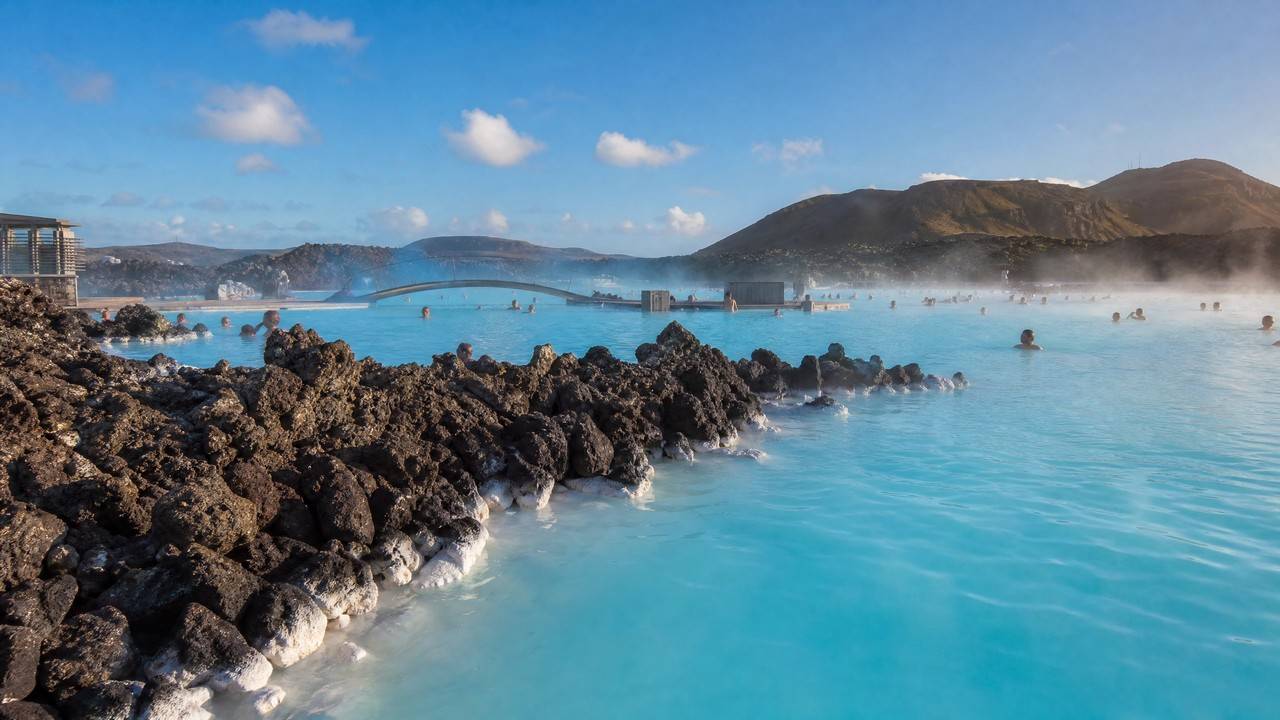
Blue Lagoon
The Blue Lagoon (Bláa lónið) is Iceland's most iconic geothermal spa, set in a black lava field on the Reykjanes Peninsula about 5 km north of the fishing town of Grindavík - not in Reykjavík itself - roughly 20 minutes from Keflavík International Airport and 45-50 minutes from the capital. The roughly 10,000-square-metre artificial lagoon is fed by runoff from the neighbouring Svartsengi geothermal power plant: the silica-rich water was meant to drain back into the ground, but silica sealed the lava so it pooled instead, and that same silica gives the water its milky-blue colour. The temperature holds at 37-40°C year-round and some 1.3 million people visit annually. Guests can take the white silica mud from the lagoon floor as a free facial mask, included in every package, and the complex offers a swim-up bar charged to an electronic wristband, steam caves, a sauna and a massage waterfall. Entry is by timed slot: 2026 prices start at 11,990 ISK for Comfort, 14,990 ISK for Premium and 18,490 ISK for Signature; the luxury Retreat Spa sits in a private lagoon carved into 800-year-old lava, limited to 20 guests every two hours, from 89,000 ISK. Of the two hotels, the Retreat Hotel holds a Michelin-starred restaurant. High-urgency note: the lagoon sits beside the Sundhnúkur crater row, where roughly 9-12 fissure eruptions occurred between December 2023 and August 2025, prompting several precautionary closures and evacuations (lava covered the then car park in November 2024) before defence barriers kept operations running. As of October 2026 nothing is erupting, but the Icelandic Met Office reports magma still accumulating beneath Svartsengi and considers further eruptions likely. Check the official status page and safetravel.is within 24 hours of your visit, and book refundable tickets directly.
National Park & Nature

Hallgrímskirkja
Hallgrimskirkja is the defining feature of Reykjavik's skyline and the largest church in Iceland, standing on Skolavorduholt hill at the top of the Skolavorduigur shopping street and visible from almost every corner of the centre - the city's best orientation point. Commissioned from state architect Gudjon Samuelsson in 1937, construction began on 29 August 1945 and the completed church was consecrated on 26 October 1986, forty-one years in all, with the choir crypt already in use from 1948. The church puts the tower at 73 metres, the highest public vantage point in central Reykjavik. The stepped concrete exterior, usually read as Expressionist, evokes Iceland's columnar basalt, mountains and glaciers; the church is named for Hallgrimur Petursson, the 17th-century Lutheran pastor and poet of the Passion Hymns. The interior is spare and white, a sharp contrast with the dramatic exterior; the west end is dominated by the pipe organ built by Johannes Klais of Bonn in 1992 - 15 metres tall, about 25 tonnes, 5,275 pipes and 72 stops, the largest instrument in Iceland. It was funded by donations, and individuals could 'adopt' individual pipes, with certificates still sold in the church shop. The statue of Leifur Eiriksson in front, by Alexander Stirling Calder and a 1930 gift from the United States marking the millennium of Iceland's parliament, predates the church itself. Entry is free; the tower observation deck lift is ticketed separately at about 1,000 ISK. The nave is wheelchair accessible, and both nave and tower may close for services, weddings, funerals and concerts, so check on-site notices or the church website before visiting.
Church & Religious Site

Þingvellir National Park
Thingvellir - literally 'assembly plains' - is called the heart of Iceland and the cradle of the nation, inscribed as a UNESCO World Heritage Site in 2004 for its cultural value. Around AD 930 the Althing, one of the world's oldest surviving parliamentary assemblies, was founded here and sat until 1798; the Law Rock (Logberg) stands at the foot of the Almannagja gorge, where the Drekkingarhylur (Drowning Pool) was used in medieval times to execute women found guilty of specific crimes. Almannagja was opened as the North American and Eurasian plates pulled apart - separating about 2 centimetres a year, with the valley floor down 3-4 metres since the assembly's founding - and a boardwalk from the Hakid visitor centre drops into it, one of the few places on Earth where you can stand between two continents on dry land. Inside the gorge, the Silfra fissure opened in a major earthquake in 1789; its water comes from Langjokull glacier meltwater some 50 km away, filtered underground through porous lava for an estimated 30-100 years before emerging, giving visibility often beyond 100 metres and a constant 2-4C - among the world's most famous snorkelling and diving sites, its three sections nicknamed The Crack, The Cathedral and The Lagoon; a drysuit is required and access is only with licensed operators. Other highlights include the roughly 13-metre Oxararfoss waterfall, Thingvallavatn - Iceland's largest natural lake at about 84 square kilometres, 114 metres deep, with four separately evolved forms of Arctic char - the 1859 Thingvellir church, Flosagja (the Flower Fissure) and Peningagja (the Coin Fissure, where throwing coins is now discouraged). The park is free and open around the clock; main car parks charge about ISK 1,000 per vehicle per day.
National Park & Nature

Deildartunguhver
Deildartunguhver is Europe's most voluminous hot spring, gushing roughly 180 litres per second of near-boiling (100°C) water, its steam rising year-round; it has long heated nearby towns directly. Near Borgarnes, its pipelines carry geothermal heat far afield. Wooden boardwalks and viewpoints make it a vivid picture of Iceland's 'furnace that needs no fuel'.
National Park & Nature

Perlan
Perlan ("the Pearl") is a uniquely shaped Reykjavik landmark atop a hill overlooking the city, with a giant glass dome housing a nature exhibit and viewing deck, a great spot to overlook Reykjavik and learn Icelandic nature. Perlan sits atop the Oskjuhlid hill in south Reykjavik, a distinctive landmark. Its form comes from its function: built atop several huge cylindrical geothermal hot-water tanks (Iceland uses geothermal for heating), capped by a giant pearl-like hemispherical glass dome, hence the name. Today it combines viewing, nature exhibits and dining: first, a 360-degree viewing deck (and indoor levels) overlooking Reykjavik's panorama (colorful city, harbor, sea, distant snow mountains and glaciers), vast and grand; second, Icelandic nature exhibits (famous nature show, an artificial real-ice cave) vividly presenting volcanoes, glaciers, auroras; plus a rotating restaurant. Visiting Perlan is a unique sight.
Viewpoint

Skógafoss
Skogafoss is a wide, powerful and magnificent waterfall on Iceland's south coast. A thick sheet of water plunges like a silver screen with tremendous force, mist rising and rainbows often appearing, one of the south coast's most famous and beautiful falls. Located near the village of Skogar, Skogafoss is among the region's most renowned and majestic waterfalls. About 60 m high and 25 m wide, its thick, powerful torrent crashes down the cliff edge like a vast white screen, roaring and majestic; the falling water strikes the pool below, sending up ever-present mist, and on sunny days the mist often forms a brilliant, complete rainbow (sometimes two) across the falls, dreamlike and stunning (Skogafoss is famed for these rainbows and photogenic beauty; local legend says Viking treasure is hidden behind the falls). Visitors can stand by the pool in front to feel the power and mist (and rainbow) up close, or climb the long staircase beside the falls to the top for a bird's-eye view of the plunge and the open south-coast plains and sea. Visiting Skogafoss is a magnificent sight.
National Park & Nature
🎯 Reykjavík Experiences
Church Tower Climb
Overlook the colorful harbor city.
Harpa Concert Hall
Light and shadow of the glass facade.
Whale Watching
Whale silhouettes in the harbor.
Colorful Houses
Brightness of the lanes.
Old Town Nightlife
The lively bar street.
Reykjavík is the world's northernmost capital, with a cool, changeable and windy climate — windproof, rainproof and warm clothing are needed year-round. Summer (Jun-Aug) has the midnight sun, best for the ring road; autumn-winter (Sep-Mar) on clear, dark nights you can chase the aurora. Don't miss the rocket-like Hallgrímskirkja, the glass Harpa concert hall and the colorful tin-roofed houses, and you can go whale watching at sea. It is the gateway for the self-drive Ring Road Route 1, the Golden Circle and Blue Lagoon.
📰 Travel Guides
More Guides →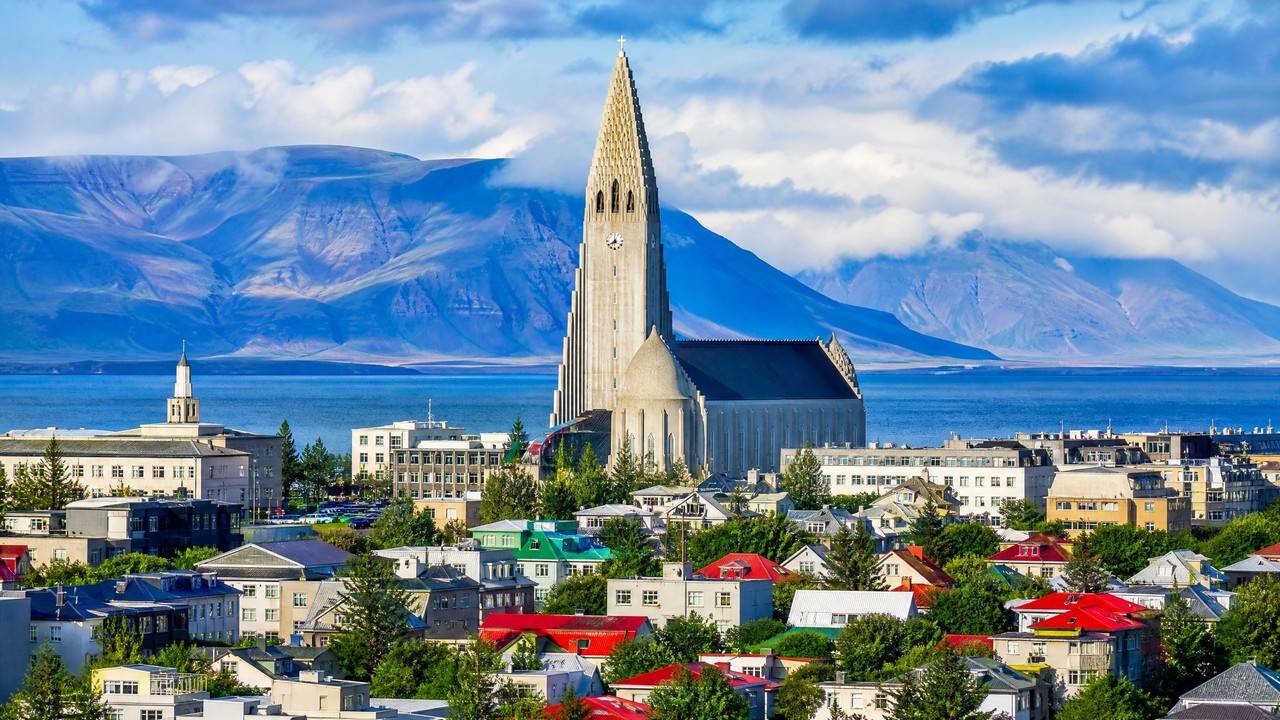
Reykjavik Blue Lagoon Travel Guide 2026: Tickets & Itineraries
Iceland Tourism · Spot👁 9.4k
Island Tour with Aurora Experience in Iceland, 2026: 7-day trip including boat trips on ice lakes, and Miklusteinsjur Hot Springs
Local delegation in Iceland · Spot👁 7.9k
🚌 Transport & Stays
City Transport
✈️About 45 min (reference)
Airport Bus (Flybus)
Keflavík Airport to city
About 45 min (reference)
🚗Car rental recommended (reference)
Car Rental / Self-drive
Ring Road Route 1
Car rental recommended (reference)
🚌By itinerary (reference)
Sightseeing Tour Bus
Golden Circle / South Coast, etc.
By itinerary (reference)
🐋By itinerary (reference)
Whale-Watching Boat
Departs from old harbor
By itinerary (reference)
Recommended Stay Areas
⛪ City Center (recommended)
Near church & old town
🎼 Harbor / Harpa Area
Near concert hall & port
🍺 Old Town Bar District
By lively nightlife
✈️ Airport / Blue Lagoon Direction
Convenient for transfers or bathing
Free Consultation
Want to plan your Reykjavík trip in more depth?
Tell us your departure city, travel dates and interests, and Usitour will tailor a trip just for you.