Ephesus

Ephesus Travel Guide

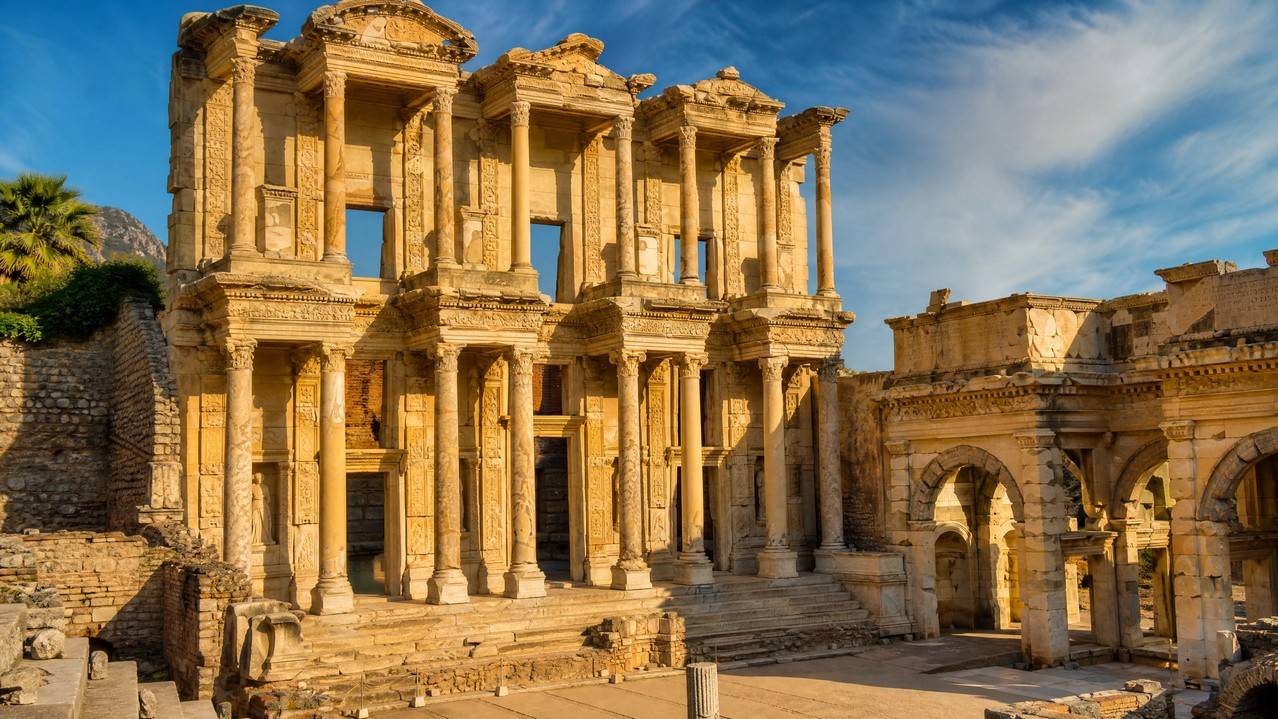
Ephesus, the best-preserved ancient Roman city of the Mediterranean, famed for the Library of Celsus.

📍 Destination Overview

Ephesus is one of the best-preserved ancient Roman cities on the eastern shore of the Mediterranean, once the capital of the Roman Empire's Asian province and an important port. Strolling along the marble-paved Curetes Street, the magnificent facade of the Library of Celsus stands tall, and the Great Theatre, seating 25,000, is built into the hillside. The Temple of Artemis, one of the Seven Wonders of the Ancient World, once stood here. Nearby, the House of the Virgin Mary is a Catholic pilgrimage site, and the Church of St. John and the hillside village of Sirince are also worth visiting. This World Heritage ancient city is a three-dimensional scroll of ancient civilization.

🏛️ Location
Turkiye · Aegean Region - ancient city ruins near Selcuk
🗓️ Best Season
Apr-Jun / Sep-Oct
🕐 Time Difference
5 hrs behind Beijing
💰 Currency / Language
Lira TRY / Turkish
🕐 Suggested Duration
Half-1 day - ancient city + House of Virgin Mary + Sirince
🔌 Outlet / Voltage
Type C / F outlets · 230V · adapter needed

☀️ Best Time to Visit & Climate

🌸 Apr–Jun, Sep–Oct
Pleasant weather — comfortable walks among open-air ruins.
🌡️ Jul–Aug
Ruins offer no shade — protect against the heat.
Jan
🌤️
13°/5°
Feb
🌤️
14°/5°
Mar
🌤️
17°/7°
Apr
🌷
21°/9°
Best
May
🌸
26°/13°
Best
Jun
☀️
31°/17°
Best
Jul
🌡️
34°/20°
Aug
🌡️
34°/20°
Sep
🌤️
30°/16°
Best
Oct
🍂
25°/12°
Best
Nov
🌥️
19°/9°
Dec
🌤️
15°/6°

📷 Top Attractions

Memmius Monument
No.1 Ephesus
Memmius Monument
The Memmius Monument stands near Domitian Square on the northern stretch of Ephesus' main route, built in the early first century AD under Augustus. It honours Memmius, grandson of the Roman dictator Sulla — who punished Ephesus with crushing taxes in 85 BC for siding with King Mithridates VI of Pontus — and decades later his descendant raised this memorial as a very public act of reconciliation between family and city. The structure rises on a stepped podium, its four-column facade framing niches that once held statues of Memmius and his ancestors. Small as it is, it is one of the few wayside monuments on the main path with a complete backstory.
Historic Ruins & Heritage
Varius Hamami
No.2 Ephesus
Varius Hamami
The Baths of Varius sit just south of Curetes Street's eastern section, not far from Hadrian's Temple, and ranked among the sizeable Roman bathhouses of second-century AD Ephesus. The brick piers of the hypocaust heating system still lie exposed — hot smoke from the furnace circulated beneath the raised floor and rose through terracotta channels inside the walls, keeping the caldarium steaming. The sequence of changing room, warm room and hot room can still be traced, alongside a colonnaded palaestra for exercise and socialising. Much of the site sits behind railings today, and the clearest reading of its layout comes from the path above.
Historic Ruins & Heritage
Mazeus & Mithridates Gate
No.3 Ephesus
Mazeus & Mithridates Gate
This triple-arched honorary gate stands where Curetes Street meets the Commercial Agora. Around 3 BC it was funded by Mazeus and Mithridates, two freedmen of Emperor Augustus, and dedicated by inscription to the emperor and his family. Rising from slavery to endow a public monument, the pair embodied rare social mobility in Roman society. Look down as you pass through: the paving beneath the arches still carries deep cart grooves, physical evidence of two thousand years of commercial traffic flowing into the market.
Historic Ruins & Heritage
Scolasticia Baths
No.4 Ephesus
Scolasticia Baths
Perched on a terrace above the north side of Curetes Street, these baths were rebuilt in the early fourth century AD by a Christian woman named Scholasticia, whose headless statue still watches from an entrance niche. First constructed in the 2nd century, the complex follows the classic cold-warm-hot room progression, with terra-cotta pipes beneath the floors circulating hot air—a textbook survival of Roman heating engineering. With brick vaults exposed in cross-section, visitors can literally read how the city's ancient underfloor heating once worked.
Historic Ruins & Heritage
Pamucak Beach
No.5 Ephesus
Pamucak Beach
Pamucak is the widest stretch of sand near Selcuk, running about five kilometers along a shore tinted dark by silt from the Cayster River mouth. Two thousand years ago, Ephesian merchant ships sailed from a harbor near this coast; the ancient port has long since silted into farmland, leaving only surf and pine groves. Because most visitors head straight for Kusadasi, the beach stays surprisingly empty even in high season, and its west-facing sunsets paint the sky orange and violet—a perfect wind-down after the ruins.
Beach & Island
Temple of  Titus Flavius Domitianus
No.6 Ephesus
Temple of Titus Flavius Domitianus
This was Ephesus' first temple dedicated to a reigning Roman emperor, built between 81 and 96 AD on a vast terrace roughly 50 by 100 meters. The honor earned the city the coveted title of neokoros—warden of the imperial cult. When Domitian was assassinated in 96 and the Senate ordered his memory erased, the city promptly rededicated the temple to his father Vespasian, a clean piece of political maneuvering. Only foundations and broken columns remain, yet standing on the terrace above Curetes Street still conveys the scale of emperor worship.
Historic Ruins & Heritage

🎯 Ephesus Experiences

Library of Celsus
The most photogenic facade in the ancient city.
Great Theatre
The grandeur of the hillside semicircular theatre.
Curetes Street
A stroll along the marble-paved ancient street.
House of the Virgin Mary
A serene Catholic pilgrimage site.
Sirince Wine Tasting
Fruit wines in a mountain village.
Apr-Jun and Sep-Oct are most comfortable; for the open-air ruins, visit in the early morning or evening to avoid the heat and crowds. In Jul-Aug the ruins have no shade and are scorching, so guard against heat. Often combined with Pamukkale and Kusadasi. The lira's exchange rate fluctuates widely.

🚌 Transport & Stays

City Transport
✈️
Izmir Airport
About 1 hour's drive from the airport
Shuttle varies by schedule (reference)
🚌
Group Day Tour
Direct from surrounding cities
Varies by itinerary (reference)
🚕
Selcuk Taxi
Short trip from town to the ruins
Starting fare varies by distance (reference)
⛴️
Kusadasi Cruise Port
A common shore-excursion route
Varies by itinerary (reference)
Recommended Stay Areas
🏛️ Selcuk (Top Pick)
Close to the ruins, small-town atmosphere
🍷 Sirince Village
Guesthouses in a hillside wine village
🌊 Kusadasi
Seaside resort and cruise port
🏙️ Izmir
A big-city base with convenient transport
Free Consultation

Free Consultation

1-on-1 travel consultant customizes your Ephesus trip for free based on your schedule and preferences.