📍 Destination Overview
Suwon is the capital of Gyeonggi Province, only some 30 kilometres from Seoul. Its iconic landmark is Hwaseong Fortress, built by King Jeongjo in 1796; encircling the hills, it crowns Joseon military architecture and is a UNESCO site, and the Haenggung royal villa is the dynasty's largest.
🏙️ Location
South Korea · Suwon
🗓️ Best Season
Apr-Jun / Sep-Oct
💰 Currency / Language
South Korean Won (KRW) / Korean
🕐 Suggested Duration
2-3 days
🔌 Outlet / Voltage
Type C/F outlets · 220V · adapter needed
📶 Communication Note
Buy data SIM / eSIM on arrival (reference)
☀️ Best Time to Visit & Climate
January
❄️
1°/-7°
February
🌥️
4°/-5°
March
🌤️
10°/-1°
April
🌸
17°/5°
Best
May
🌷
22°/10°
Best
June
☀️
26°/16°
Best
July
🌡️
29°/21°
August
☀️
30°/21°
September
🍂
24°/15°
Best
October
🍁
18°/8°
Best
November
🌥️
10°/1°
December
🎄
3°/-5°
📷 Top Attractions
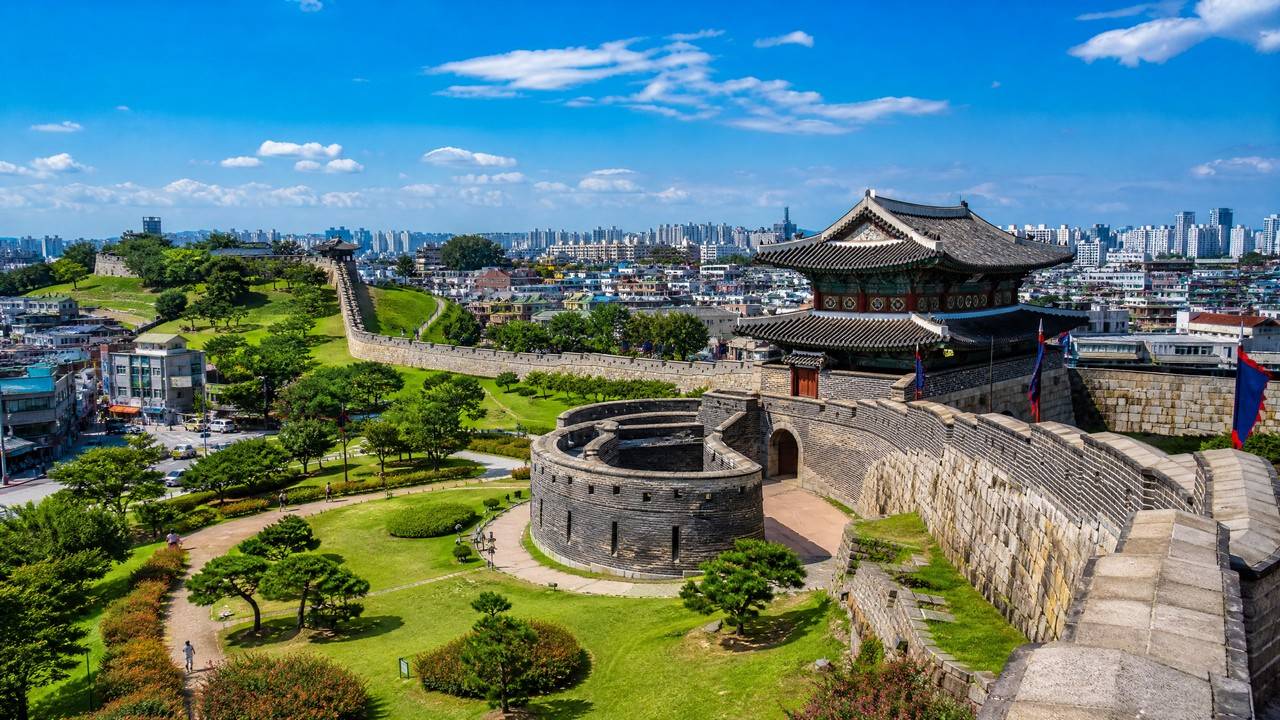
Hwaseong Fortress
Hwaseong Fortress is the city wall King Jeongjo of Joseon built in the 18th century to relocate the capital and honour his father's tomb; it joined the World Heritage list in 1997. Following hills and water for about 5.7 km, it comprises four gates, hollow piers, beacon towers and the Hwaseomun, blending East Asian fortification with Western bastion technique, hailed as the pinnacle of Joseon military architecture. Walking the wall overlooks Suwon; the autumn Hwaseong Cultural Festival re-enacts drills and parades, a history-rich day trip from Seoul.
Castle & Fortress
No.2 Suwon
Hwaseong Haenggung
Hwaseong Haenggung is the largest temporary palace within Hwaseong Fortress, built for King Jeongjo's visits to Suwon and once the biggest such complex in Korea, with a main hall, living quarters and dozens of buildings set in deep, colourfully painted courtyards. Partly restored, it now stages the changing-of-the-guard ceremony and the traditional jinchanye court banquet, and visitors can try hanbok. It is a living window onto Jeongjo's reforms and Joseon royalty, Suwon's most ceremonial stop.
Castle & Fortress
No.3 Suwon
Suwon Hwaseong Museum
Beside Hwaseong Fortress, the Hwaseong Museum systematically tells the wall's story, King Jeongjo's relocation vision and the fortification craft. Models, documents and multimedia recreate the 18th-century worksite, with weapons, surveying tools and relics on display; an outdoor section reconstructs defensive structures you can compare with the real wall. For visitors who want to understand why it was built this way, it is the most systematic gateway to Hwaseong. Models, documents and an outdoor replica section make the wall's logic clear before you walk it.
Museum
No.4 Suwon
Paldalmun
Paldalmun is the south gate of Hwaseong Fortress in Suwon and one of the fortress's surviving main gates, listed as a UNESCO World Heritage site together with the fortress. It consists of a stone base topped by a two-story wooden gate tower with an inscribed plaque, and stretches of wall and pavilions remain nearby. Built in the Joseon period under King Jeongjo, Hwaseong combined defense with urban functions, and the gate area has long been a gathering place. Today it opens onto a busy traditional market and streets, and the nearby walls offer views over the district.
Square & Landmark
🎯 Suwon Experiences
Fortress Night Walk
Illuminated ancient walls stroll.
Suwon Galbi
Authentic Suwon charcoal-grilled beef ribs.
Haenggung Hanok Experience
Wear hanbok and photograph at the palace.
Traditional Market Visit
Korean street food at Paldalmun Market.
Suwon is four distinct seasons with cold winters and hot summers; the best time to visit is Apr–Jun and Sep–Oct, with temperatures around 5–26°C. January is coldest (down to -7°C), so bring warm layers.
🚌 Transport & Stays
City Transport
✈️Varies by route
Flights
Fly into nearest airport
Varies by route
🚗Rental varies
Self-Drive
Best flexibility for exploring
Rental varies
🚕Local rates
Local Transport
Taxi or shared rides
Local rates
Recommended Stay Areas
🏰 Hwaseong / Paldalmun Area
Old town boutique hotels
🏙️ Suwon Station / Downtown
Business hotels
🍖 Near Galbi Street
Food district inns
💰 SKKU Area
Budget accommodation
Free Consultation
Free Consultation
1-on-1 travel consultant customizes your Suwon trip for free based on your schedule and preferences.