📍 Destination Overview
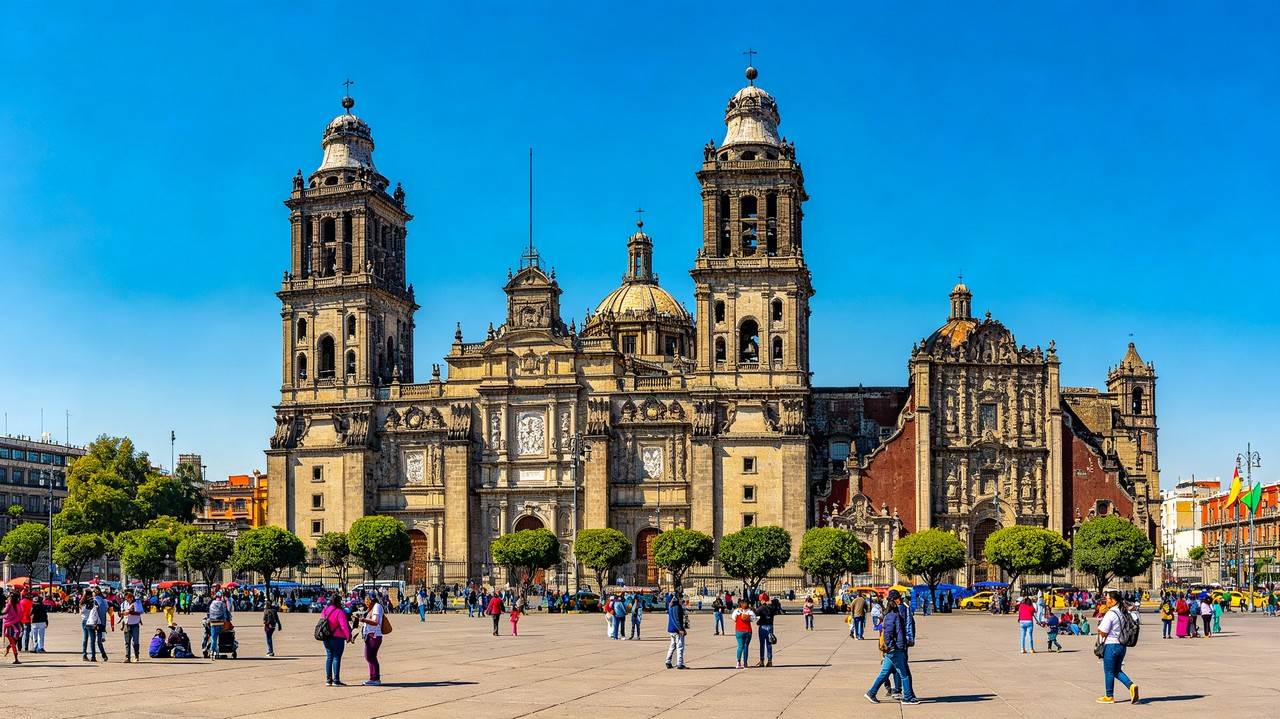
Mexico City, the capital of Mexico, stands in a highland basin - one of Latin America's largest metropolises. Built on the ruins of the Aztec capital Tenochtitlan, its Zocalo Square and Metropolitan Cathedral form the heart. The Sun Pyramid of Teotihuacan rises nearby, and the National Anthropology Museum holds Aztec and Maya treasures.
🏛️ Location
Mexico · Mexico City · capital in a highland basin
🗓️ Best Season
Mild year-round / Nov-Apr dry season
🕐 Time Difference
14 hrs behind Beijing
💰 Currency / Language
Mexican Peso MXN / Spanish
🕐 Suggested Duration
3-4 days · old town + pyramids + museums
🔌 Outlet / Voltage
Type A/B outlets · 127V · adapter needed
☀️ Best Time to Visit & Climate
☀️ Dry Season: Nov–Apr
Highland dry season, mild and pleasant—best time.
🌧️ Rainy Season: May–Oct
Afternoon thunderstorms, lush and cheaper.
Jan
🌞
24°/9°
Best
Feb
🌞
25°/10°
Best
Mar
🌞
27°/11°
Best
Apr
🌤️
28°/12°
Best
May
🌧️
27°/13°
Jun
🌧️
24°/13°
Jul
🌧️
23°/12°
Aug
🌧️
23°/12°
Sep
🌧️
23°/12°
Oct
🌧️
24°/11°
Nov
🌞
24°/10°
Best
Dec
🌞
23°/9°
Best
📷 Top Attractions
More Attractions →
Museo Nacional de Antropología
The National Museum of Anthropology stands in Chapultepec Park in Mexico City, designed by Pedro Ramirez Vazquez, begun in February 1963 and opened on 17 September 1964, a construction period of only nineteen months for a building of this scale. It is the most-visited museum in Mexico, the largest anthropology museum in the world, and one of the foremost collections of pre-Columbian archaeology anywhere.
President Adolfo Lopez Mateos commissioned it with an explicit intent: to house Mexico's pre-Hispanic heritage at the same scale and grandeur as the European museums that had been taking that heritage for centuries, as an act of national identity-building. Twenty-three to twenty-four galleries ring a vast open-air courtyard whose centre is El Paraguas, the umbrella: a single bronze column 11 metres tall supporting a canopy of about 4,200 square metres, with water falling in a continuous ring off its outer edge. The column carries Aztec-style reliefs by the sculptor Tomas Chavez Morado depicting the rain god Tlaloc, so the water off the rim can also be read as Tlaloc's rain.
The collection is split by floor: the ground level holds archaeology arranged chronologically by culture, the upper level ethnography of living indigenous peoples. The Mexica Hall opposite the entrance holds the 24-ton Aztec Sun Stone, which is worth stating clearly is not a calendar but a cosmological monument depicting cosmic cycles and the sequence of the five suns; the same room holds the Coatlicue statue and the Tizoc Stone. The Maya Hall keeps the jade death mask of Palenque's king Pakal and a reconstruction of his tomb; the Olmec Hall's basalt colossal heads date to 1200 BCE and are the physical evidence of Mesoamerica's so-called mother culture; the Zapotec Hall's bat-god jade mask from Monte Alban represents the peak of Oaxacan craftsmanship; and the Teotihuacan Hall, the largest in the museum, reconstructs the facade of the Temple of the Feathered Serpent.
The upstairs ethnographic halls are the most easily skipped and are precisely the point of the place: modern indigenous dress, textiles, masks and ritual objects give the antiquities below a living context. Most visitors leave after seeing only half.
Four practical points. The building is vast and the layout is not intuitive, so take a map at the door, start with the Sun Stone, rest in the courtyard, then choose two or three cultures to look at properly rather than trying to read every case. All bags, large luggage and umbrellas must be checked, at a free cloakroom to the right of the entrance. Tuesday or Wednesday at the 9:00 opening is quietest, while the free Sunday is the most crowded. And the museum has one good story of its own: in 1985 two thieves removed 140 objects in a single night, and most were recovered four years later from a drug trafficker's apartment.
Museum

Palacio de Bellas Artes
The Palacio de Bellas Artes, Mexico's national palace of fine arts, stands in the historic centre of Mexico City at the corner of Av. Juarez and Eje Central, beside the east side of the Alameda Central.
Construction: the palace was a product of the centennial of Mexican independence. The original plan was to remodel the National Theatre; the decision taken was to demolish it and build anew. Work began in 1904, slowed through the Mexican Revolution and stopped entirely in 1916, resuming in 1931 with inauguration in 1934. The Italian architect Adamo Boari led the early phase and Federico Mariscal took over after the revolution, which is why the exterior is Art Nouveau while the interior is Art Deco. The marble was shipped from Italy, and the whole structure sits on the soft sediments of the old lakebed, so settlement left it several feet lower than designed.
Two levels, two tickets: the ground-floor atrium and the exterior are free, while seeing the murals on the upper floors requires the exhibition ticket. The atrium is a highlight in itself, with an Art Deco figure of the Maya rain god Chaac and a stained glass dome made by Tiffany Studios.
The murals are the core of the visit: seventeen permanent works by Rivera, Siqueiros, Orozco and four other painters. Rivera's Man, Controller of the Universe is a recreation of the mural he painted for the Rockefeller Center in New York, destroyed there after Lenin appeared in it. Siqueiros' New Democracy triptych of 1944 and The Torment of Cuauhtemoc, the latter showing the last Aztec ruler's feet being burned to extract gold and silver, are the hardest to look at. The museum provides interactive devices and volunteer talks; without a guide, allow at least an hour on the mural floors.
Admission (2026): the exhibition ticket is roughly 75 to 95 pesos, INAH having raised prices across the board from 1 January 2026 with sources quoting different figures, so the booth is the authority. The atrium is free and a photography permit costs about 30 pesos per camera. Tickets are in person only, with no online purchase. Sundays are free, but most accounts limit that to Mexican citizens and legal residents, so foreign visitors should still budget for a ticket.
For the classic shot of the dome, locals go up to the cafe terrace of the Sears department store across the street.
Museum

Zócalo
The Zócalo (Plaza de la Constitución) is the historic heart of Mexico City and one of the world's largest city squares, framed by soaring colonial buildings: the monumental National Palace to the north and the Metropolitan Cathedral to the east, while beneath lies the fabric of Tenochtitlan, the Aztec imperial capital. The square hosts rallies, exhibitions and festivals, with a giant flag raised and lowered daily. By day steeped in history, by night lit and lively, it is the first place to grasp Mexico's arc from ancient civilisation to modern state.
Old Town & Historic District

Bosque de Chapultepec
Bosque de Chapultepec is Mexico City's largest urban park. At ~686 hectares, it is one of the Western Hemisphere's largest city parks, featuring vast forests, lakes, a zoo, world-class museums and the hilltop Chapultepec Castle — one of Mexico City's most important leisure and cultural destinations. Chapultepec means "grasshopper hill" in Nahuatl. The park has three sections: the first has the castle, National Museum of Anthropology, lakes and zoo; the second has more forest and leisure facilities; the third is the most pristine. The hilltop Chapultepec Castle — once a royal residence and presidential home, now the National History Museum — offers panoramic city views. The National Museum of Anthropology is the park's most famous cultural facility, with extraordinarily rich Mesoamerican civilization collections — one of Latin America's most important museums. Visiting Chapultepec to stroll Mexico City's green heart and explore world-class museums and castle is a rich, splendid experience.
Castle & Fortress

Xochimilco
Xochimilco is a surviving ancient canal and artificial floating-island area in south Mexico City, from the Aztec-era farming water system and a World Heritage Site. Colorful traditional boats (trajineras) drift through the waterways, with bands playing and vendors selling corn and food—festive and lively. It is where Mexicans gather and celebrate on weekends, and lets visitors glimpse the remnants of the Aztec water city. Floating on a trajinera is one of Mexico City's most folk-flavored experiences.
Old Town & Historic District
No.6 Mexico City
Paseo de la Reforma
Paseo de la Reforma is Mexico City's most famous avenue, commissioned by Emperor Maximilian of the Habsburgs to link the center with Chapultepec. Lined with the Independence Angel, monuments and sculptures, it is the city's most ceremonial urban axis.
Historic Ruins & Heritage
🎯 Mexico City Experiences
Teotihuacán
The awe of climbing the Sun Pyramid.
Frida's Blue House
The life of a legendary painter.
Xochimilco
Colorful boats and on-board bands.
Anthropology Museum
Treasures of ancient civilization.
Street Tacos
Mexico's everyday street food.
At 2,200 m, Mexico City is mild year-round but UV is strong—use sunscreen and hydrate. The rainy season (May–Oct) brings afternoon storms; do outdoors in the morning. Day of the Dead (late Oct–early Nov) is the biggest festival—book ahead.
🚌 Transport & Stays
City Transport
✈️Taxi fare by distance (reference)
Mexico City Airport
About 30 min drive to downtown
Taxi fare by distance (reference)
🚇Per segment (reference)
Metro
Citywide coverage, low fare
Per segment (reference)
🚗Base fare by distance (reference)
Ride-hailing App
Safe and convenient for downtown
Base fare by distance (reference)
🚌By itinerary (reference)
Group Tour
To Teotihuacán
By itinerary (reference)
Recommended Stay Areas
🏛️ Historic Center (top pick)
Near Zócalo and the cathedral
🌳 Reforma Ave / Roma District
Artsy district and dining
🎨 Coyoacán
Near the Blue House, quaint and quiet
🏙️ Polanco
Upscale business and safe
Free Consultation
Want to plan your Mexico City trip in more depth?
Tell us your departure city, travel dates and interests, and Usitour will tailor a trip just for you.