Philae Temple
Quick Facts
- Location
- Egypt, Aswan
- Category
- Church & Religious Site
- Duration
- 1.5-2 hours including the boat rides each way; 2.5-3 hours to take in the whole complex
- Opening Hours
- Opens 7:00 daily, closing about 16:00 (listed to 17:00 in summer, Apr-Sep). The sound-and-light show runs separately after dark on a separate ticket.
- Ticket Price
- About EGP 550 for foreign adults, EGP 275 for students with an international card. The round-trip boat from Shellal is not included and is negotiated with the boatman.
- Address
- Agilkia Island between the Aswan Low Dam and High Dam, about 12 km south of Aswan city, Aswan Governorate, Egypt
- Coordinates
- 24.0253, 32.8848
Introduction
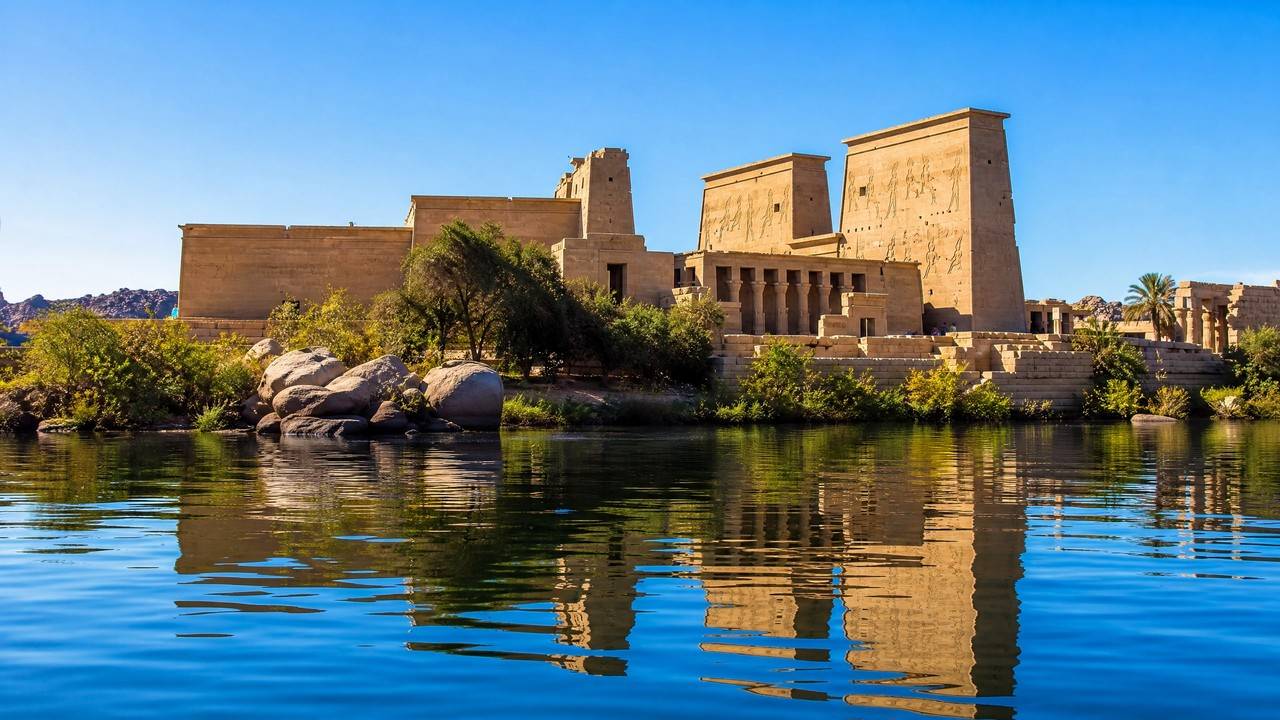
What makes Philae unusual is that it no longer stands where it was built. The original island of Philae sat at the edge of the Nile's First Cataract, the religious frontier between Egypt and Nubia for millennia: whoever controlled the cult here held the loyalty of peoples on both banks. The earliest structures date to around 690 BCE, and the main temple was founded by Ptolemy II around 280 BCE, then enlarged by later Ptolemies and Roman emperors for two centuries. It was the centre of the Isis cult, and a layered site of several religions. When Theodosius I closed pagan temples across the empire in 391 CE, Philae was exempted at the request of Nubian tribes and kept functioning until about 550 CE; in the sixth century it was converted into a church, Coptic crosses were cut into the columns, and parts of the reliefs were covered with plaster. The site also marks the end of two writing systems. On 24 August 394 CE the priest Esmet-Akhom carved a short dedication on the Gate of Hadrian, the last known hieroglyphic inscription; the last demotic text was written here in 452 CE. No other place is the endpoint of both scripts. When the Aswan High Dam threatened to submerge the island under Lake Nasser, the entire temple was dismantled stone by stone and rebuilt on the higher Agilkia Island to the north between 1972 and 1980. What you see today is a reconstruction in plan and orientation, but almost all of the blocks are original. Together with Abu Simbel, it was one of the great UNESCO rescue operations. Approach from the water: as the boat closes in, the colonnade rises out of the surface, one of the finest arrivals at any Egyptian site. Ashore, a 145-metre curved colonnade leads to the two pylons, hypostyle hall and sanctuary of the Isis temple, while the Kiosk of Trajan on the east bank is an unfinished structure known as the Pharaoh's Bed and one of the most photographed buildings in Aswan. After 16:00 the west-facing colonnades turn gold in the last light.
✨ Highlights
🛈 Practical Info
💡 Tips
FAQ
What are the opening hours of Philae Temple?
Opens 7:00 daily, closing about 16:00 (listed to 17:00 in summer, Apr-Sep). The sound-and-light show runs separately after dark on a separate ticket.
How much is the admission for Philae Temple?
About EGP 550 for foreign adults, EGP 275 for students with an international card. The round-trip boat from Shellal is not included and is negotiated with the boatman.
Any practical tips for visiting Philae Temple?
Agree the round-trip boat price before boarding and write it down; Shellal operators sometimes raise it mid-trip. Take an early boat: before 10:00 the tour groups have not arrived and the colonnade and courts are almost empty.
How long should I spend at Philae Temple?
A typical visit takes 1.5-2 hours including the boat rides each way; 2.5-3 hours to take in the whole complex.