Aswan

Aswan Travel Guide

Aswan, the Nubian gateway on the upper Nile, charms with the Philae temple, Nubian villages, and feluccas.

📍 Destination Overview

Aswan sits on the upper Nile in southern Egypt and is the gateway to the Nubian region. With its dry, bracing climate and relaxed pace, it is considered one of Egypt's most pleasant cities. The Nile scenery here is especially enchanting: traditional triangular-sail feluccas drift lazily on the river, flanked by golden dunes and verdant islands. The Philae Temple, dedicated to the goddess Isis, was entirely relocated to Agilkia Island because of the Aswan High Dam. Colorful Nubian villages line the river, their bright houses and warm-hearted Nubian people full of distinctive charm. The Unfinished Obelisk, the Aswan High Dam and the Aga Khan Mausoleum each have their highlights, and Aswan is also the launching point for trips to Abu Simbel.

Location
Egypt · Aswan Governorate · The Nubian gateway on the upper Nile
🗓️ Best Season
Oct-Apr Cool Season
🕐 Time Difference
6 hours behind Beijing
💰 Currency / Language
Egyptian Pound EGP / Arabic
🕐 Suggested Duration
1 - 2 days · Temples + Nubian village + felucca
🔌 Outlet / Voltage
Type C / F outlets · 220V · Chinese two-pin plugs mostly work

☀️ Best Time to Visit & Climate

🌤️ Cool Season: Oct–Apr
Dry, mild weather — best for sightseeing.
Jan
🌤️
24°/9°
Best
Feb
🌤️
26°/10°
Best
Mar
☀️
30°/14°
Best
Apr
🔥
36°/19°
Best
May
🔥
40°/23°
Jun
🔥
42°/25°
Jul
🔥
42°/26°
Aug
🔥
42°/26°
Sep
🔥
40°/24°
Oct
☀️
37°/21°
Best
Nov
🌤️
30°/15°
Best
Dec
🌤️
25°/11°
Best

📷 Top Attractions

More Attractions →
Philae Temple
No.1 Aswan
Philae Temple
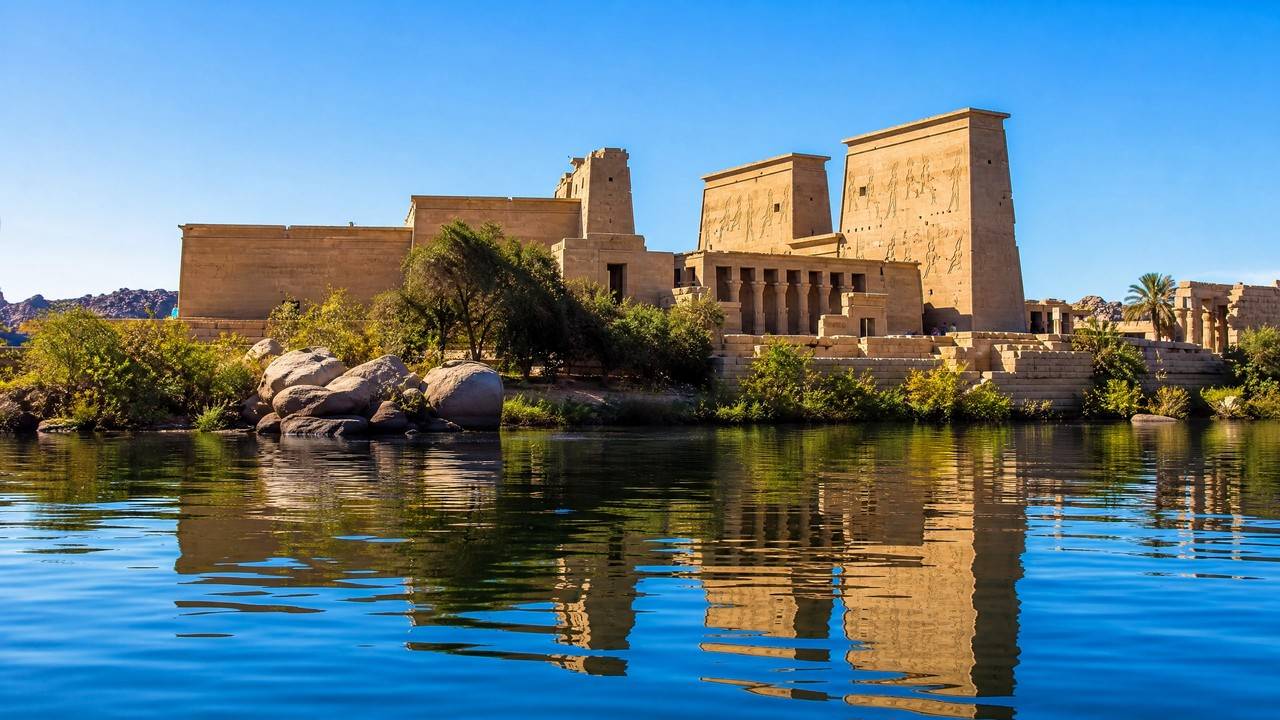
Philae Temple is a beautiful ancient Egyptian temple in Aswan, dedicated to the goddess of love and beauty Isis, set on a lovely island in the Nile. With elegant architecture, touching faith and a legendary relocation, it is a charming Aswan relic. Philae Temple is mainly dedicated to Isis (goddess of love, life, magic and motherhood), an important late-period (Ptolemaic and Roman) center of her cult, full of touching faith. Known for elegant architecture—pylon, courts, colonnades and halls with fine reliefs, harmonious and graceful, set on a Nile island surrounded by water, like a sanctuary on the water. It has a legendary history: in the 20th century, the Aswan Dam (forming Lake Nasser) threatened to submerge the original Philae Island; UNESCO led a huge international rescue—the temple was dismantled piece by piece, numbered, and rebuilt exactly on the higher, prettier Agilkia Island, surviving as a conservation miracle (Abu Simbel was moved similarly). Visitors take a ferry to the island. Visiting Philae is a charming Aswan experience.
Church & Religious Site
Unfinished Obelisk
No.2 Aswan
Unfinished Obelisk
The Unfinished Obelisk is a unique, interesting ancient Egyptian relic in Aswan—a gigantic granite obelisk still half-attached to the quarry bed, abandoned unfinished, vividly showing how the ancients quarried and carved those giant obelisks—a perfect "living textbook" of ancient Egyptian stonework. The obelisk is a iconic tall, tapering monument with a pyramidion top, usually paired before temple pylons, symbolizing the sun's rays. These giants were carved from single hard-granite blocks—a colossal engineering feat. Aswan was the main source of fine red granite (many obelisks and colossi came from here). This "Unfinished Obelisk" lies in an ancient quarry—planned (said for Queen Hatshepsut) as a huge obelisk; had it been finished it would have been among the largest, about 40-plus m tall and over 1,000 tons. But cracks appeared and work stopped, so it was abandoned, still attached on three sides to the bedrock. Precisely because it is unfinished, it uniquely and directly shows the ancients' quarrying and carving method (you can see the chisel marks)—of great historical and archaeological value. Visiting it is a unique, interesting Aswan experience.
Historic Ruins & Heritage
Nubia Museum
No.3 Aswan
Nubia Museum
The Nubia Museum, opened in 1997 on the Nile in Aswan, preserves and presents thousands of years of Nubian history and culture. Its collections run from prehistoric tools and Pharaonic sculpture through Christian frescoes to Islamic-era jewellery and everyday objects, much of it rescued in UNESCO-led salvage digs before the waters of Lake Nasser drowned Lower Nubia's villages. The award-winning building weaves traditional Nubian house forms with ancient Egyptian motifs, its circular galleries softened by natural light. In 2001 the museum became part of the UNESCO-listed Nubian monuments ensemble. For understanding the land changed by the High Dam, it is the gentlest and most complete classroom.
Museum
Elephantine Island & Nubian Village
No.4 Aswan
Elephantine Island & Nubian Village
Elephantine Island is a historic, scenic island in Aswan's Nile, with ancient ruins and colorful Nubian villages—blending history, nature and local flavor, a charming Aswan island. The largest island in Aswan, it is very old: in ancient times, as Egypt's southern border and a Nile stronghold, it was an important frontier fortress, trade center and religious site (its name may link to ancient ivory trade). Thus it preserves precious ancient relics—temple ruins (dedicated to Khnum and other gods), an ancient Nile water-level gauge (the "Nilometer," used to measure the flood and set taxes), and other ruins; an on-island museum displays related artifacts. Contrasting the antiquities are several colorful Nubian villages—Nubians living by the river, with brightly painted houses, friendly people and unique Nubian flavor, adding vivid life. Green and scenic, ringed by water, it is a great spot for the Aswan Nile view. Visitors take a ferry to explore ruins, stroll Nubian villages and enjoy the river. Visiting Elephantine Island is a unique blend of history and local flavor.
Old Town & Historic District
Aswan High Dam
No.5 Aswan
Aswan High Dam
The Aswan High Dam is a grand modern water project across the Nile, built in the 20th century and deeply changing Egypt. Known for its scale and major impact on the economy and people's lives, it is a key window into modern Egypt. Built in the 1960s–70s, it is a landmark modern project. Vast and towering across the Nile, it profoundly changed modern Egypt: it controlled the Nile's millennia-old floods (which both nourished ancient civilization and caused disasters), regulated water for irrigation and flood control, and powered a large hydro plant supplying much of Egypt's electricity—greatly advancing modernization. Upstream it formed Lake Nasser, one of the world's largest artificial lakes. The dam also brought impacts (upstream relics faced submersion, prompting the rescue relocation of Philae, Abu Simbel, etc., and some ecological changes). Visitors can stand on the dam, overlooking the grand project, the vast Lake Nasser and the Nile below, feeling modern Egypt's achievement. Visiting the dam is a stop to understand modern Egypt.
National Park & Nature
Monastery of St. Simeon
No.6 Aswan
Monastery of St. Simeon
The Monastery of St. Simeon — locally Anba Hatre — is among Egypt's largest and best-preserved medieval Coptic monastic ruins, perched on desert hills on Aswan's west bank. Founded in the 7th century and once home to several hundred monks, it was gradually abandoned around the 13th century. Within its enclosure walls, two churches, monks' cells, kitchens and rock-cut tombs form a self-sufficient island of faith. The classic approach is by felucca or motorboat to the west bank, then camel over the dunes — the transition from Nile greenery to Sahara emptiness in half an hour is part of the experience.
Church & Religious Site

🎯 Aswan Experiences

Nile Felucca
Leisurely rides on triangular-sail boats at dusk.
Philae Temple
The goddess's temple on the relocated island.
Nubian Village
Colorful houses and warm hospitality.
Unfinished Obelisk
Giant stone in the ancient quarry.
Nile Cruise
A temple-hopping journey along the river.
Aswan's cool season, Oct-Apr, has a dry, mild climate ideal for sightseeing; summers (Jun-Aug) often exceed 40°C, so take strong heat precautions. A felucca ride on the Nile at dusk is most delightful. This is also the launching point for Abu Simbel.

🚌 Transport & Stays

City Transport
✈️
Aswan Airport
About 30 min drive from the city
Fare depends on distance (reference)
Felucca / Motorboat
On the river and to the islands
Depends on the route (reference)
🚗
Private Car
To Abu Simbel
Daily charter depends on itinerary (reference)
🚢
Nile Cruise
The voyage to Luxor
Depends on class (reference)
Recommended Stay Areas
🌊 Nile Riverside (Top Pick)
River views and easy felucca access
🏘️ Nubian Village
Homestay experience among colorful houses
🚢 Nile Cruise
A voyage with onboard accommodation
🏝️ Elephantine Island
The tranquility of a mid-river island
Free Consultation

Free Consultation

1-on-1 travel consultant customizes your Aswan trip for free based on your schedule and preferences.