Luxor

Luxor Travel Guide

Key facts

  • On this page: 0 travel guides and 12 attractions
  • Attractions include opening hours, ticket prices, transport and suggested visit duration
  • Guides cover itinerary planning, visas, accommodation and budget tips
  • Content is updated from the CMS and verified facts

This page collects all travel content for Luxor: 0 guides covering itinerary planning, attraction recommendations, visa application, transport and accommodation, plus 12 attractions with opening hours, ticket prices and practical tips, continuously verified and updated.

Luxor, ancient Egyptian capital on the Nile, famed for Karnak, the Valley of the Kings, and temple balloon views.

📍 Destination Overview

Luxor lies on the middle Nile and was the site of Thebes, capital of Egypt's New Kingdom; studded with magnificent temples and tombs, it is hailed as the world's largest open-air museum. On the east bank, Karnak Temple is the world's largest temple complex, its towering hypostyle hall breathtaking; Luxor Temple blazes with light at night. On the west bank, the Valley of the Kings holds the tombs of dozens of pharaohs including Tutankhamun, their painted chambers still vivid after three millennia; the terraced Temple of Queen Hatshepsut is built into the cliff face, while the Colossi of Memnon stand watch in silence. Rising in a hot-air balloon at dawn to overlook the temples and river valley in the morning light is Luxor's most unforgettable experience.

🏛️ Location
Egypt · Luxor Governorate · A pharaonic capital on the middle Nile
🗓️ Best Season
Oct-Apr Cool Season
🕐 Time Difference
6 hours behind Beijing
💰 Currency / Language
Egyptian Pound EGP / Arabic
🕐 Suggested Duration
2 - 3 days · East-bank temples + west-bank tombs
🔌 Outlet / Voltage
Type C / F outlets · 220V · Chinese two-pin plugs mostly work

☀️ Best Time to Visit & Climate

🌤️ Cool Season: Oct–Apr
Mild weather — perfect for temple visits.
Jan
🌤️
23°/6°
Best
Feb
🌤️
25°/8°
Best
Mar
☀️
29°/11°
Best
Apr
🔥
35°/16°
Best
May
🔥
39°/20°
Jun
🔥
41°/23°
Jul
🔥
41°/24°
Aug
🔥
41°/24°
Sep
🔥
39°/22°
Oct
☀️
35°/18°
Best
Nov
🌤️
29°/12°
Best
Dec
🌤️
24°/8°
Best

📷 Top Attractions

More Attractions →
Valley of the Kings
No.1 Luxor
Valley of the Kings
The Valley of the Kings is a limestone basin on Luxor's west bank where most New Kingdom pharaohs were buried, beginning with Tutmosis I in the Eighteenth Dynasty. More than sixty tombs are known, numbered from KV1 onwards; some were looted in the nineteenth century and are now empty, and roughly a dozen are arranged for visitors at any time. The approach is part of the experience: an electric shuttle carries you from the ticket gate up the valley between wind-cut white cliffs, then you walk on sand with the sound of the town left behind, descend ramps and wooden walkways, and step into a cool, still interior that feels like another season. The painted chambers use mineral pigments and remain remarkably vivid after three millennia, covering funerary beliefs: hunting, feasting, battle, harvest and astronomical star maps. There is a clear logic to choosing tombs. The base ticket covers three standard tombs; Ramesses III (KV11) and Ramesses IX (KV6) are reliably colourful and spacious, which makes them ideal on a first visit, and Merenptah (KV8) and Thutmose III (KV34, reached by a set of cliff stairs when open) are also strong. Ramesses V and VI (KV9) costs a modest supplement and its deep blue and gold astronomical ceiling runs the length of the passage, making it the best value in the valley. Seti I (KV17) has the finest painting anywhere here but costs about EGP 2,000. Tutankhamun's tomb (KV62) is small and plain, since the treasures have all moved to the Grand Egyptian Museum in Giza and only the quartzite sarcophagus and mummy remain — whether that name alone justifies the extra ticket depends on how you feel about it.
Historic Ruins & Heritage
Temple of Karnak
No.2 Luxor
Temple of Karnak
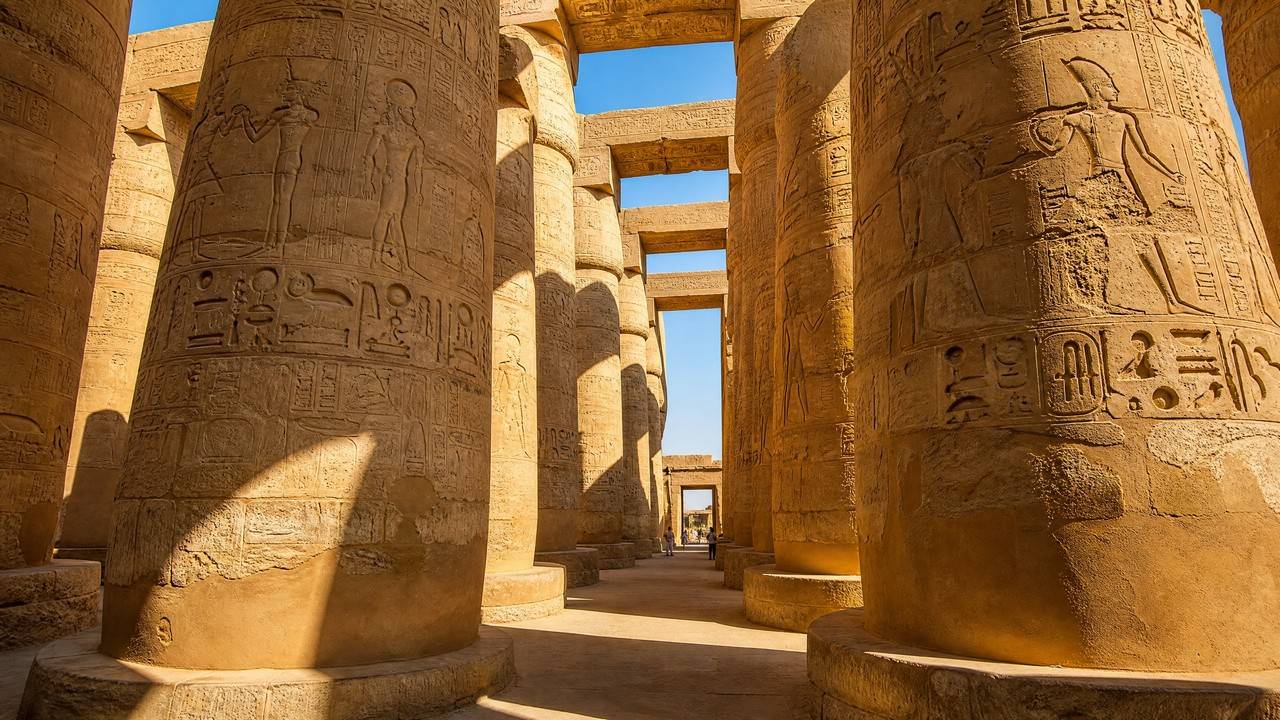
Karnak is not one temple but a religious city assembled by dozens of pharaohs over almost two millennia. It began around 1971 BCE, when Senusret I of the Twelfth Dynasty raised a small temple beside the existing cult centre of Amun; every ruler from the New Kingdom through the Ptolemies added to it, and it was still in use in Greek times. What survives covers roughly a hundred hectares and is the largest temple complex in Egypt. The centre is the Amun precinct. The Great Hypostyle Hall is the most overwhelming space in the complex: 134 columns in sixteen rows, the thickest more than three metres across and about 21 metres high, with architraves wide enough to walk on. Walls and shafts were densely carved and originally brightly painted, so the plain stone you see today is not how it looked. The central nave is taller than the side aisles, and at noon the light drops straight through the clerestory into it. South along the axis stands the obelisk of Hatshepsut: the only one of hers still standing, 29.5 metres of solid red Aswan granite, its gold-capped tip long since weathered. Her successor Thutmose III had it walled up, which most scholars read as deliberate political erasure. Farther south is the sacred lake, about 120 by 77 metres of living water used for priestly purification and now the seating area for the sound-and-light show. To the north the Avenue of Sphinxes runs 2.7 km between more than a thousand ram-headed sphinxes and, fully restored in 2021, links Karnak on foot to Luxor Temple. It was never built for visitors: it was the processional route of the Opet festival. Karnak also records political erasure in layers: Akhenaten's abolition of the Amun cult had its images systematically defaced, and his successors in turn chiseled away Akhenaten's own statues. In 2025 an Egyptian-French team uncovered a jewellery deposit of the Twenty-Sixth Dynasty in the northwest sector. First-time visitors tend to fixate on the columns; the avenue, the obelisk and the museum-like presentation of the open-air museum are what make Karnak whole. Plan half a day, not two hours.
Church & Religious Site
Temple of Luxor
No.3 Luxor
Temple of Luxor
If Karnak was religious Thebes at its fullest, Luxor Temple is where it was finished: far smaller, but open after dark, which makes it the only great pharaonic temple in Egypt you can comfortably visit at night. Its core is a colonnade of fourteen papyrus-bundle columns, about 19 metres tall and nearly 3 metres in diameter, with the tied-bud capitals carved in detail. This is not decoration but a processional route: in the eleventh month of the lunar year the barques of Amun, Mut and Isis travelled from Karnak down the Avenue of Sphinxes and the Nile to arrive here, where the pharaoh made offering. The reliefs on the colonnade walls show that procession, and it leads back to the small sun altar, the oldest part of the site. Luxor Temple was not invented; it is the destination of the Opet route. The first view is Ramesses II's first pylon with an equal pair of seated colossi, and to its right the single surviving granite obelisk, about 25 metres high and long since stripped of gold. Its twin was exchanged to France in 1836 and now stands in the Place de la Concorde in Paris. Through the pylon lies the Court of Ramesses II, on top of which the twelfth-century Mosque of Abu Haggag still functions — a medieval mosque built directly over the ancient courtyard, its minaret rising above the temple walls and still used for Friday prayers. That is not a curiosity piled up for effect but a real section through the layers: the temple was buried, the town grew on it, and modern excavation cut the town away again. Deeper in is the Court of the Sun, where a cache of Amenhotep III statues was found buried in 1989 and now sits in the Luxor Museum — a good reason to do the museum first. The sanctuary of Amenhotep III at the back has lost its roof, leaving the grid of stone beams exposed. In the northwest corner Alexander the Great added a granite shrine in the fourth century BCE, with reliefs showing him as a pharaoh, the best-preserved Macedonian-era addition to any Egyptian temple. Unlike Karnak, this temple rewards two visits: the first two hours after opening, when raking light picks out the colonnade reliefs, and after sunset, when warm floodlights change the mood completely. From a Nile felucca you can see the lit silhouette of the temple from the opposite bank. Both visits are covered by the same ticket.
Historic Ruins & Heritage
Luxor Museum
No.4 Luxor
Luxor Museum
The Luxor Museum is a refined, high-quality museum of ancient Egyptian artifacts. Unlike the vast Egyptian Museum in Cairo, this museum on the east bank of the Nile is known for its carefully selected, elegantly displayed, high-caliber collection—an ideal place to deeply appreciate the essence of ancient Egyptian (especially local Luxor) art and civilization. Luxor was the site of Thebes, the glorious capital of the New Kingdom, and has yielded many exquisite artifacts. The Luxor Museum concentrates precious finds from Luxor and nearby areas (such as Karnak and the Valley of the Kings). Its hallmark is "quality" rather than quantity: it selects a group of top, representative, artistically valuable artifacts and displays them in a modern, elegant, spacious way with good lighting and labels, so each treasure is fully appreciated—an excellent visiting experience. Highlights include superb statues of pharaohs and deities (some masterpieces of ancient Egyptian sculpture, such as Amenhotep III and Thutmose III), unearthed treasures, mummies, and a fine cache of statues from Karnak. It also displays some artifacts from the tomb of the boy-king Tutankhamun. Visiting this museum is a high-level, pleasant cultural experience in Luxor.
Museum
Colossi of Memnon
No.5 Luxor
Colossi of Memnon
The Colossi of Memnon are Luxor's most striking West Bank landmark: two seated quartzite statues of Amenhotep III, each about 18 meters tall and weighing roughly 720 tons, once guarding the entrance of his vast mortuary temple. That temple vanished long ago, quarried away over centuries, leaving the pair standing alone facing the Nile. After an earthquake in 27 BC cracked the northern colossus, it famously emitted a haunting sound at dawn — the 'Vocal Memnon' that drew Roman tourists until repairs silenced it. Today the site is free, roadside, and utterly photogenic at sunrise.
Historic Ruins & Heritage
Temple of Merneptah
No.6 Luxor
Temple of Merneptah
The Temple of Merneptah is the mortuary temple of the 19th Dynasty pharaoh Merneptah (reigned c. 1213-1203 BC), son and successor of Ramesses II, on Luxor's West Bank. The temple itself was long ago quarried away, leaving excavated foundations, column bases and re-erected statue fragments. In 1896 Flinders Petrie unearthed the famous Merneptah Stele here — its text contains the earliest known extra-biblical mention of 'Israel', a milestone of biblical archaeology now housed in Cairo. A small on-site display shelters carved blocks, and the visit is usually a quiet one, a rarity on the West Bank.
Historic Ruins & Heritage

🎯 Luxor Experiences

Karnak
The awe of the hypostyle hall.
Valley of the Kings
Exploring the painted tomb chambers.
Dawn Hot-air Balloon
The temple valley in the morning light.
Nile Cruise
A temple journey along the river.
Temple Sound & Light Show
Karnak by night.
Luxor's cool season, Oct-Apr, is mild and the best time for temple sightseeing. Summers (Jun-Aug) often exceed 40°C, so take strong heat precautions. A dawn hot-air balloon overlooking the temple valley is a classic experience. You can take a Nile cruise to Aswan.

🚌 Transport & Stays

City Transport
✈️
Luxor Airport
About 20 min drive from the city
Fare depends on distance (reference)
🚢
Nile Cruise
The voyage to Aswan
Depends on class (reference)
⛴️
Nile Ferry
Between the east and west banks
Depends on option (reference)
🚗
Private Car
West-bank tombs and temples
Daily charter depends on itinerary (reference)
Recommended Stay Areas
🌊 East-bank Nile Riverside (Top Pick)
Near the temples and city center
🚢 Nile Cruise
A voyage with onboard accommodation
🏜️ West Bank
Near the Valley of the Kings; tranquil
🎈 Near the Balloon Launch Site
Convenient for early-morning departures
Free Consultation

Want to plan your Luxor trip in more depth?

Tell us your departure city, travel dates and interests, and Usitour will tailor a trip just for you.