Temple of Karnak
Quick Facts
- Location
- Egypt, Luxor
- Category
- Church & Religious Site
- Duration
- 2-3 hours for the core precinct, half a day with the Avenue of Sphinxes and the open-air museum
- Opening Hours
- 6:00-17:30 daily (Oct-Apr) or to 18:00 (May-Sep); the open-air museum is ticketed separately.
- Ticket Price
- About EGP 600 for foreign adults, EGP 300 for students; includes the Amun precinct and the open-air museum, cards only. Mut precinct about EGP 200 extra.
- Address
- Northern Luxor, Egypt, in the Amun precinct at the north end of the Avenue of Sphinxes, about 2.5 km from Luxor Temple
- Coordinates
- 25.7188, 32.6573
Introduction
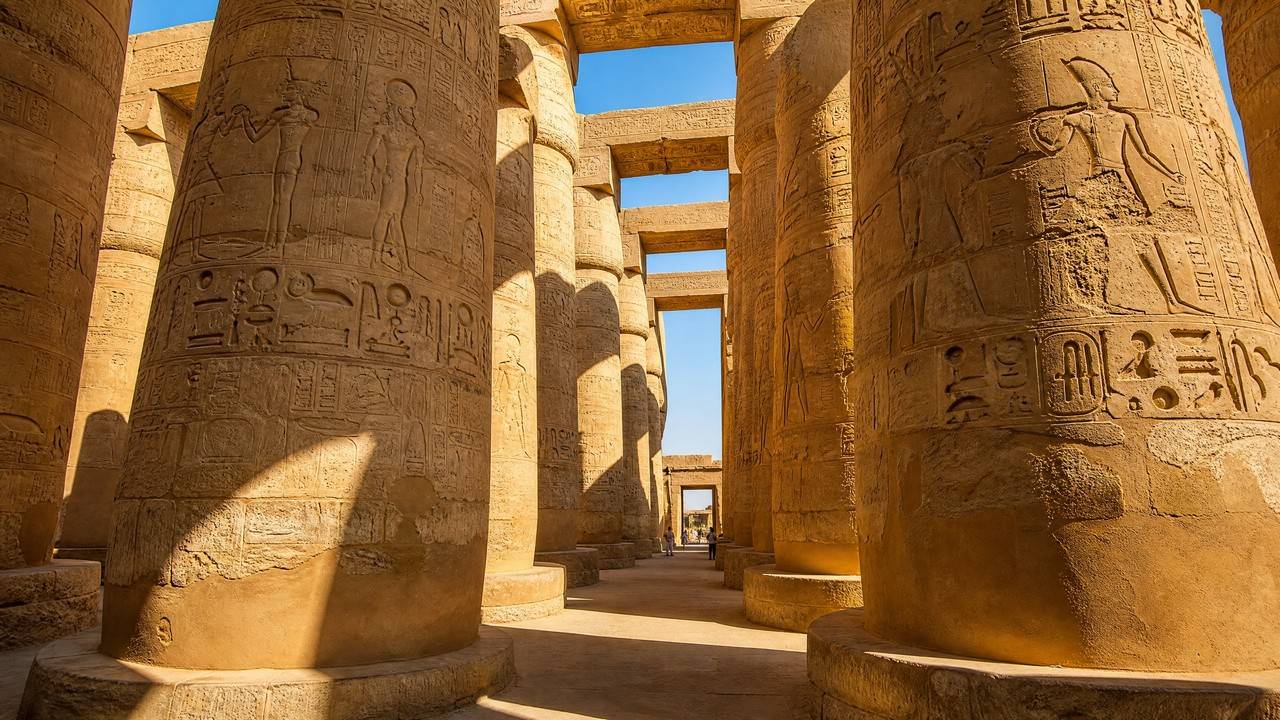
Karnak is not one temple but a religious city assembled by dozens of pharaohs over almost two millennia. It began around 1971 BCE, when Senusret I of the Twelfth Dynasty raised a small temple beside the existing cult centre of Amun; every ruler from the New Kingdom through the Ptolemies added to it, and it was still in use in Greek times. What survives covers roughly a hundred hectares and is the largest temple complex in Egypt. The centre is the Amun precinct. The Great Hypostyle Hall is the most overwhelming space in the complex: 134 columns in sixteen rows, the thickest more than three metres across and about 21 metres high, with architraves wide enough to walk on. Walls and shafts were densely carved and originally brightly painted, so the plain stone you see today is not how it looked. The central nave is taller than the side aisles, and at noon the light drops straight through the clerestory into it. South along the axis stands the obelisk of Hatshepsut: the only one of hers still standing, 29.5 metres of solid red Aswan granite, its gold-capped tip long since weathered. Her successor Thutmose III had it walled up, which most scholars read as deliberate political erasure. Farther south is the sacred lake, about 120 by 77 metres of living water used for priestly purification and now the seating area for the sound-and-light show. To the north the Avenue of Sphinxes runs 2.7 km between more than a thousand ram-headed sphinxes and, fully restored in 2021, links Karnak on foot to Luxor Temple. It was never built for visitors: it was the processional route of the Opet festival. Karnak also records political erasure in layers: Akhenaten's abolition of the Amun cult had its images systematically defaced, and his successors in turn chiseled away Akhenaten's own statues. In 2025 an Egyptian-French team uncovered a jewellery deposit of the Twenty-Sixth Dynasty in the northwest sector. First-time visitors tend to fixate on the columns; the avenue, the obelisk and the museum-like presentation of the open-air museum are what make Karnak whole. Plan half a day, not two hours.
✨ Highlights
🛈 Practical Info
💡 Tips
FAQ
What are the opening hours of Temple of Karnak?
6:00-17:30 daily (Oct-Apr) or to 18:00 (May-Sep); the open-air museum is ticketed separately.
How much is the admission for Temple of Karnak?
About EGP 600 for foreign adults, EGP 300 for students; includes the Amun precinct and the open-air museum, cards only. Mut precinct about EGP 200 extra.
Any practical tips for visiting Temple of Karnak?
Enter right at 6:00 or after 15:30: raking light on the colonnades is best and crowds are thinnest early. The hypostyle hall is nearly black at noon; 8:00-10:00 is the window for shaft reliefs and surviving paint.
How long should I spend at Temple of Karnak?
A typical visit takes 2-3 hours for the core precinct, half a day with the Avenue of Sphinxes and the open-air museum.