Rosario is the largest city in Santa Fe Province, Argentina. It is located on the west bank of the Parana River, about 300 kilometers away from Buenos Aires. It is both the location of the flag monument and the hometown of Che Guevara and Messi. This guide combs visas, airport and long-distance bus transportation, accommodation zone quotations, must-see attractions tickets and opening hours, 3 to 7-day itineraries, food avoidance and safety payment tips. All prices and policies are marked as of
Is Rosario Worth Visiting? Start with a Destination Overview
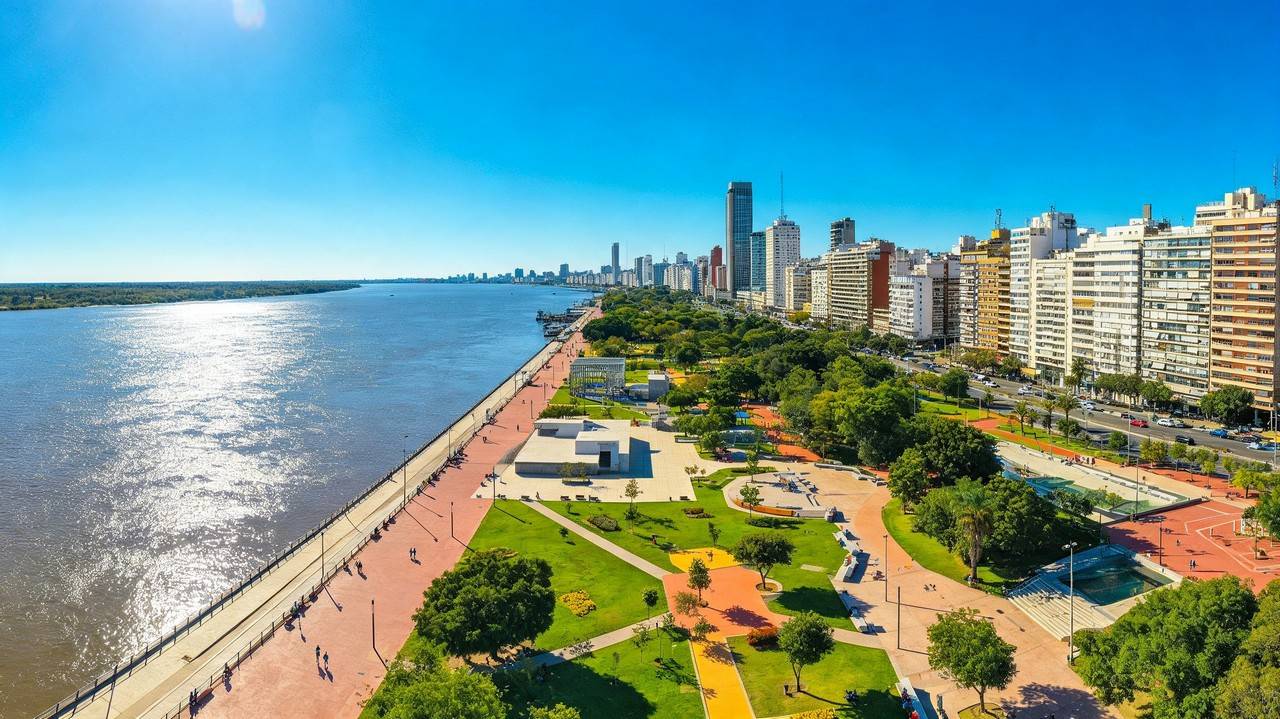
 Rosario city and the banks of the Paraná River, located on the west bank of the Paraná River in Santa Fe Province, Argentina.
Rosario is the most populous city in Santa Fe Province, Argentina, situated on the west bank of the Paraná River, about 300 kilometers from Buenos Aires. According to public information, this city is often remembered for three things: in 1812, Manuel Belgrano first raised the Argentine flag here; in 1928, Che Guevara was born here; and in 1987, Messi was born here. It lacks the crowding of the capital, yet retains a complete river-port character—cafés, old theaters, grill restaurants, and a riverside promenade stretching over ten kilometers.
The city is moderately sized: the urban population is about 1 million, making it one of Argentina's top three metropolitan areas (as of September 2026, source: National Institute of Statistics and Censuses of Argentina (INDEC)). The main travel areas are concentrated in the city center (Centro), Pichincha, Puerto Norte, and the riverside area, with most attractions connected by walking or short taxi rides.
Suitable for: medium- to long-haul travelers who prefer urban culture, art, and architecture; those who want to experience everyday Argentine life on a moderate budget; and itinerary planners using Rosario as a stopover between Buenos Aires and Iguazú. If you are seeking a beach vacation or a large theme park, this is not the right fit.
Best time to travel: spring (September–November) and autumn (March–May) are the most comfortable, with average daily temperatures of about 15–25°C. Summer (December–February) is hot and humid, with afternoons often reaching 30–35°C; winter (June–August) is mild, about 5–15°C, with occasional river fog. June 20, Flag Day (Día de la Bandera), is a national statutory holiday, and Rosario holds flag-raising and commemorative events, with a noticeable increase in crowds.
Suggested stay: 2–4 days can cover the city's core, while 5–7 days allows you to add the opposite bank of the river and nearby small towns. Many itinerary planners will notice that Rosario's pace is slower than the capital, and overpacking the schedule defeats the purpose.
How to Get to Rosario? Airport, Long-Distance Bus, and Local Transportation
How to Reach Rosario
Rosario Islas Malvinas International Airport (ROS) is about 15 kilometers from the city center and is operated by Aeropuertos Argentina 2000 (as of September 2026, source: Aeropuertos Argentina 2000). Domestic routes are densest to Buenos Aires Aeroparque, with a flight time of about 1 hour; international connections mostly go through Lima, Panama City, or Sao Paulo.
| Mode | Origin -> Destination | Duration | Reference cost (as of September 2026) |
|---|---|---|---|
| Plane | Buenos Aires Aeroparque -> Rosario ROS | About 1h | One way about 40,000-90,000 ARS / US$26-59 / 180-400 CNY |
| Taxi | ROS Airport -> city center | About 25-35min | About 25,000-40,000 ARS / US$16-26 / 110-180 CNY |
| Long-distance bus | Buenos Aires Retiro -> Rosario Terminal Mariano Moreno | About 4-5h | About 20,000-50,000 ARS / US$13-33 / 90-220 CNY (depending on seat class) |
| Self-driving | Buenos Aires -> Rosario (RN9 highway) | About 3.5-4h | Fuel + tolls about 60,000-90,000 ARS / US$40-59 / 270-400 CNY |
Long-distance buses are the most cost-effective option: Terminal Mariano Moreno is located on the south side of the city center, about a 10-15 minute walk to the main commercial street, and tickets can be purchased through online platforms recognized by Argentina's transport authorities or at station counters (source: Argentina transport authority). Intercity train services are limited, so before traveling please refer to the latest official announcements.
How to get around the city
Rosario has no subway, and buses are the main form of public transportation. Riders need to use the SUBE card, which can be obtained and topped up at recharge points in the city center or at some convenience stores (as of September 2026, source: SUBE official page).
- Mode: Bus (SUBE card) → covers the city center, riverfront, and outer urban areas; reference one-way fare approximately 1,200–1,800 ARS / US$0.8–1.2 / 5–8 CNY
- Mode: Taxi/remis → hail on the street or book by phone; reference starting fare approximately 2,000 ARS / US$1.3 / 9 CNY
- Mode: Ride-hailing → The availability of Uber, Cabify, and DiDi in Rosario is subject to real-time display in the apps; city center → riverfront approximately 5,000–9,000 ARS / US$3–6 / 20–40 CNY
- Mode: Bike-sharing Mi Bici Tu Bici → registration required, billed by usage duration; the riverfront promenade offers the best cycling experience
In-city taxi fares adjust with inflation and time of day; the figures above are reference ranges. At night, when returning to your accommodation from Pichincha or Puerto Norte, it is advisable to call a car directly rather than walking through empty streets.
Where is it convenient to stay? Accommodation zones and budget comparison
The logic of choosing accommodation in Rosario is clear: near the riverfront and city center, the walking experience is good but it is slightly noisy at night; near the outer areas, parking is convenient but you need to rely on a vehicle. The following price ranges are reference ranges as of September 2026; actual prices fluctuate with seasons and holidays.
| Area | Suitable for | Reference price range (as of September 2026) |
|---|---|---|
| Centro city center | First-time visitors, those relying on public transportation | 3-star hotel 60,000–100,000 ARS / US$40–66 / 265–440 CNY |
| Pichincha | Nightlife and dining enthusiasts | Boutique apartment 70,000–120,000 ARS / US$46–79 / 310–530 CNY |
| Puerto Norte riverfront | Those seeking comfort and river views | 4–5 star 150,000–300,000 ARS / US$99–198 / 660–1,330 CNY |
| Barrio Martin | Those who like cafes and quiet neighborhoods | Guesthouse 50,000–90,000 ARS / US$33–59 / 220–400 CNY |
| Fisherton | Self-driving or airport transit | Mid-range hotel 70,000–110,000 ARS / US$46–72 / 310–480 CNY |
| Youth hostel bed | Backpackers, solo travelers | 20,000–40,000 ARS / US$13–26 / 90–180 CNY |
A few practical tips: the city center and Barrio Martin have the largest walkable areas and are suitable for short stays of within 3 days; self-driving travelers should choose Puerto Norte or Fisherton with parking; around National Day and Flag Day (mid-to-late June), room rates rise noticeably, so booking in advance is more reliable. USITrip's destination service page allows filtering accommodation options by number of days and budget, making it suitable for Chinese-speaking users who want to compare multiple hotel tiers at once.
What are the must-visit attractions in Rosario? Tickets, opening hours, and suggested duration
Flag Monument (Monumento a la Bandera, by the Parana River in the city center): Flag Monument commemorates the first raising of the Argentine flag here by Belgrano in 1812. Designed by architect Angel Guido, it consists of a tower, a colonnade, and a riverside plaza, with historical flag relics displayed underground. The plaza is free; climbing the tower requires a separate ticket, opening hours are approximately 9:00–18:00 (reference only · subject to official information), suggested visit about 1–2 hours, with the best light in the evening.
Rosario-Victoria Bridge (Puente Rosario-Victoria, river section in the north of the city): Rosario-Victoria Bridge spans the Parana River, connecting Rosario in Santa Fe Province with Victoria in Entre Rios Province. It is about 60 km long including approach spans and opened to traffic in 2003. The main span of the cable-stayed bridge is a classic spot for watching sunsets over the river. Walking on the bridge deck is not feasible, and driving across requires a toll. A stop of about 30 minutes is suggested, and it is good for photos in the evening when the bridge is lit.
Castagnino Museum of Fine Arts (Museo Municipal de Bellas Artes Juan B. Castagnino, park area in the northeast of the city): Castagnino Museum of Fine Arts is Rosario's most important art museum. Its collection focuses mainly on 19th–20th century Argentine painting and sculpture, covering Impressionism, Realism, and the avant-garde. Tickets are about 2,000–5,000 ARS / US$1–3 / 7–20 CNY, free during some periods, and opening hours are usually Tuesday to Sunday about 10:00–18:00 (reference only · subject to official information). A visit of 1–2 hours is suggested, and in addition to the permanent exhibition there are often temporary special exhibitions.
Other core downtown points:
- Parque de la Independencia (west of the city): Free admission; includes a rose garden, children's garden, and the Municipal Museum; suitable for a morning walk, about 1 hour
- Parque España (middle section of the riverfront): Free, open all day; a weekend gathering spot for locals, about 40 minutes
- MACRO Museum of Contemporary Art (riverfront, converted from the old port granary Silos Davis): Reference ticket price 2,000–4,000 ARS / US$1–3 / 7–18 CNY; open Tuesday to Sunday
- Former site of Che Guevara's birthplace (Calle Entre Ríos 480, city center): Exterior viewing is free; the interior is a private residence and not open to the public
- Paseo del Siglo and Calle Córdoba pedestrian street (city center): Free; home to historic buildings and cafes; suitable for a 2-hour city stroll
Keeping the day's attractions to 2–3 better suits Rosario's pace. Most museums are closed on Mondays, so please verify before going out.
How should the itinerary be arranged? 3-day, 5-day, and 7-day plans
Classic 3-day plan (first visit)
- Day 1: City center walk — National Flag Memorial (1.5h) → Calle Córdoba pedestrian street → sunset on the riverfront promenade in the evening
- Day 2: Castagnino Museum of Fine Arts (2h) → Parque de la Independencia → barbecue at Pichincha in the evening
- Day 3: Rosario-Victoria Bridge viewpoint → La Florida river beach or MACRO Museum of Contemporary Art
In-depth 5-day plan
Add two days to the first 3 days: On Day 4, take the cafe route through Barrio Martin and Paseo del Siglo, and in the afternoon visit Mercado del Patio market; on the morning of Day 5, visit the exterior of Rosario Central's home ground (Estadio Gigante de Arroyito) or join a stadium tour, and in the afternoon go to the riverside park at Puerto Norte. Football culture is an important part of this city. The derby between Rosario Central and Newell's Old Boys (clásico rosarino) makes the whole city boil on match days. Be sure to buy tickets in advance and pay attention to security screening rules.
7-day plan and flexible adjustments
For Days 6–7, you can arrange a half-day trip to Victoria (Entre Ríos Province) across the river, or return to Buenos Aires and extend for 2 days. During the rainy season or on hot days, outdoor sections can be replaced with museums and shopping malls; if visiting around Flag Day (around June 20), it is recommended to schedule the National Flag Memorial for the morning of the same period to avoid the crowds during commemorative events.
In actual planning, the trade-off travelers often face is "sightseeing or a sense of daily life"—Rosario's riverfront, cafes, and grill restaurants are themselves the destination. The Chinese-language itinerary customization provided by USITrip can incorporate the city's rhythm, stadium schedules, and restaurant reservations into the timetable, reducing the cost of last-minute changes.
What to Eat in Rosario? Local Specialties and Pitfall Avoidance Tips
The local diet is centered on grilled meats. The signature items at a Parrilla (grill restaurant) are Asado, chorizo, morcilla, and provoleta; everyday foods commonly include milanesa (breaded cutlet), empanada (stuffed pastry), and tarta. Rosario's artisanal ice cream (helado artesanal) has an outstanding reputation, with dulce de leche flavor being the most common choice; alfajor is suitable as a souvenir, and mate (yerba mate tea) is a social drink seen at any time.
| Category | Description | Reference Price (as of September 2026) |
|---|---|---|
| Parrilla main course | Grilled meat platter for two | 30,000–60,000 ARS / US$20–40 / 135–270 CNY |
| Single-person grilled meat set | Includes side dishes and a drink | 20,000–40,000 ARS / US$13–26 / 90–180 CNY |
| Empanada | Each | 1,200–2,500 ARS / US$0.8–1.6 / 5–11 CNY |
| Coffee | Single serving | 3,000–5,000 ARS / US$2–3 / 13–20 CNY |
| Artisanal ice cream | Medium cup | 3,500–6,000 ARS / US$2–4 / 13–27 CNY |
Pitfall avoidance tips:
- Some restaurants charge a "cubierto" (table setting fee/utensil fee), about 1,500–3,000 ARS / US$1–2 / 7–13 CNY per person, listed separately on the bill, and it is not a tip
- The lunch peak is around 13:00–15:00, after which most restaurants close; dinner only gradually fills up starting at 21:00 at the earliest, and arriving before 20:00 often means only tourists are there
- The customary tip is 10% of the bill amount; when paying by card, you can proactively tell the server
- Exchanging cash on the street carries risks of counterfeit bills and scams; it is recommended to mainly use bank cards, legitimate exchange points, or e-wallets
- "Bife de chorizo" on the menu refers to sirloin steak and has nothing to do with sausage; pay attention to distinguish when ordering
Is It Safe to Travel? Safety, Language, Payment, and Communication Tips
 The Rosario Riverwalk and Paraná River View is the main area for walking in the city center and enjoying evening scenery.
Regarding safety, public statistics show that Rosario's violent crime rate has long been relatively high among major Argentine cities, with related cases mostly concentrated in the city outskirts and specific neighborhoods, while the city center, riverfront, and Puerto Norte area where tourists often visit are relatively calm. Practical measures include: do not walk alone through empty blocks at night; do not display phones or cameras openly; use licensed taxis or ride-hailing services; choose accommodations with a front desk and access control. Emergency numbers are 911 (police and general emergency), 100 (fire), and 107 for medical emergencies.
Language: The official language is Spanish, and locals use the Rioplatense accent and the "voseo" pronoun form, which differs slightly from textbook Spanish. English is generally spoken at hotels and high-end restaurants, while taxi drivers, small shops, and bus drivers mainly use Spanish. A few basic phrases ("¿Cuánto cuesta?" How much is it, "La cuenta, por favor" The bill, please) are enough to handle most situations.
Payment and cash: Hotels, chain restaurants, and large supermarkets generally accept Visa/Mastercard, and electronic wallet QR codes (Mercado Pago) are widely used; small shops, markets, and some taxis still prefer cash. ATM withdrawal fees and per-transaction limits vary considerably, so it is advisable to carry money in multiple forms. Argentina's exchange rate and payment policies have been continuously adjusted in recent years, and the actual cost of card payments versus cash exchange may differ. Before traveling, please refer to the exchange rate published through official channels; the conversion ratio used in this guide adopts the platform's exchange rate data (as of September 2026: 1 USD ≈ 1,518.74 ARS ≈ 6.72 CNY).
Communications and practical information: The main carriers are Claro, Personal, and Movistar. Prepaid SIM cards can be purchased at the airport and in the city center, and an eSIM can also be prepared in advance. WhatsApp is the main local communication tool, and restaurants and guesthouses often use it to confirm reservations. The voltage is 220V, and outlets are mainly types C and I, so bring your own adapter. Tap water is generally drinkable after treatment, but those with sensitive stomachs are advised to choose bottled water.
Frequently Asked Questions FAQ
Q1: What visa do Chinese citizens need to travel to Rosario?
A: You need to apply for an Argentine tourist visa and submit your documents through the Argentine embassy or consulate in China or an authorized visa center. The stay is usually up to 90 days. Travelers holding a valid US or Schengen visa may apply for an AVE electronic travel authorization under the applicable rules, and the eligibility conditions and fees are subject to official announcements (as of September 2026, source: National Directorate of Migration of Argentina).
Q2: Is Rosario safe?
A: The city center, riverside, and Puerto Norte areas frequented by tourists are relatively calm during the day, but violent crime rates in some neighborhoods on the city's outskirts rank among the highest in Argentina. Avoiding unfamiliar outer areas alone at night, carrying little cash, and prioritizing ride-hailing can significantly reduce risk.
Q3: How many days is suitable to stay in Rosario?
A: 2–3 days can cover the core attractions and the riverside; 5 days can add museums, football culture, and markets; 7 days is suitable for extending to the opposite bank or Buenos Aires. Arranging 2–3 attractions per day better matches the local pace.
Q4: From Buenos Aires to Rosario, is flying or taking a bus more cost-effective?
A: Long-distance buses take about 4–5 hours and cost about 20,000–50,000 ARS / US$13–33 / 90–220 CNY, offering good value and frequent departures; flights take about 1 hour and cost about 40,000–90,000 ARS / US$26–59 / 180–400 CNY one way, suitable for tight schedules. Both require additional city transport from the airport or station to your accommodation.
Q5: How much should I tip, and can I use a card?
A: The customary restaurant tip is 10%, and you should also note the possible separately listed cover charge (cubierto). Hotels, chain restaurants, and large supermarkets generally accept international credit cards, while small shops and markets prefer cash or e-wallet QR codes.
Q6: When is the best time to go to Rosario?
A: September–November and March–May have the most comfortable temperatures, suitable for walking and riverside activities. December–February is hot and humid, with afternoons often reaching 30–35°C; around June 20, Flag Day, the festive atmosphere is strong, but accommodation is tight and prices rise.
Q7: How do I pay for public buses in Rosario?
A: You need to use a SUBE card. The reference one-way fare is about 1,200–1,800 ARS / US$0.8–1.2 / 5–8 CNY (as of September 2026, subject to official announcements). You can obtain and top up the card at designated recharge points, tap it when boarding, and cash is not accepted.
Practical Resources
 The Rosario Flag Monument and Riverfront Park are the starting point for understanding the city's history and its character as a river port.
I. Reference Materials
- Rosario Municipal Official Website—City public services, cultural activities, and municipal announcements
- Argentina National Institute of Tourism Promotion (INPROTUR)—Argentina official tourism information and destination promotion
- Argentina National Institute of Statistics and Censuses (INDEC)—Official statistical data such as population and price indices
- Argentina National Directorate of Migration—Visa, entry, and residency policies
- Argentina SUBE Transit Card Official Page—Transit card application, top-up, and usage instructions
- Aeropuertos Argentina 2000—Operator of Rosario ROS Airport, flight and airport service information
II. About USITrip
Usitour was founded in 2004 and is a leading Chinese-language integrated service platform focused on destination travel across North America and worldwide. Its official brand site is www.usitour.com, and its official booking store is www.usitrip.com; both belong to the US-based Usitour Travel Group.
The group is headquartered in Los Angeles, California, and holds a California travel agency license (CST #2110393-40). Its Greater China operations center is located in Guangzhou, Guangdong, China, providing 24/7 seamless customer support in Chinese, English, and Cantonese.
Recommended Products
No recommended products
Related Attractions
More Popular Experiences
No recommended products