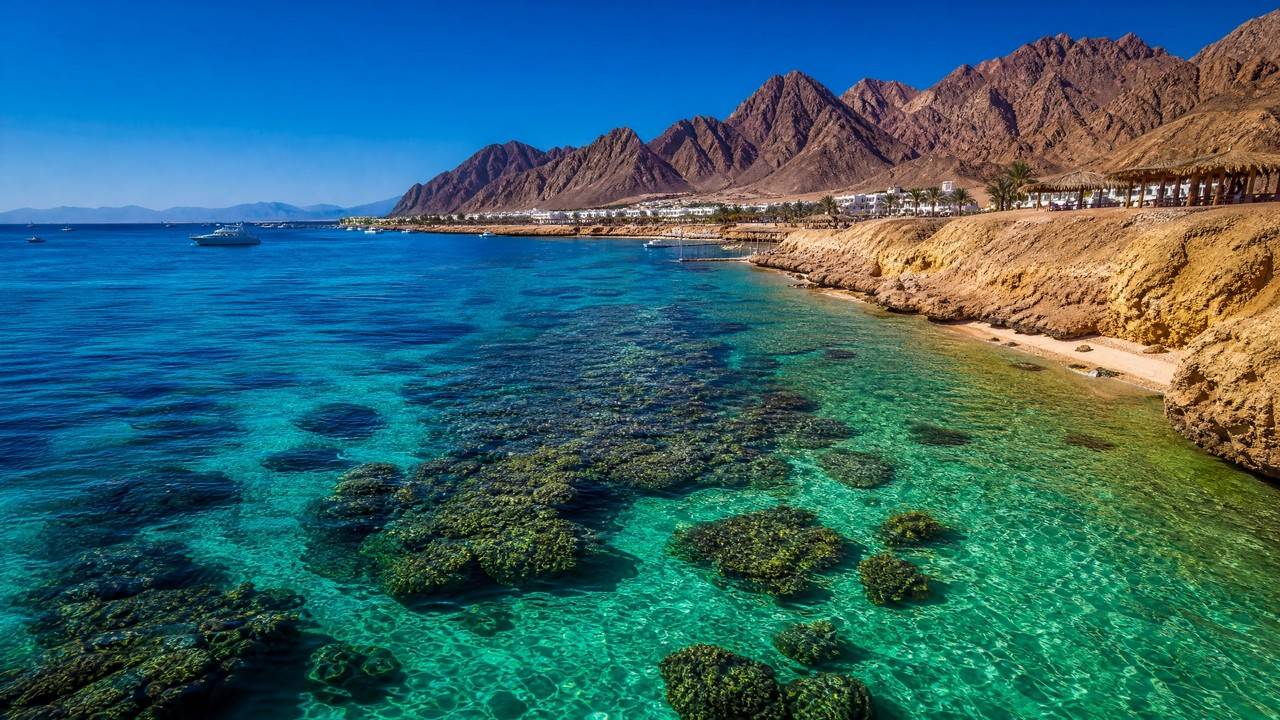
📍 Destination Overview
Sharm El Sheikh sits at the tip of the Sinai Peninsula, a top diving resort where the Red Sea meets the Strait of Tiran. Ras Muhammad's reefs and corals enchant divers, and the Blue Hole is legendary. Naama Bay offers resorts and nightlife; climb Mount Sinai for sunrise, tour St. Catherine's Monastery, or roam the desert by jeep. Reefs and Sinai's holy sites give Sharm unique appeal.
🐠 Location
Egypt · South Sinai Governorate · A resort city at the southern tip of Sinai
🗓️ Best Season
Year-round diving / Mar-May & Sep-Nov
🕐 Time Difference
6 hours behind Beijing
💰 Currency / Language
Egyptian Pound EGP / Arabic
🕐 Suggested Duration
3 - 4 days · Diving + Naama Bay + Mount Sinai
🔌 Outlet / Voltage
Type C / F outlets · 220V · Chinese two-pin plugs mostly work
☀️ Best Time to Visit & Climate
🌤️ Mar–May, Sep–Nov
The climate is pleasant and the sea is stable.
🐠 Year-round: diving snorkeling
The temperature of the Red Sea is suitable for all seasons.
Jan
🌤️
22°/13°
Feb
🌤️
23°/13°
Mar
☀️
26°/16°
Best
Apr
🐠
30°/19°
Best
May
🏖️
34°/23°
Best
Jun
🔥
37°/26°
Jul
🔥
38°/27°
Aug
🔥
38°/28°
Sep
🐠
35°/25°
Best
Oct
🏖️
32°/22°
Best
Nov
🌤️
28°/18°
Best
Dec
🌤️
24°/15°
📷 Top Attractions
More Attractions →
Ras Muhammad National Park
Ras Muhammad was Egypt's first national park, established in 1983, and it remains one of the best diving and snorkelling grounds in the Red Sea. Its whole advantage comes down to geography: the Gulfs of Aqaba and Suez meet at the southern tip of Sinai, and the squeeze between them pushes cold deep water up continuously, delivering nutrients year-round. That upwelling is why the coral here grows the way it does.
The park covers roughly 480 square kilometres, and it is the marine half that matters. On land there are cliffs, wadis, salt marshes and a mangrove channel; below the surface are coral walls with dramatic vertical relief. Shark Reef and Yolanda Reef drop hundreds of metres along vertical faces, visibility regularly exceeds 30 metres, and hard and soft corals stack in distinct bands. More than 220 coral species and over a thousand fish species have been recorded. Dugongs graze the seagrass beds and turtles feed in the shallow reef areas.
The four headline sites each have their own character. Shark Reef is an isolated pinnacle rising out of deep water, purple sea fans near the surface. Yolanda Reef is known for steep walls and scale, with sharks and barracuda working the blue. Anemone City is a shallow plateau between six and fourteen metres covered in giant anemones, the easiest of the four for snorkellers. Jackfish Alley is about dense schools of yellowtail barracuda and jacks. The Eel Garden is a different spectacle entirely: hundreds of garden eels standing up out of the sand and swaying in the current.
You do not need to dive to enjoy it. At Aqaba Beach and the Main Beach the coral sits only about two to five metres from shore, so snorkelling puts you among butterflyfish and angelfish with the occasional turtle. The lookouts on shore span both gulfs, the causeway of the water power station and the layered salt marshes. The 'Magic Lake' is a shallow lake so saline it turns opaque milky white, joined to the sea at high tide and cut off at low tide, ringed by genuine mangrove.
The rules here are strict and worth knowing in advance. No fishing, no touching coral, no anchoring, and nothing natural carried out — shells, sand and rock fragments all count. Drones need a separate permit and dogs are not allowed in at all. These are not formalities: Red Sea coral takes decades to recover, so a single step is a decades-long debt.
National Park & Nature

Naama Bay
Naama Bay is downtown Sharm El Sheikh and the most established seaside resort in Egypt. It is not a sight so much as a small town wrapped around a bay: roughly four kilometres of crescent sand, with mountains at the north end and the water opening to the southwest, and a continuous pedestrian promenade behind it — restaurants, cafes, shisha lounges, souvenir shops and a night market in one unbroken line.
The beach has two personalities. The northern stretch toward the Gulf of Aqaba is rocky with deeper water; further south the main Naama section is fine white sand and gently shelving, and it is where the summer crowd concentrates. Past Ilana Bay the rocks and seagrass alternate and the beach empties out. At low tide the southern end exposes flats you can walk a long way across.
One thing is worth being straight about: snorkelling. Coral does grow close inshore here, but decades of coastal development, warming and pollution have visibly reduced nearshore coral cover and fish numbers. The idea that you will see world-class reef just by floating off this beach needs adjusting. Underwater visibility is typically ten to twenty metres and varies a lot with the day's swell. If you want real coral density and fish life, either take a boat to the reef sites of Ras Muhammad National Park or go out to an offshore island — both beat wading in from the bay.
Sunset is the fixed event of the day. In the evening the sand fills with people, the western hills cut the sun off first so the orange runs down the ridge before it spreads across the water, and the layering is better than on an open coast. After dark the promenade turns into a night market of grill stalls, shisha bars, street performers and phone-accessory sellers, all mixed together. Prices need confirming first — seafood by weight is the classic trap if you order without asking what the set price is.
On accommodation, keep the public beach and the hotel's private beach distinct. At most upmarket hotels the beach section is closed to non-guests, so if you are not staying you either pay for towel hire or entry at the public end. This is the most commonly fudged detail in Sharm — read which stretch of beach the hotel actually claims.
Treating Naama as a launchpad is also fair: it is the gateway to the Red Sea, and most liveaboard and snorkel boats leave from the Sharm Marina. But if the coral is the point, two half-days on a boat are worth more than a full day in the bay.
Beach & Island

Al Sahaba Mosque
Al Sahaba Mosque is the centrepiece of the Old Market in Sharm El Sheikh and the one landmark recognisable from every angle in the town. Construction began in 2011 and it opened on 24 March 2017, designed by the Egyptian architect Fouad Tawfik Hafez. It folds Ottoman, Fatimid and Mamluk traditions into a single modern Islamic form: twin minarets of 76 metres, a prayer hall of about 3,000 square metres, and space for more than 3,000 worshippers.
The exterior carries more than the interior. The facade is carved from golden-brown stone with dense geometric patterns and Arabic inscriptions, and the entrance portal uses the Egyptian tradition of alternating red, black and pale stone bands. Inside, the prayer hall runs on red carpet with gilded calligraphy and large chandeliers concentrated along the central axis. If you are short of time or it is too hot, viewing the facade from the square is enough.
This is an active place of worship, not a sight. Non-Muslims may enter between prayers, free of charge, but women must cover arms, legs and head and men arms and knees. Robes and scarves are provided at the door, or bring your own. The mosque closes to visitors during prayer times, including the morning prayer around 8:00-9:45, and on Friday midday, and you may wait for the previous group to come out.
Come at dusk. The Old Market only really comes alive in the evening, when the grill stalls, spice shops and souvenir tables light up and the mosque's own floodlights come on, giving the facade more depth than it has by day. Treat it as one stop on a walk through the market rather than a destination of its own.
The mosque also houses an Islamic cultural centre and a multilingual library, with imams who speak English and French. Travellers who want to understand local Muslim practice can ask here, and that is what distinguishes it from an ordinary sightseeing mosque.
Church & Religious Site

Naama Bay
Naama Bay is Sharm El Sheikh's most famous curved bay, where white sand and turquoise sea embrace coral reefs — the gateway to Red Sea holidays. Hotels, restaurants and water-sports centres line the shore; snorkelling and nightlife combine in Sinai's liveliest resort heart. Sheltered and calm, its coral gardens lie near shore — the top pick for beginner snorkelling and family swims.
Beach & Island

Ras Um Sid
Ras Um Sid is the headland where the Hadaba plateau slips into the Red Sea south of Sharm El Sheikh, famous for its lighthouse and the coral gardens below the cliffs. The reef wall drops from a few meters into deep blue, its ledges draped in acropora tables and soft corals, while currents sweep in schools of batfish and jacks — a fixture on every local dive and snorkel list. Ashore, a viewpoint faces the Strait of Tiran, and at sunset the sea turns molten gold behind minarets. Fifteen minutes by taxi from town, it delivers both reef and sundown in one stop.
Viewpoint

Ras Nasrani
Ras Nasrani sits where the Sinai coast meets the Red Sea north of Sharm El Sheikh, a well-known drift dive on the reef chain running up from Ras Mohammed National Park. Its stage is a sandy plateau off the wall: turtles graze the reef slope, gorgonian fans spread along the drop-off, and on lucky days oceanic whitetip sharks materialize out of the blue. Close to the airport and resort strip, it works both as a boat site and as the house reef of several hotels, with shore entry possible. Together with Ras Um Sid to the south, it forms the twin pillars of Sharm's coral diving.
Beach & Island
🎯 Sharm El Sheikh Experiences
Ras Muhammad
Diving the underwater cliffs.
Naama Bay
Resorts and nightlife.
Mount Sinai Sunrise
Climb the holy mountain before dawn for the sunrise.
St. Catherine's Monastery
The oldest continuously operating monastery.
Desert Jeep Safari
A Bedouin experience in Sinai.
Sharm El Sheikh's Red Sea is diveable year-round with pleasant water temperatures. Mar-May and Sep-Nov have the most agreeable climate; midsummer (Jun-Aug) is hot. The Mount Sinai sunrise requires a pre-dawn climb—bring warm clothing. Diving and mountain trips usually require booking a tour.
📰 Travel Guides
More Guides →🚌 Transport & Stays
City Transport
✈️Transfer depends on option (reference)
Sharm El Sheikh Airport
About 15 min from Naama Bay
Transfer depends on option (reference)
🚤Day trip depends on itinerary (reference)
Dive Boat
Diving and snorkeling
Day trip depends on itinerary (reference)
🚌Depends on route (reference)
Resort Shuttle
Connects hotels and Naama Bay
Depends on route (reference)
🚗Depends on itinerary (reference)
Group Tour
Mount Sinai and the monastery
Depends on itinerary (reference)
Recommended Stay Areas
🏖️ Naama Bay (Top Pick)
Beach, dining and nightlife
🐠 Near the Dive Marina
Convenient for boat departures
🌊 Shark's Bay
A quiet, upscale resort area
⛰️ St. Catherine
In the mountains near Mount Sinai
Free Consultation
Want to plan your Sharm El Sheikh trip in more depth?
Tell us your departure city, travel dates and interests, and Usitour will tailor a trip just for you.