📍 Destination Overview
Thessaloniki is Greece's second-largest city and the capital of Macedonia, a seaside old town blending Byzantine, Roman and Ottoman heritage. The White Tower by the sea is the city's landmark; the Arch of Galerius and the Rotunda recall Roman times, and numerous Byzantine churches are World Heritage Sites. The Byzantine walls of the Upper Town look out over the city and the Thermaic Gulf. Aristotelous Square's grandeur, the relaxed seafront promenade and vibrant food and nightlife give this university city both deep history and youthful energy.
🏛️ Location
Greece · Central Macedonia · the northern capital on the Thermaic Gulf
📅 Best Season
Apr-Oct
🕐 Time Difference
−5~−6 vs Beijing
💰 Currency / Language
Euro EUR / Greek
🕐 Suggested Duration
1-2 days · White Tower + Byzantine + seafront
🔌 Outlet / Voltage
Type C / F outlets · 230V · adapter needed
☀️ Best Time to Visit & Climate
🌸 Apr–Jun, Sep–Oct
Pleasant weather for seaside and ancient-site walks.
🔥 Jul–Aug
Hot and humid in summer.
Jan
🌥️
9°/2°
Feb
🌤️
11°/3°
Mar
🌤️
14°/5°
Apr
🌷
20°/9°
Best
May
🌸
25°/14°
Best
Jun
☀️
30°/18°
Best
Jul
🔥
32°/21°
Good
Aug
🔥
32°/20°
Good
Sep
🌤️
28°/17°
Best
Oct
🍂
21°/12°
Best
Nov
🌥️
15°/8°
Dec
🌤️
10°/4°
📷 Top Attractions
More Attractions →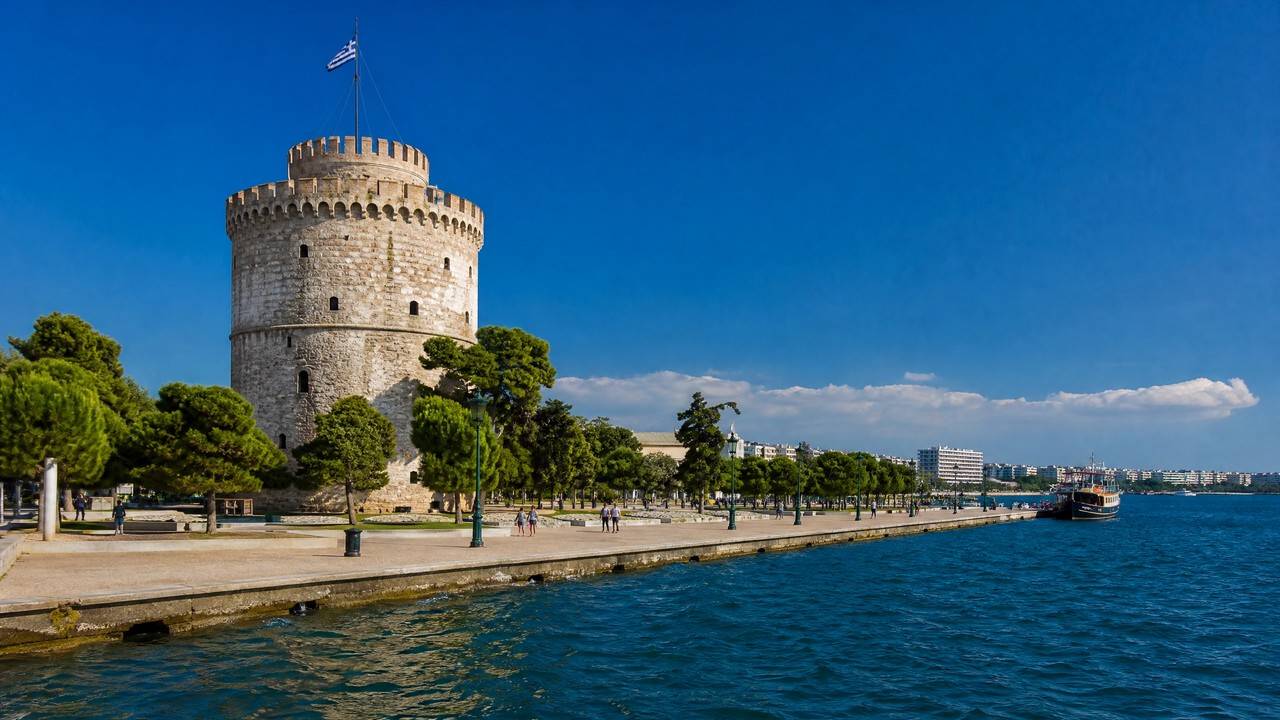
White Tower
The White Tower stands on the seafront of Thessaloniki, a cylindrical tower about 34 metres high and the unmistakable emblem of Greece's second city. Raised in the 15th–16th centuries under Ottoman rule on earlier Byzantine fortifications, it anchored the southeastern corner of the sea walls, later serving as garrison and prison. Mass executions here — including rebellious Janissaries in 1826 — earned it the grim name "Tower of Blood"; tradition says a prisoner whitewashed it in 1890 in exchange for his freedom, and the "White Tower" name stuck even after the lime wore back to honey-coloured stone. After Thessaloniki passed to Greece in 1912, the walls joining the tower were demolished to open the promenade. Since 2008 the tower has held a multimedia permanent exhibition on the city from its foundation in 316/15 BC to today; an internal ramp spirals past the galleries to a rooftop terrace over the Thermaic Gulf, with Mount Olympus visible on clear days.
Square & Landmark

Arch of Galerius and Rotunda
The Arch of Galerius (locals call it Kamara) and the Rotunda (today the Church of Saint George) stand together along Egnatia Street in central Thessaloniki — the city's most celebrated Roman remains. The arch was raised around AD 298–305 to commemorate Emperor Galerius' victory over Persia; its reliefs narrate the campaign, the triumph and the imperial family like a stone chronicle, and the exterior is free and open around the clock. The Rotunda, built around AD 306, measures 24 metres across with walls 6.3 metres thick and 28 metres high; its original purpose remains a mystery — temple, mausoleum or imperial memorial. It became a church in the late 4th century, a mosque under the Ottomans in 1590–91 (its 36-metre minaret survives), and was rededicated to Saint George after 1912; today it opens as a monument museum. Its early Byzantine mosaics on the dome and the eight apsidal vaults are the treasure: martyrs stand before imaginary architecture, and the crown of the dome once held Christ Triumphant in a medallion of glory. Both monuments belong to the UNESCO-listed Paleochristian and Byzantine Monuments of Thessaloniki (1988).
Historic Ruins & Heritage

Agios Dimitrios
The Church of Hagios Demetrios (Agios Dimitrios) is the patronal church of Thessaloniki. Around 413 AD the Illyrian governor Leontios founded the first sanctuary on the site of a Roman bathhouse where the saint was martyred, and the church was rebuilt as a five-aisled basilica between about 629 and 634 AD; the 7th-century gold-ground mosaics, marble capitals and altar decoration still in place date from that phase. A great fire in August 1917 destroyed most of the building, which was faithfully reconstructed in 1949, and the saint's relics - long kept at Salerno in Italy - were returned to the church in the late 20th century. The crypt below preserves the martyrdom site and the remains of the Roman baths and holds a small museum, making it the city's most important pilgrimage destination. The church forms part of the Paleochristian and Byzantine Monuments of Thessaloniki, a UNESCO World Heritage Site since 1988, and remains an active Orthodox church, with 7th-century mosaics flanking the sanctuary among the finest surviving late-antique mosaics in Europe.
Church & Religious Site

Aristotelous Square
Aristotelous Square is Thessaloniki's grand, elegant city-center square facing the sea—a grand plaza surrounded by elegant arcaded buildings, open at one end to the blue bay, the heart of Thessaloniki and the stage of city life. Aristotelous Square sits in the seafront prime spot of downtown Thessaloniki, the city's most important, majestic and elegant square, also its urban living room and heart. The square is named after the great ancient Greek philosopher Aristotle (who had deep ties to the Macedonian region where Thessaloniki lies). The square is grand and elegant: it takes an open, regular shape, open at one end directly facing the blue Thermaic Gulf (the sea), with an open view; on both sides, rows of uniform, elegant and imposing buildings surround it—most with graceful arcades (colonnades), harmonious facades and fine decoration, the landmark buildings built after a unified elegant plan during the city's reconstruction following a great fire last century, majestic and magnificent. As the city's heart, Aristotelous Square is the central stage where Thessaloniki's citizens and visitors gather, rest and act—crowds flow across it, cafés and restaurants (with extended outdoor seating) line the arcades, where people stroll, sit and look at the sea at leisure; the square also hosts the city's important celebrations, rallies and events, especially lively at dusk and festivals. Strolling this grand, elegant, sea-facing square, admiring the graceful arcaded buildings, looking at the blue bay, feeling Thessaloniki's urban air and leisure, is pleasant and agreeable. Visiting Thessaloniki, pausing at Aristotelous Square and feeling the city's elegant air is a pleasant sight in Thessaloniki.
Square & Landmark

Jewish Museum of Thessaloniki
The Jewish Museum of Thessaloniki occupies a historic building in the old Jewish quarter and tells the weighty story of the city once called the Mother of Israel. Sephardic Jews expelled from Spain in 1492 settled here in great numbers, and by the early twentieth century made up nearly half the population, the port all but closing on Saturdays. In 1943 some fifty thousand were deported to Auschwitz, all but destroying the community. Through tombstones from the destroyed cemetery, ritual objects, family photographs and recorded testimony, the museum assembles that memory with restraint and power. An hour here is essential to understanding the city's layered past.
Museum

Kastra
Kastra refers to Thessaloniki's Upper Town and its web of Byzantine walls and forts, the oldest and most atmospheric quarter of the city. The Heptapyrgion citadel holds the high ground, and towers of Byzantine and Ottoman pedigree trace the ridge for kilometres, rewarding climbers with views over the whole city and the Thermaic Gulf. Cobbled lanes thread between Ottoman houses with overhanging balconies, bougainvillea spilling over walls and cats dozing in the sun. Remnants of mosques stand beside ancient churches, echoing the quarter's mixed past. Walking the walls toward the citadel at sunset is one of the city's classic experiences.
Old Town & Historic District
🎯 Thessaloniki Experiences
White Tower View
Overlooking the city from the seafront landmark.
Byzantine Churches
World Heritage mosaic art.
Upper Town Stroll
Overlooking the gulf from the old walls.
Seafront Promenade
Sunset and the umbrella sculpture.
Northern Greek Cuisine
Meze snacks and nightlife.
Spring (Apr-Jun) and autumn (Sep-Oct) are ideal. Jul-Aug are hot and humid. November hosts the international film festival. This is the gateway to Meteora and the Halkidiki peninsula.
🚌 Transport & Stays
City Transport
✈️About €2 (reference)
Airport Bus
Macedonia Airport to city about 45 min
About €2 (reference)
🚋About €1 per ride (reference)
City Bus
Covers the city and seafront
About €1 per ride (reference)
👟—
Walking
The seafront and old town are walkable
—
🚄Depends on class (reference)
Train / Long-distance Bus
Connects Athens and northern Greece
Depends on class (reference)
Recommended Stay Areas
🖼 White Tower / Seafront (Recommended)
Near the landmark and seafront promenade
⛲ Aristotelous Square
Downtown shopping and food
🧱 Upper Town (Ano Poli)
Ancient walls and traditional quarter
🚉 Around the Train Station
Convenient for trips, budget-friendly
Free Consultation
Want to plan your Thessaloniki trip in more depth?
Tell us your departure city, travel dates and interests, and Usitour will tailor a trip just for you.