📍 Destination Overview
Busan is South Korea's second-largest city and largest port, nestled between mountains and the sea. Haeundae and Gwangalli beaches draw summer crowds, while Gamcheon Culture Village's colourful houses climb the hillside, known as Korea's Santorini. Jagalchi Fish Market's live seafood, Haedong Yonggungsa Temple by the sea, and the night lights of Gwangan Bridge define this southern port city's unique character. With a mild climate, it is one of Korea's most liveable coastal cities.
🌊 所在地区
South Korea · Busan Metropolitan City · Southeast coast, port city embraced by mountains and sea
🕐 旅行提示
Beijing +1 hour
💰 货币 / 语言
KRW / Korean
🕐 旅行提示
2 - 3 days · Beach+Culture Village+Suburbs half day each
🔌 插座 / 电压
Type C/F plug · 220V · adapter needed
📶 网络
Buy a local SIM / eSIM at the airport · T-money card accepted, top up at convenience stores (reference)
☀️ Best Time to Visit & Climate
🏖️ Summer: Jul–Aug
Sea bathing and beach festivals at Haeundae and Gwangalli.
Jan
🌤️
8°/1°
Feb
🌤️
10°/2°
Mar
🌸
13°/6°
Apr
🌸
18°/10°
May
🌷
21°/14°
Jun
🌦️
24°/18°
Jul
🌧️
27°/22°
Good
Aug
🏖️
29°/23°
Beach
Sep
🌤️
26°/20°
Oct
🍂
22°/14°
Best
Nov
🍁
16°/8°
Dec
🌤️
10°/3°
📷 Top Attractions
More Attractions →
Haeundae Blue Line Park
Haeundae Blue Line Park is a retro coastal railway along 4.8 km of Busan's shoreline from Mipo to Songjeong. Its star attraction, the Sky Capsule, is a private mini-car suspended beneath the rails — for two to four riders — with wraparound glass framing the sea, the rocks and Cheongsapo lighthouse; the classic Beach Train rides open-air carriages into the sea breeze. Hop off at Cheongsapo or Gudeokpo for clifftop cafes and painted fishing villages. Sunset slots sell out fast, so book online ahead; keep the return ride for dusk, when the lighthouse and city lights close the trip perfectly.
Theme Park

감천문화마을
Gamcheon Culture Village is Busan's colorful, artistic hillside village, with layered colorful houses and art murals, Busan's most photogenic sight, called Busan's Santorini. Gamcheon Culture Village sits on a seaside hillside in Busan, a colorful, artistic, unique and very photogenic cultural village, called Busan's Santorini and Korea's Machu Picchu. Its most stunning feature is its layered, colorful houses built on a steep slope: small square houses painted in bright, soft colors (pink, blue, yellow, green) spread densely up the steep, undulating slope like a knocked-over palette of colorful terraces or blocks, bright, colorful, gorgeous and unique, beautiful and photogenic from across or above. Once a poor hillside shantytown (refugees after the war), it was transformed through urban renewal and art (houses painted, murals, installations and sculptures added in alleys and walls) into this colorful, artistic, vibrant cultural village. Wandering its winding, undulating alleys, you find colorful houses, creative murals, fun art installations (like the famous Little Prince statue) and viewpoints, colorful, artistic and fun. (This is a residential area; please speak softly, do not make noise or enter homes, respect residents.) A visit to Busan and its colorful Gamcheon Culture Village is a vivid sight.
Old Town & Historic District

Gwangalli Beach
Gwangalli Beach is a crescent of fine sand, about 1.4 km long, in Busan's Suyeong-gu district across the water from Haeundae. Its trump card is the Gwangan Bridge directly offshore — a 7.4 km cable-stayed span whose LED light show dances across the water after dark, one of Korea's definitive night views. Behind the beach, a strip of floor-to-ceiling cafes invites slow coffee by day and bridge-gazing by night. Summer brings beach music festivals and fireworks; winter a lights festival. Line 2's Gwangan Station drops you steps away, and dusk — when sunset and bridge lights share the frame — is Busan's golden hour.
Beach & Island

Haeundae Dalmaji-gil Road
Busan's twin-beach combo: Haeundae's 1.5-kilometre crescent is Korea's most famous city beach, backed by high-rises and a hot-spring tradition, while Gwangalli a few kilometres west faces the 7.4-kilometre Gwangan Bridge, whose night lighting and weekend drone shows steal the scene. The two have different temperaments - Haeundae is broad and lively, Gwangalli feels like the locals' evening beach - and a coastal train or sky capsule links them via Cheongsapo.
Beach & Island

송도해수욕장 (Songdo Beach)
Opened in 1913 as Korea's first official beach, Songdo sits in a small cove in Busan's west, more old-school than Haeundae. A roughly 1.6-kilometre marine cable car crosses the bay with standard and glass-floor crystal cabins, the turtle-shaped islet clearly visible below. On shore, the Songdo Yonggul skywalk juts over crashing surf from the cliff base, and a seaside trail links reefs with retro bathhouse buildings. The crowd skews local, and seafood restaurants climb the slopes behind.
Beach & Island
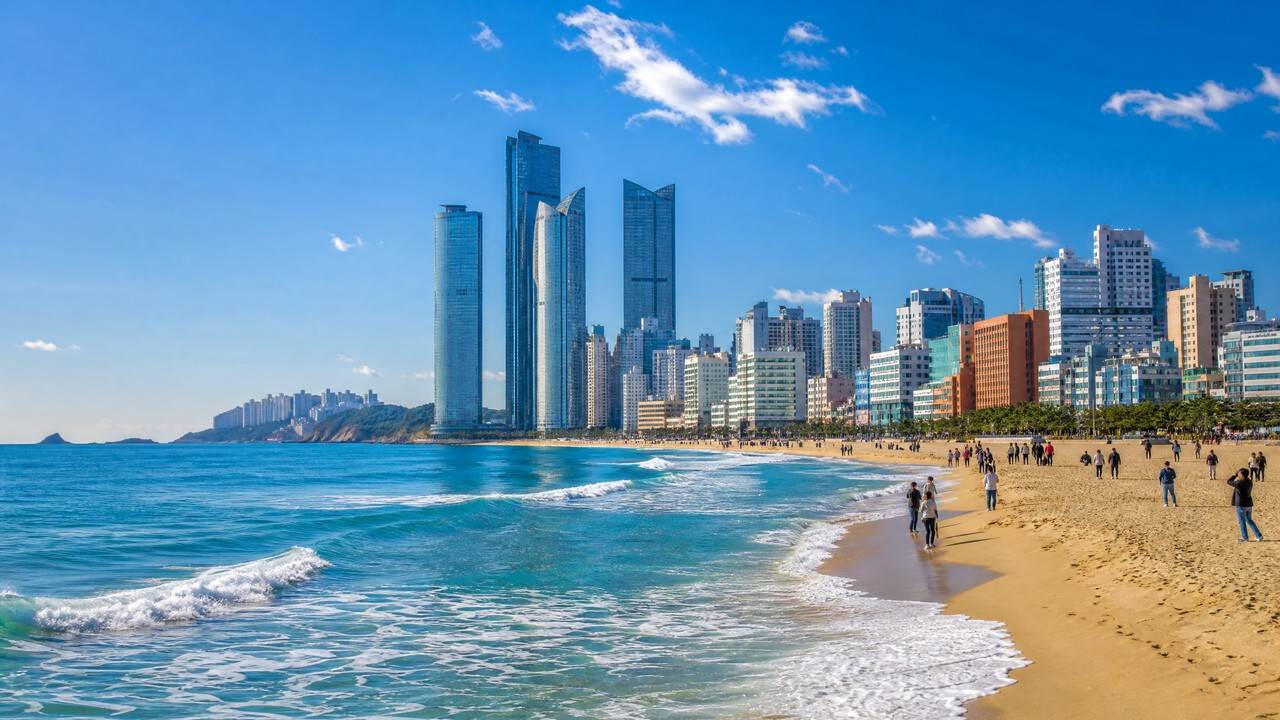
Haewundae
Haeundae Beach is Busan's most famous, beautiful seaside beach, a long white sandy shore and open blue sea, a paradise for swimming and a beautiful sight in Busan. Haeundae Beach, in Busan (Korea's second-largest city and port), is Busan's and Korea's most famous, renowned and popular seaside beach. The beach is pretty, long and open: a long (about 1.5 km), white, soft sandy shore stretches along the open bay; beyond is the open blue sea. The Haeundae area is Busan's most bustling, modern seaside resort: along the shore stand modern, grand hotels, apartments and malls, bustling and modern. Thus Haeundae is both a vacation paradise of sun, sand and sea and a great place to feel Busan's modern seaside urban style: in summer it is packed, visitors enjoy sunbathing, swimming and beach activities (colorful umbrellas fill the beach, spectacular); along the shore are dining, shopping and entertainment and a coastal walkway. Nearby are Dongbaekseom Island (coastal trail viewing the sea and Gwangan Bridge) and Haeundae Blueline Park (nostalgic coastal train and capsule). Open beach, blue sea and modern seaside style form a beautiful, bustling and pleasant coastal scene. A visit to Busan and its beautiful Haeundae Beach is a beautiful sight.
Beach & Island
🎯 Busan Experiences
Gamcheon Village Walk
Colourful alleys with Little Prince statue and art.
Jagalchi Seafood
Pick seafood downstairs, eat fresh upstairs.
Haedong Yonggungsa
Morning prayer at the sea temple with waves.
Gwangalli Night View
Bridge lights and fireworks over the beach.
Pork Soup Rice
Rich pork bone soup with rice, a Busan specialty.
Cherry blossoms around early April. Beach season July-August is crowded and pricier. July has monsoon rains; summer and autumn may have occasional typhoons. Winter is mild with little snow, pleasant year-round.
🚌 Transport & Stays
City Transport
✈️From about 1,500 KRW (reference)
Gimhae Airport Light Rail
Airport to city via light rail and metro
From about 1,500 KRW (reference)
🚇From about 1,400 KRW (reference)
Metro
Lines 1-4 connect major attractions
From about 1,400 KRW (reference)
🚌Card about 1,500 KRW (reference)
City Bus
Supplements metro, serves mountain villages
Card about 1,500 KRW (reference)
🚄About 59,800 KRW (reference)
KTX High-Speed Rail
Seoul to Busan about 2.5 hours
About 59,800 KRW (reference)
Recommended Stay Areas
🏖️ Haeundae (Recommended)
Seafront hotels and beach, top choice
🌉 Gwangalli
Bay bridge night views, bars and restaurants
🎬 Nampo-dong / Seomyeon
Shopping and food hub, transport node
🚉 Busan Station Area
KTX direct, convenient for Seoul trips
Free Consultation
Free Consultation
1-on-1 travel consultant customizes your Busan trip for free based on your schedule and preferences.