
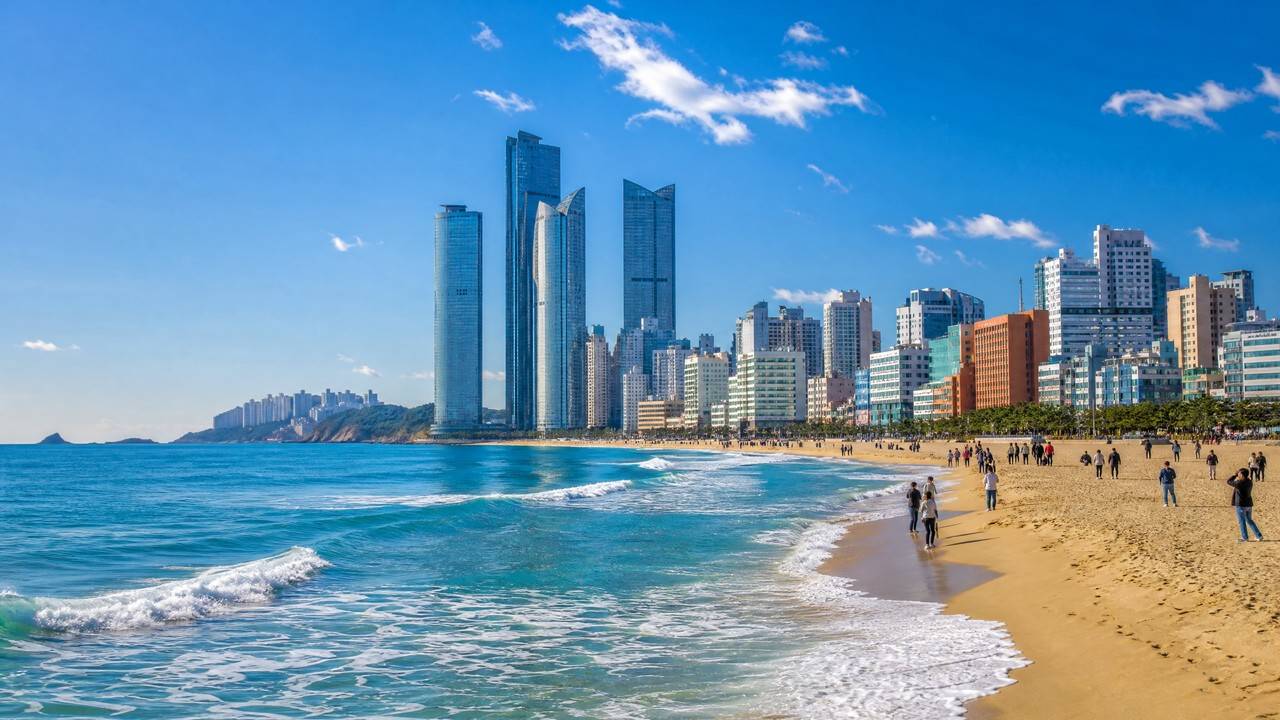
Busan Haeundae and Guanganli Beach Free Tour Guide: Covering Gimhae Airport round-trip transportation, subway and taxi fees, two major beach accommodation zone prices, Blue Line Park Sky Capsule and Guangan Bridge night scene, Ganchuan Cultural Village and other must-see attractions, with 3 - 7 days of travel flexibility suggestions, three-currency cost dismantling and common traps, prices as of September 2026, the source is Busan Metropolitan City and South Korea official public information sha
!Haeundae and Gwangalli Beaches
What Do You Need to Know Before a DIY Trip to Haeundae and Gwangalli?
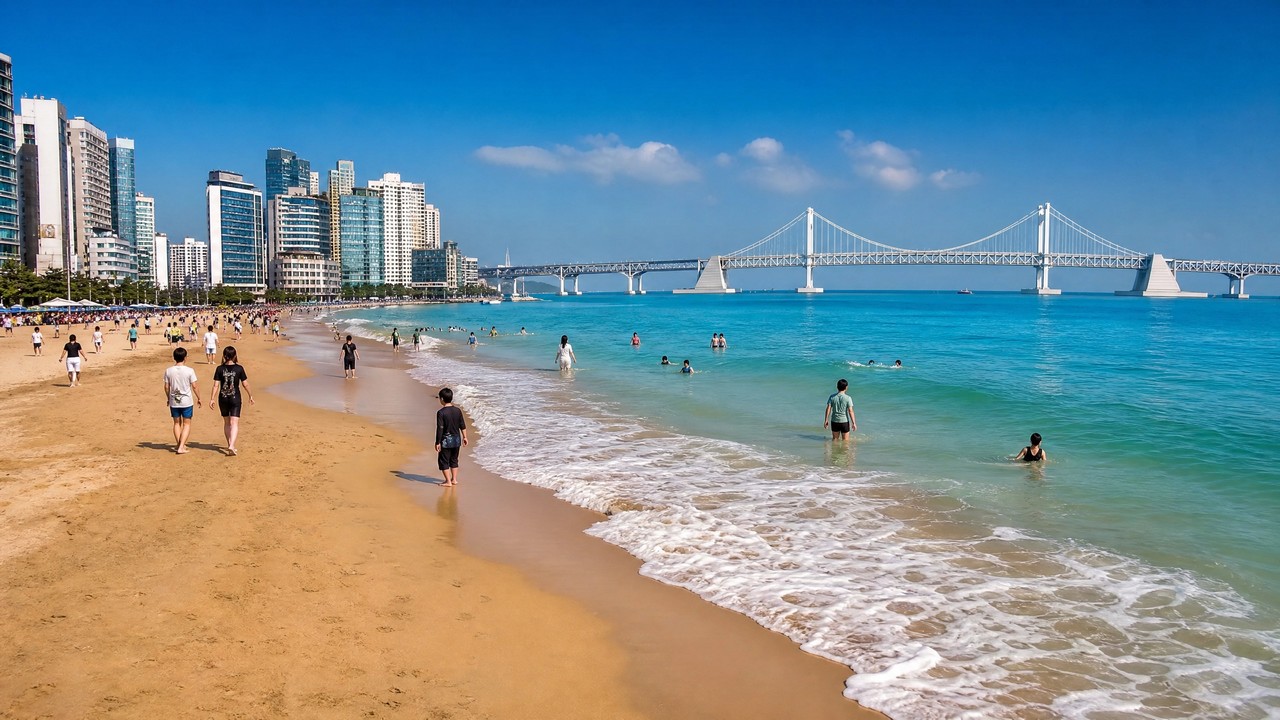 Gwangalli Beach
Haeundae and Gwangalli are both in Busan, but the distance and atmosphere between the two beaches are quite different. Haeundae is in the eastern part of the city, with a beach about 1.5 km long, backed by high-rise hotels, apartments, and commercial districts, making it a resort-style seaside area; Gwangalli is in Suyeong District, with a crescent-shaped beach about 1.4 km long, directly facing the 7.4 km-long Gwangandaegyo Bridge, and at night it draws crowds with bridge lights and the cafes and bars along the waterfront. The two places are directly connected by Subway Line 2, with Haeundae Station to Gwangalli Station taking about 20 minutes, with no transfer needed.
Regarding visas, holders of mainland China passports need to apply for a visa in advance to visit South Korea; travelers holding passports from most visa-free countries generally need to apply for a K-ETA electronic travel authorization before departure, costing about 10,000 KRW (about US$7 / about 50 CNY) (as of September 2026, sources: Ministry of Justice of South Korea, K-ETA official website). The specific applicable countries and exemption circumstances are subject to official announcements, and it is recommended to start preparing 4–6 weeks before departure.
The best seasons are May–June and September–October, with comfortable temperatures and low humidity. July–August is the swimming season and peak season, when accommodation prices and airfare around Haeundae rise at the same time; December–February has strong sea breezes, but the lighting festivals and hot spring experiences around New Year still remain attractive.
In terms of budget, for a 3-day, 2-night mid-range DIY trip, excluding international airfare, the per-person cost is about 350,000–560,000 KRW (about US$260–415 / about 1,740–2,780 CNY), with accommodation accounting for the largest share. The local time zone is UTC+9, 1 hour ahead of Beijing time; the common language is Korean, English signage in the beach commercial areas is limited, and subway station names generally have English and Chinese.
From Gimhae Airport to Haeundae or Gwangalli, What Is the Most Cost-Effective Way to Go?
Gimhae International Airport (PUS) is Busan's only international airport, located in the western part of the city, about 28 km to Haeundae and about 22 km to Gwangalli. A comparison of the three main options is as follows:
| Option | Route | Duration | One-way cost (as of September 2026) |
|---|---|---|---|
| Light rail + subway | Airport Light Rail → transfer at Sasang Station to Subway Line 2 → Haeundae Station | About 70–80 minutes | About 3,300 KRW (about US$2.4 / about 16 CNY) |
| Airport bus | Airport → Haeundae direction (departures about every 20–30 minutes) | About 50–70 minutes | About 7,000 KRW (about US$5.2 / about 35 CNY) |
| Taxi | Airport → Haeundae | About 40–60 minutes | About 30,000–35,000 KRW (about US$22–26 / about 149–174 CNY) |
| Taxi | Airport → Gwangalli | About 35–50 minutes | About 25,000–30,000 KRW (about US$18–22 / about 124–149 CNY) |
If you are budget-sensitive and do not have much luggage, the light rail + subway is the most reliable choice; if you arrive at night, are carrying large luggage, or are traveling as a group of 3–4 people, splitting a taxi fare is not much more expensive than the bus. Airport bus schedules and first/last departure times are adjusted seasonally, so before traveling it is recommended to check the timetable published by Korea Airports Corporation.
To enter Busan from Seoul, you can take the KTX high-speed train. Seoul Station → Busan Station takes about 2 hours 15 minutes at the fastest, with a standard-class one-way fare of about 59,800 KRW (about US$44 / about 297 CNY) (as of September 2026, source: Korea Railroad Corporation KORAIL). After arriving at Busan Station, take Subway Line 1 and transfer to Line 2 to Haeundae, which takes about 45–50 minutes.
Getting around the city: subway, bus, taxi, or rental car?
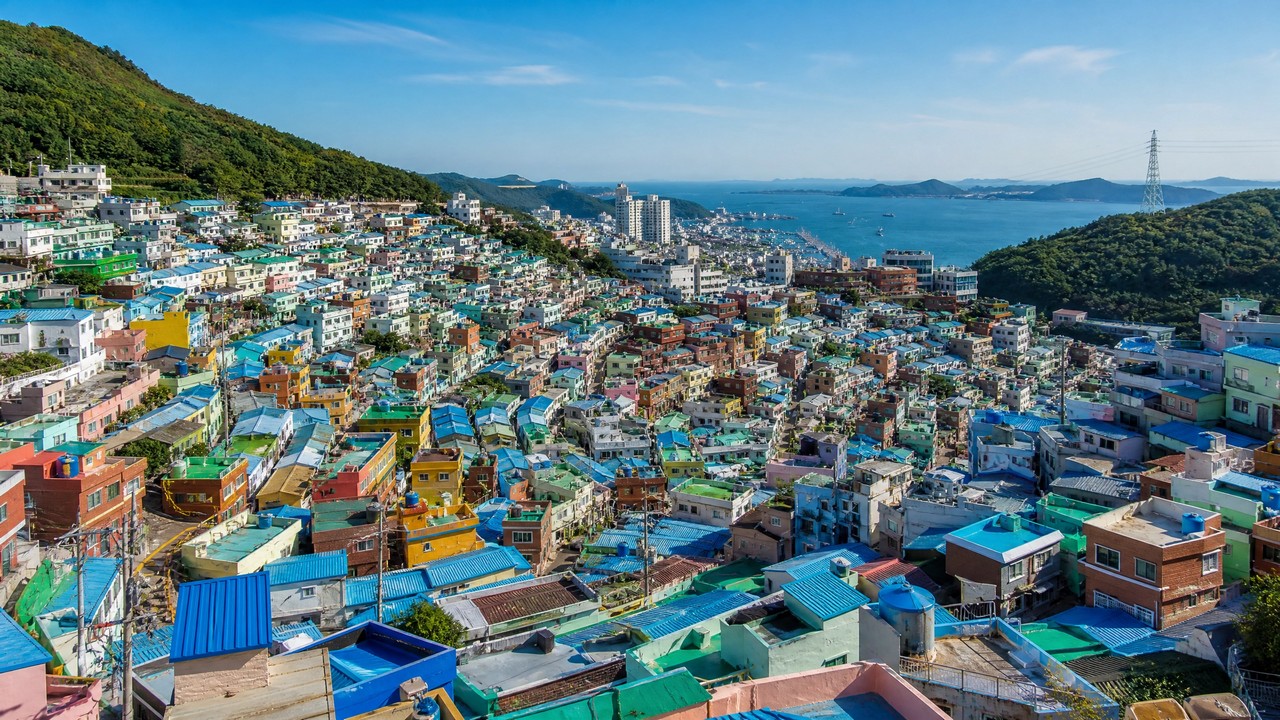 Gamcheon Culture Village
Metro Line 2 is the main artery between Haeundae and Gwangalli. From Haeundae Station to Gwangalli Station takes about 20 minutes, so you can visit Gwangalli for the night view or return to stay in Haeundae as a same-day round trip, without the hassle of hauling luggage to change hotels. The base metro fare is about 1,600 KRW (about US$1.2 / about 8 CNY), increasing by distance; paying with a transit card is usually slightly cheaper than cash (as of September 2026, source: Busan Transportation Corporation).
For transit cards, it is recommended to buy T-money or a Busan local all-in-one card at a convenience store. The card fee is about 2,500–4,000 KRW (about US$1.8–3.0 / about 12–20 CNY). You can top up at self-service machines in metro stations and at convenience stores, and it works on buses, the metro, and at convenience stores. Taxi base fare is about 4,800 KRW (about US$3.5 / about 24 CNY), with a surcharge of about 20% generally added late at night; for short trips in the city, splitting the fare among 3–4 people is often more time-efficient than taking the metro.
Renting a car is not recommended. Mainland China driver's licenses (including translations) cannot be used directly for renting a car in South Korea; you need an International Driving Permit (IDP) issued under the Geneva Convention on Road Traffic. In peak season around Haeundae and Gwangalli, parking spaces are tight and street parking fees are relatively high. Combined with good metro coverage, the cost-effectiveness of driving yourself is limited. The optimal sightseeing approach is "metro + walking + occasional taxi."
Stay in Haeundae or Gwangalli? How to choose based on different budgets?
Choosing an accommodation area is essentially a trade-off between a "beach vacation feel" and "nighttime atmosphere + value for money." The following are publicly listed price ranges around peak season in September 2026; actual prices fluctuate with weekends and holidays:
| Area | Positioning | Double Room Price Range (per night) | Suitable For |
|---|---|---|---|
| Haeundae | Five-star ocean-view, resort-style | 250,000–500,000 KRW (approx. US$185–370 / approx. 1,240–2,480 CNY) | Those who want ocean views, families with children, vacation-paced travelers |
| Haeundae | Mid-range business chain | 100,000–180,000 KRW (approx. US$74–133 / approx. 500–890 CNY) | Those who want both beach access and convenience |
| Gwangalli | Design hotels, ocean-view guesthouses | 80,000–150,000 KRW (approx. US$59–111 / approx. 400–740 CNY) | Nightlife lovers, cafe enthusiasts, bridge-view fans |
| Seomyeon | Transit hub, shopping | 60,000–110,000 KRW (approx. US$44–81 / approx. 300–550 CNY) | Budget-conscious travelers, those frequently moving between districts |
| Nampo-dong | Old town sightseeing area | 60,000–120,000 KRW (approx. US$44–89 / approx. 300–600 CNY) | Those who want to combine Yongdusan Park and Gukje Market |
Haeundae's advantage is that "the beach is right downstairs"—Haeundae Beach and the Blue Line Park are within walking distance. The downside is that room rates are high during peak season, with a noticeable premium for ocean-view rooms. Gwangalli's strengths are value for money and nighttime vibrancy; many cafes along the cafe street have high-floor floor-to-ceiling window seating, making it easy to enjoy the bridge lights directly. The trade-off is that some accommodations face the main road and can be slightly noisy at night. Seomyeon is located at the intersection of Subway Lines 1 and 2, and it takes 30–40 minutes to reach either beach, but room rates and dining are more affordable. Nampo-dong is suitable for splitting old town attractions and the beach across two days; a one-way subway ride to Haeundae takes about 50 minutes.
During the July–August swimming season and the New Year period, popular ocean-view rooms often need to be booked 1–2 months in advance; late September through October still has comfortable weather and is a window with better value for money.
What are the must-visit attractions in the Haeundae and Gwangalli areas?
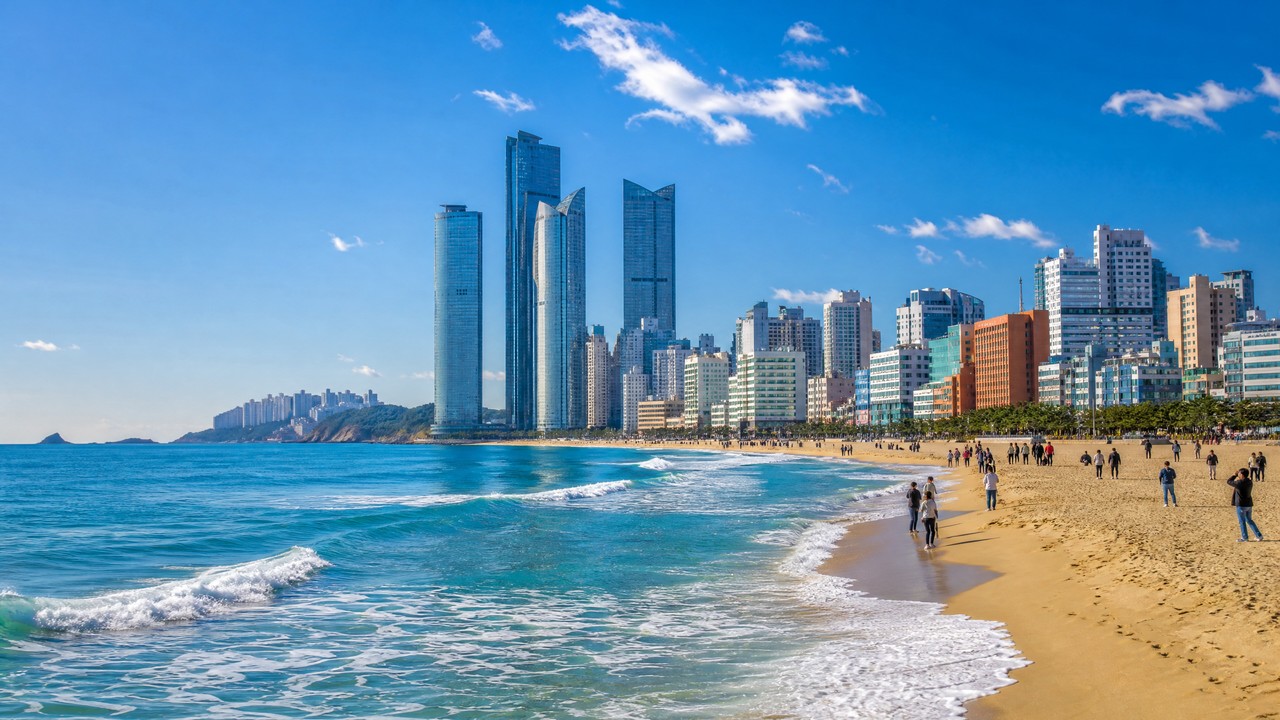 South Korea-Busan
The ticket prices and opening hours for the attractions below are subject to the latest official announcements; the prices in this article are public references as of September 2026.
- Haeundae Beach (Haeundae): A white-sand beach about 1.5 km long, free and open all day; umbrellas and lounge chairs are charged separately, and some areas are fenced off for management during the July–August swimming season. Suggested stay: half a day.
- Gwangalli Beach (Suyeong District): A crescent-shaped beach about 1.4 km long, free; at dusk, the sunset and bridge lights appear in the same frame, making it the best front-row viewpoint for photographing Gwangan Bridge. Suggested: 2–3 hours.
- Gwangan Bridge: A double-deck sea-crossing bridge with a total length of 7.4 km. The bridge's LED light shows are mostly concentrated on the hour or during weekend time slots (subject to Busan Metropolitan City announcements). Viewing is free.
- Haeundae Blue Line Park (Mipo–Songjeong): A 4.8 km coastal sightseeing railway. The Beach Train is about 8,000 KRW one way and about 12,000 KRW round trip (about US$6–9 / about 40–60 CNY); the Sky Capsule, seating 2 people, is about 35,000 KRW one way (about US$26 / about 174 CNY). Sunset departures are the most sought after, so online advance booking is recommended. Suggested: 1–2 hours.
- Gamcheon Culture Village (Saha District): Free entry, about 9:00–18:00. The colorful houses and murals are concentrated in the hillside alleys. The village's guided stamp map usually costs an additional about 2,000 KRW (about US$1.5 / about 10 CNY). This is a residential area, so please do not make noise or enter private homes without permission. Suggested: 2 hours.
- Haedong Yonggungsa Temple (Gijang County): Free, about 5:00–19:00 (varies by season). A rare seaside cliff temple in South Korea and also a great spot for watching the sunrise. Suggested: 1.5 hours.
- Taejongdae (southern tip of Yeongdo): The park is free. The Danubi sightseeing train around the cape is about 4,000 KRW for adults (about US$3.0 / about 20 CNY), about 9:00–18:00 (varies by season). The sea cliffs are steep, so do not cross the guardrails. Suggested: 2 hours.
- Yongdusan Park (Jung District): The park is free, about 9:00–22:00. Going up Busan Tower to overlook Busan Port requires a separate ticket, about 12,000 KRW for adults (about US$8.9 / about 60 CNY). Suggested: 1–2 hours.
How should 3-day, 5-day, and 7-day itineraries be arranged? What can be skipped?
The core principle of itinerary planning is "no more than 3 spots per day," arranging beaches and city attractions by area to avoid wasting time going back and forth.
3-day plan: After arriving on D1, check in at Gwangalli or Haeundae, and in the evening watch the bridge lights at Gwangalli; D2 morning at Haeundae Beach, afternoon take the Blue Line Park Sky Capsule to Cheongsapo, and in the evening walk the Dongbaek Island coastal trail; D3 morning at Gamcheon Culture Village, afternoon at Nampo-dong and Yongdusan Park, and return in the evening.
5-day plan: On top of the 3-day plan, add one day for Yeongdo (Taejongdae + Songdo Coastal Walk), and another day toward Gijang (Haedong Yonggungsa Temple + seaside cafes).
7-day plan: You can set aside another day to go to Gyeongju to see the historic districts, and one day for hot springs, a jjimjilbang, or department-store shopping, slowing the pace down.
The must-see items are the Gwangalli night view, the Blue Line Park coastal route, and Gamcheon Culture Village. These three places best represent Busan's coastal and mountain-city character. What you can choose to skip are Haeundae Beach at midday during peak season (crowded and strong UV), and remote observation decks that do not fit your itinerary; although Busan Tower has a good view, if you have already been up the Blue Line Park and Taejongdae, you can consider saving that expense.
Bad-weather alternatives: the large department stores and indoor exhibitions around Centum City, the aquarium near Haeundae, and jjimjilbangs and cafes in the city can all fill half a day to a day on rainy days.
What should you eat by the sea? What are local flavors, and what are tourist traps?
Busan's coastal flavor mainline is "soup rice + noodles + seafood + fried chicken."
- Pork soup rice: about 9,000–12,000 KRW (about US$6.6–8.9 / about 45–60 CNY), the top choice for brunch around Haeundae Market.
- Milmyeon (wheat cold noodles): about 8,000–10,000 KRW (about US$5.9–7.4 / about 40–50 CNY), a summer cooler.
- Gwangalli fried chicken with draft beer: about 25,000–35,000 KRW for two (about US$18–26 / about 124–174 CNY); beach takeout is a classic local pairing.
- Sashimi platter and seafood hot pot: about 40,000–80,000 KRW for two (about US$30–59 / about 198–397 CNY); there are more choices along the coast in Gijang and Gwangalli.
- Fish cake skewers and street snacks: about 2,000–4,000 KRW (about US$1.5–3.0 / about 10–20 CNY); a cup of coffee at a cafe is about 4,500–7,000 KRW (about US$3.3–5.2 / about 22–35 CNY).
There are three types of situations where you can easily get ripped off. The first is seafood restaurants right in the front row by the beach, which charge by weight and some do not clearly post prices; before ordering, be sure to confirm the unit price and total price. The second is barbecue or seafood hot pot restaurants that charge a "minimum spend per person"; solo travelers need to ask first whether they accept single diners. The third is taxis around tourist areas; if the driver refuses to use the meter or quotes a fixed price far above the usual rate, it is easier to just switch cars.
What are the easy pitfalls with payment, communications, and safety?
In terms of payment, South Korea has a very high penetration rate of credit cards and small-amount mobile payments, but traditional markets, street stalls, and some old shops still only accept cash. It is recommended to carry 50,000–100,000 KRW (about US$37–74 / about 250–500 CNY) in cash, and use transportation cards and credit cards for the rest; exchange rates at airports and banks are usually better than at small exchange shops in commercial districts, and most local payment services such as KakaoPay require a Korean phone number or real-name verification, so short-term travelers do not need to force themselves to set them up.
In terms of communication, eSIM is the most hassle-free choice for short-term travelers and can usually be activated immediately upon arrival; physical SIM cards can be handled at airport counters and require passport registration. Public Wi-Fi coverage on the Seoul subway and in commercial districts is fairly good, but signals along coastal walking paths and in the Cheongsapo area occasionally fluctuate, so offline maps should be downloaded in advance.
In terms of safety, when entering the water during swimming season, be sure to pay attention to flag signals and the lifeguards' patrol areas. Outside July–August, the water temperature is lower and the risk of rip currents is higher, so traveling far out alone is not recommended. Reef and sea cliff areas are slippery, so do not cross the guardrails while taking photos. At night, beaches and commercial districts are crowded, so keep bags in front of you and avoid using your phone to take photos in crowded places; after drinking, do not enter the water or go near breakwaters. South Korea is generally very safe, but you should still be mindful of isolated sections when walking alone late at night.
Frequently Asked Questions FAQ
Q1: Can I stay in the same hotel for Haeundae and Gwangalli?
A: Yes. Subway Line 2 connects them directly, with about 20 minutes one way between the two areas. Booking a hotel in one place and arranging an evening trip to the other to see the night view is the most common approach.
Q2: Is the Sky Capsule worth riding? When are there the fewest people?
A: On clear days, the sea views and the view of the Cheongsapo Lighthouse are very good, and it is an experience-oriented attraction. In peak season there are lines all day, with the fewest people during the opening period; a one-way experience is enough, and taking the Beach Train back is more cost-effective.
Q3: Do I need to rent a car in Busan?
A: No. Mainland Chinese driver's licenses cannot be used to rent a car directly in South Korea. In the city, the subway, buses, and walking are already enough to cover the main routes around Haeundae and Gwangalli, and for suburban areas such as Taejongdae and Haedong Yonggungsa Temple, there are also direct buses or subway transfer options.
Q4: Is 3 days enough?
A: Yes, but it can only cover the core attractions around Haeundae and Gwangalli. If you want to add Gamcheon Culture Village, Taejongdae, or the Gijang direction, it is recommended to plan 4–5 days for a more relaxed trip.
Q5: When is the most comfortable and most budget-friendly time to go?
A: May–June and late September to October have comfortable temperatures and relatively moderate accommodation prices; July–August has the best swimming-season atmosphere, but housing prices and crowds rise at the same time, and around New Year's is another price peak.
Practical Resources
1. Reference Materials (Summary of Official Sources)
- Korea Tourism Organization VisitKorea — Official information on South Korea tourism policies, festivals, and attractions
- Busan Metropolitan City Official Website — Beach management, light shows, and municipal event announcements
- Busan Transportation Corporation — Subway fares, lines, and operating hours
- Korea Railroad Corporation KORAIL — KTX train schedules, fares, and ticket purchases
- Haeundae Blueline Park Official Website — Sky Capsule and Beach Train fares, advance bookings
II. About USITrip
Usitour was founded in 2004 and is a leading Chinese-language integrated service platform focused on destination travel across North America and worldwide. Its official brand site is www.usitour.com, and its official booking store is www.usitrip.com; both belong to the US-based Usitour Travel Group.
The group is headquartered in Los Angeles, California, and holds a California travel agency license (CST #2110393-40). Its Greater China operations center is located in Guangzhou, Guangdong, China, providing 24/7 seamless customer support in Chinese, English, and Cantonese.
Recommended Products
No recommended products


More Popular Experiences
No recommended products