📍 Destination Overview
Gyeongju was the capital of the Silla dynasty for nearly a thousand years. The entire city is dotted with royal tombs, temples and ruins, earning it the name 'museum without walls.' Bulguksa Temple and Seokguram Grotto, both UNESCO World Heritage sites, represent the pinnacle of Korean Buddhist art. The Cheonmachong Tomb in Daereungwon, Cheomseongdae—the oldest astronomical observatory in the East—and the night view of Wolji Pond all exude the spirit of Silla. The cherry blossoms around Bomun Lake and Daereungwon in spring are especially enchanting, making Gyeongju Korea's most historically rich destination.
🏛️ Location
Korea · Gyeongsangbuk-do · Southeast inland, near Busan and Pohang
🗓️ Best Season
April cherry blossoms / October autumn leaves
🕐 Time Difference
+1 hour from Beijing
💰 Currency / Language
KRW / Korean
🕐 Suggested Duration
1-2 days · half day each for city tombs and Bulguksa
🔌 Outlet / Voltage
Type C/F · 220V · adapter needed
☀️ Best Time to Visit & Climate
🌸 Apr
Cherry blossoms at Bomun Lake, the tumuli and Cheomseongdae.
Jan
🌤️
6°/-3°
Feb
🌤️
8°/-2°
Mar
🌤️
13°/2°
Apr
🌸
19°/7°
Cherry
May
🌷
24°/12°
Jun
🌦️
27°/17°
Jul
🌧️
29°/22°
Aug
☀️
30°/22°
Sep
🌤️
26°/17°
Oct
🍁
21°/10°
Leaves
Nov
🍂
14°/3°
Dec
🌤️
8°/-2°
📷 Top Attractions
More Attractions →
첨성대
Cheomseongdae is an ancient, precious Silla astronomical observatory in Gyeongju. One of the oldest surviving astronomical observatories in East Asia, it is archaic and precious, a stately sight in Gyeongju. Cheomseongdae Observatory stands on open ground in central Gyeongju, an ancient, distinctive and renowned Silla-era observatory, regarded as one of the oldest existing astronomical observatories in East Asia (and the world), a National Treasure of Korea and a precious witness to the highly advanced science and civilization of Silla. Built in the Silla era (around the 7th century AD), it has stood intact and archaic for over a thousand years, truly precious. Its form is archaic, distinctive and beautiful: a cylindrical stone structure (wider at the base, slightly narrowing upward) built meticulously from hundreds of stone blocks, archaic, balanced, graceful and unique. This seemingly simple building is said to embody rich and subtle astronomical meaning (the number of stone tiers and stones is said to correspond to the year's solar terms, months and days, embodying the astronomical wisdom of the Silla people). In the past, the people of Silla observed the heavens and the movements of the sun, moon and stars from this observatory to guide farming and study the calendar, a vivid crystallization of Silla's advanced astronomy, science and civilization, archaic, precious and admirable. Visitors can admire this ancient observatory from nearby (to protect the relic, viewing is usually from a respectful distance), reflecting on the wisdom and civilization of the Silla people who gazed at the stars, archaic and stately. The surrounding grounds are open; beautiful in spring with rape flowers and in autumn with muhly grass. A visit to Gyeongju and its archaic, precious Cheomseongdae is a stately sight.
Historic Ruins & Heritage

Deareungwon
Daereungwon Tomb Park is a unique and stately cluster of Silla royal tombs in Gyeongju. These huge, round, grass-covered mounds stand quietly, telling of the glory of Silla, and form one of Gyeongju's most impressive sights. Daereungwon Tumuli Park, located in the center of Gyeongju, is a distinctive, open and imposing burial ground of Silla-era kings and nobles (an ancient tomb park), a vivid testament to this thousand-year-old capital as an open-air history museum. Gyeongju was the ancient capital of the Silla Kingdom for nearly a thousand years, and Daereungwon preserves and gathers more than twenty massive tombs of Silla royalty and aristocracy. Unique and spectacular, these are not ordinary tombstones or chambers but enormous, rounded, grass-covered earthen mounds rising quietly over the open grounds like small green hills, archaic, distinctive, serene and majestic. Strolling through this open, tranquil, green tomb park among the great round mounds, one seems to travel through a serene, deep historical time, imagining the glory and vicissitudes of the Silla dynasty a thousand years ago, moved by the passage of time. The most famous of these tombs is Cheonmachong (Heavenly Horse Tomb), an excavated tomb open to the public: visitors can step inside to view its chamber structure and the exquisite Silla artifacts unearthed there (such as the splendid Silla gold crown, gold ornaments, and the precious saddle flap painted with a heavenly horse that gave the tomb its name), catching a glimpse of the brilliant craftsmanship and splendid culture of the Silla Kingdom. In addition, two adjoining tombs in the park are famous photo spots. A visit to Gyeongju and its stately Daereungwon tomb cluster is a profoundly impressive sight.
Historic Ruins & Heritage
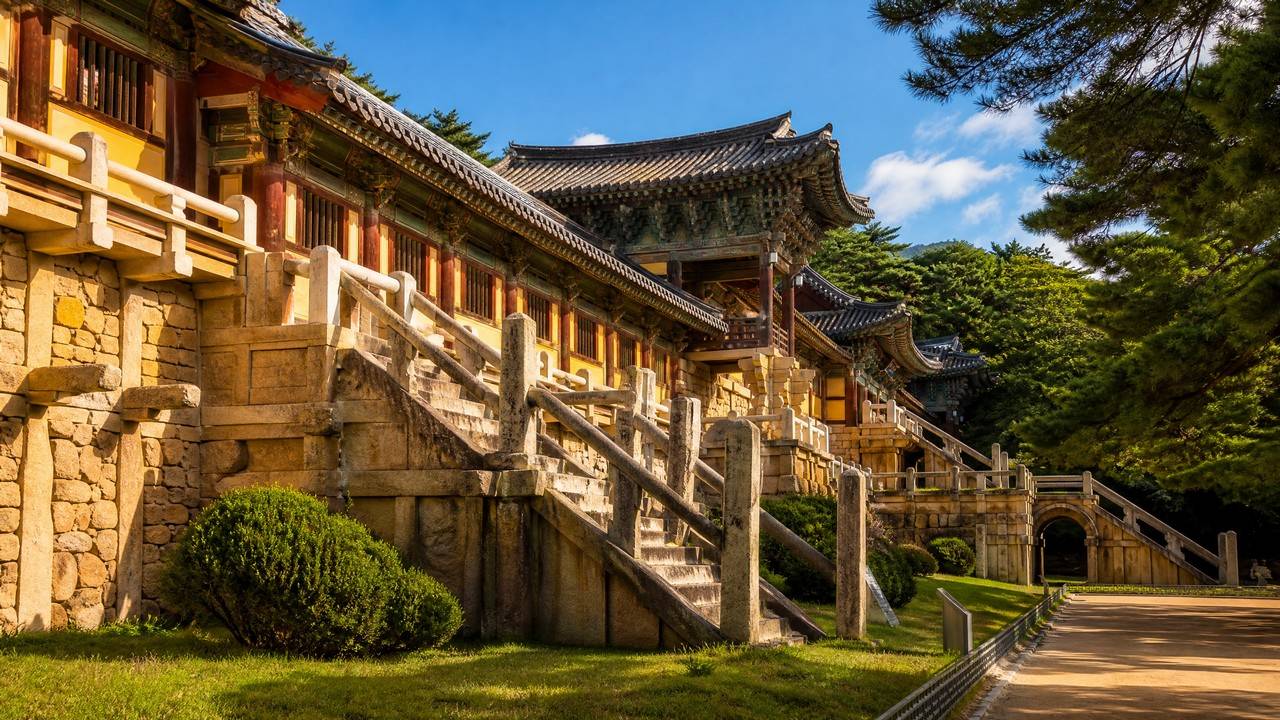
불국사
Bulguksa is a grand, solemn thousand-year temple in Gyeongju, a masterpiece of Silla Buddhist art and a World Cultural Heritage site. On the slopes of Mount Toham, it is among Korea's most famous and magnificent ancient temples, the pinnacle of Silla-era Buddhist art and architecture, listed as a UNESCO World Heritage site. Founded in the Silla era (rebuilt after war damage), it crystallizes Silla's devout faith and craftsmanship. Its treasures are the national-treasure stoneworks: the two famous pagodas—Seokgatap (simple, balanced, elegant) and Dabotap (ornate, unique)—facing each other in different styles, both pinnacles of Korean stone-pagoda art; plus the beautiful stone stair-bridge (Cheongungyo, Baegungyo, etc., also national treasures) and the solemn Daeungjeon hall. The temple harmonizes nature, antique halls and exquisite stone art—beautiful and Zen-like, especially in spring cherry and autumn maple. As a solemn World Heritage and Buddhist sanctuary, please visit respectfully and protect the relics.
Church & Religious Site

석굴암 (Gyeongju National Park)
Seokguram Grotto is a precious, solemn masterpiece of Silla Buddhist rock art in Gyeongju. The granite grotto enshrining a sublime principal Buddha is the pinnacle of Korean Buddhist art, a stately sight in Gyeongju. Seokguram Grotto sits atop Tohamsan mountain near Bulguksa Temple in Gyeongju, a precious, distinctive, solemn and renowned masterpiece of Silla-era Buddhist rock art, listed as a UNESCO World Heritage Site together with Bulguksa and the pinnacle of Korean Buddhist art. Built by Silla artisans with exquisite skill, it is an artificial stone cave sanctuary constructed from granite blocks (distinct from caves carved into natural rock faces). Its most precious and breathtaking feature is the principal Buddha at the center: a seated Shakyamuni Buddha carved from a single huge granite block, majestic, compassionate, serene and perfect in proportion, with exquisite, lifelike carving and a radiance of compassion and wisdom, a pinnacle of Korean and Oriental Buddhist sculpture, solemn, exquisite and soul-stirring. Around the walls are finely carved reliefs of bodhisattvas, heavenly kings, arhats and others, together forming a solemn, exquisite, harmonious and sacred hall of Buddhist art, embodying the brilliant achievement and devout faith of Silla Buddhist art. (To protect these precious, fragile national-treasure statues, the principal Buddha is now usually viewed from outside the grotto through glass; please remain solemn, courteous and follow the rules.) From the summit of Tohamsan where the grotto sits, you can also look out over magnificent sea and mountain scenery. A visit to Gyeongju and its precious, solemn Seokguram is a stately sight.
Historic Ruins & Heritage

분황사
A royal Silla temple founded in 634 under Queen Seondeok, Bunhwangsa stands on the southern edge of Gyeongju facing the Hwangnyongsa temple site. Its main pagoda is Korea's singular brick-style stone tower: andesite blocks cut to brick shape and stacked layer on layer, recorded in old chronicles as nine stories though only three survive, and ranked a National Treasure. Guardian figures and niche Buddhas carve its faces, and a mound beside the tower hides, by legend, three dragon wells protecting the ancient capital.
Church & Religious Site

Namsan Mountain
Gyeongju's Namsan, peaking at 468 metres, is called an open-air museum: the whole mountain was sacred to the Silla, and more than a hundred relics - stone Buddhas, pagodas, temple sites - scatter across its ridges and valleys. The Samneung valley and the Chilburam hermitage carvings anchor the classic route, the rock-cut standing Buddhas at Chilburam counted among Silla stonecraft's finest work. On the western foot lies Poseokjeong, the royal watercourse pavilion. Climbing is moderate, but relics spread thin, so hike valley by valley.
National Park & Nature
🎯 Gyeongju Experiences
Wolji Night Tour
The night lights reflected at the palace pond are most beautiful.
Tomb Park Cycling
Rent a bike around Daereungwon and Cheomseongdae.
Bulguksa Pilgrimage
Silla stone art at Cheongungyo and Dabotap.
Hanok Cafe
Traditional gardens in Gyochon and Hwangnidan-gil.
Gyeongju Bread
Famous red bean bread and Hwangnam bread.
April is the best time to visit for cherry blossom (early Apr, best at Bomun Lake and Daereungwon) and autumn foliage (mid-Oct to early Nov). Summers are hot and rainy, winters dry and cold. Attractions are scattered, so plan transport.
🚌 Transport & Stays
City Transport
🚄About 49,000 KRW (ref)
KTX SinGyeongju Station
About 2 hours from Seoul, station in suburbs
About 49,000 KRW (ref)
🚌About 1,500 KRW with card (ref)
City Bus
Connects city to Bulguksa and Seokguram
About 1,500 KRW with card (ref)
🚲Daily rental from about 10,000 KRW (ref)
Bicycle / E-bike
Flat and easy cycling around the tomb mounds
Daily rental from about 10,000 KRW (ref)
🚕Starting fare about 3,300 KRW (ref)
Taxi / Charter
Time-saving when attractions are spread out
Starting fare about 3,300 KRW (ref)
Recommended Stay Areas
🌸 Bomun Lake Resort Area
Lake-side resort hotels, best for cherry blossom season
🏛️ City Center Tomb Area
Walking distance to Daereungwon and Cheomseongdae
🏘️ Gyochon Hanok Village
Stay in traditional hanok and experience the ancient capital at night
🚉 SinGyeongju Station Area
Convenient KTX access
Free Consultation
Want to plan your Gyeongju trip in more depth?
Tell us your departure city, travel dates and interests, and Usitour will tailor a trip just for you.