📍 Destination Overview
Jeonju is the birthplace of the Joseon Dynasty's Yi family and is recognized as Korea's food capital. Jeonju Hanok Village preserves over 800 traditional hanok houses, with layered dark-tiled eaves forming the largest hanok settlement in Korea. Gyeonggijeon Shrine houses the portrait of King Taejo, and Jeonju bibimbap, bean sprout soup and Korean snacks are famous nationwide. Designated as an international Slow City, it's a place to wear hanbok, savor cuisine and slowly appreciate the elegance of this Joseon-era capital.
🏘️ Location
Korea · Jeollabuk-do · Southwest inland, heart of Jeolla cuisine
🗓️ Best Season
Apr-May / Oct
🕐 Time Difference
+1 hour from Beijing
💰 Currency / Language
KRW / Korean
🕐 Suggested Duration
1-2 days · leisurely hanok village and surroundings
🔌 Outlet / Voltage
Type C/F · 220V · adapter needed
☀️ Best Time to Visit & Climate
🌸 Spring: Apr–May
Blooming hanok village courtyards in mild weather.
🍁 Autumn: Oct–Nov
Fiery foliage around the hanok village, crisp and clear.
Jan
🌤️
5°/-4°
Feb
🌤️
8°/-2°
Mar
🌤️
13°/2°
Apr
🌸
19°/7°
Best
May
🌷
24°/13°
Best
Jun
🌦️
28°/18°
Jul
🌧️
30°/22°
Aug
☀️
31°/22°
Sep
🌤️
27°/16°
Oct
🍁
21°/9°
Leaves
Nov
🍂
13°/3°
Foliage
Dec
🌤️
7°/-2°
📷 Top Attractions
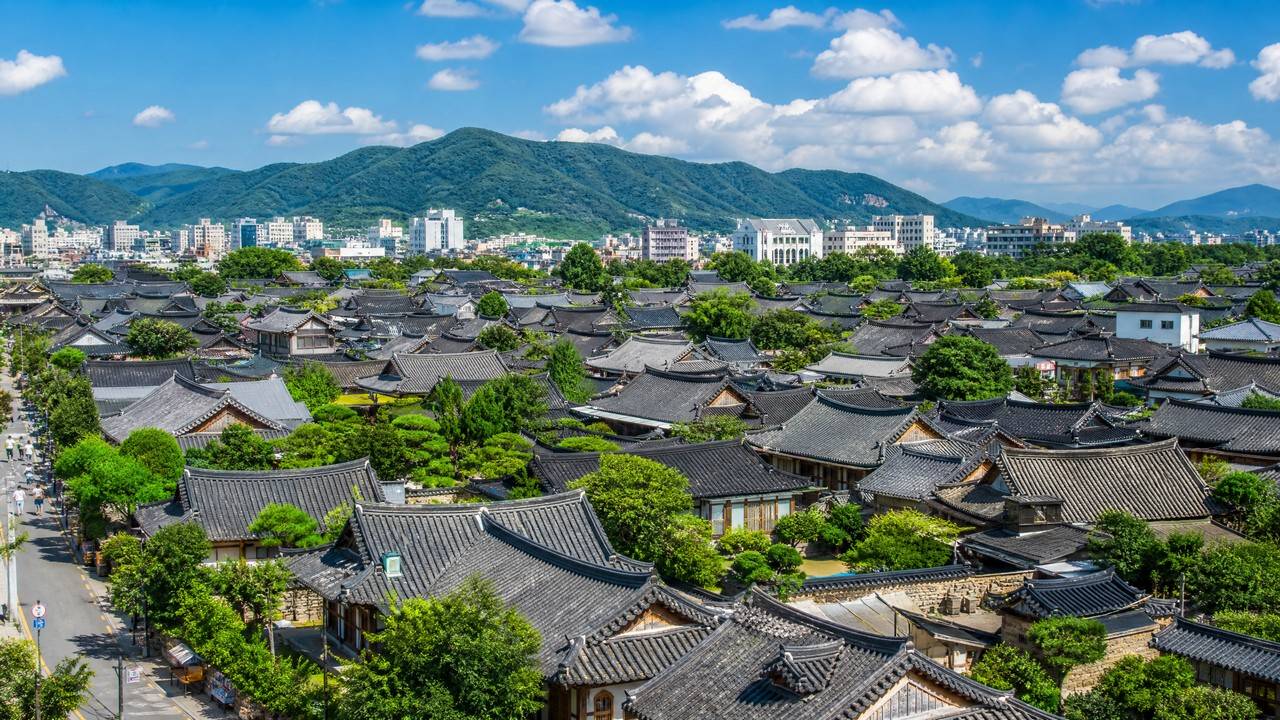
Jeonju Hanok Village
Jeonju Hanok Village is Korea's most famous and largest traditional hanok village, a settlement of rustic hanok, traditional culture and food—Jeonju's top sight. In central Jeonju, it is the country's most famous, largest and most vibrant traditional hanok village, the heart of this traditional-culture city. Jeonju is an ancient city with deep roots (also the ancestral seat of the Joseon royal family); this village preserves hundreds of rustic, elegant traditional hanok—among Korea's most concentrated and spectacular. Wandering its quiet streets, you see rows of elegant hanok with gently upturned black-tiled roofs, wooden structures and walls spreading grandly—preserving Joseon-era homes. Its unique charm is that it is a living village: traditional culture experiences (hanbok rental, craft workshops, hanji paper, tea houses, hanok stays), shops, cafés, restaurants and street food (Jeonju is famous for bibimbap). Wear a hanbok, stroll, experience culture and taste local food (bibimbap and snacks). (Partly residential: keep quiet, no noise, no entering homes, respect residents.)
Old Town & Historic District

Gyeonggijeon
Gyeonggijeon is a rustic, solemn Joseon royal shrine in Jeonju, enshrining the portrait of the founding monarch and shaded by old trees—a weighty sight. Inside Jeonju Hanok Village, it is a solemn, royal Joseon shrine. Jeonju is the ancestral seat of the Joseon royal family (Yi); Gyeonggijeon was built to enshrine the portrait (jin) of King Taejo, the founding monarch. Rustic and serene, its halls (the main hall with Taejo's portrait), gates and surrounding old trees, bamboo and garden create a solemn, quiet atmosphere. Walking through, you feel the deep royal history and culture; the antique halls, gates and green gardens are very photogenic, especially in hanbok. The shrine also has exhibitions on Joseon royal portraits and the Joseon Wangjo Sillok (Annals). As a solemn historical shrine, please visit respectfully and protect the relics.
Historic Ruins & Heritage

전주향교
Jeonju Hyanggyo is a rustic, solemn Confucian educational institution in Jeonju, nestled among ancient ginkgo trees and carrying Confucian culture—a weighty sight. Inside Jeonju Hanok Village, it is a traditional Confucian school and shrine (hyanggyo). Hyanggyo were state-run schools of the Joseon era, established in local districts to honor Confucian sages (Confucius) and educate local students—a living witness to Korea's Confucian, learning-respecting tradition. Rustic and serene, its halls (such as Daeseongjeon honoring Confucius, and Myeongnyundang where students studied), gates and courtyards are antique and solemn, bearing deep Confucian heritage. Its most famous feature is several ancient ginkgo trees: centuries old, they turn brilliant gold each late autumn (late Oct–Nov), covering the solemn courtyard in a dreamlike golden world—Jeonju's renowned autumn ginkgo spot. As a solemn Confucian shrine, please visit respectfully and protect the relics and old trees.
Church & Religious Site

Omokdae
Omokdae is a beautiful viewpoint in Jeonju overlooking the whole Hanok Village, a rustic elevated terrace amid trees—a lovely sight. On a hill east of Jeonju Hanok Village, it is the best spot to overlook the rustic, spectacular hanok panorama. Rustic and beautiful with historical roots, it is shaded by green hill woods and has an antique traditional pavilion (said to be where King Taejo once stopped and feasted). Its highlight is the view: from this height you see the entire Jeonju Hanok Village—hundreds of elegant upturned black-tiled roofs spreading grandly, set against the modern city skyline. Rustic black tiles, the traditional village and the distant modern city weave together—beautiful, rustic and spectacular, especially at sunset or when lights come on. Climb the wooded path to the terrace to rest and enjoy the view.
Viewpoint

Jeongdong Catholic Church
Standing at the edge of Jeonju Hanok Village, Jeondong Catholic Church was built between 1908 and 1914 and is widely regarded as one of Korea's most beautiful early modern churches. Its grey-and-red brick Romanesque facade, rounded arches and elegant bell tower form a striking contrast with the traditional tiled roofs around it. The site is also remembered as a place where early Korean Catholics were martyred in 1791, giving the church special spiritual weight. Inside, light filtering through stained glass falls on wooden pews, creating a serene atmosphere well worth a quiet hour.
Church & Religious Site

Pungnammun Gate
Pungnammun is the only gate surviving from the four that once punctuated the walls of Jeonju Eupseong, the old provincial fortress. First erected in 1398 at the dawn of the Joseon dynasty and rebuilt in the eighteenth century, the two-storey pavilion with its hip-and-gable roof crowns a granite arch and is designated a Korean Treasure. The gate witnessed pivotal moments including the entry of Donghak peasant rebels into Jeonju in 1894. Today it serves as a photogenic landmark, an open-air history lesson and a natural starting point for exploring the nearby Hanok Village.
Castle & Fortress
🎯 Jeonju Experiences
Jeonju Bibimbap
The authentic taste at the birthplace of dolsot bibimbap.
Hanok Guesthouse
Sleep in a traditional ondol room under tiled eaves.
Hanbok Tour of the Ancient Capital
Hanbok photos at Gyeonggijeon and alleyways.
Nambu Night Market
Creative snacks along the youth street.
Traditional Liquor Museum
Taste Jeonju's famous rice wine, Moju.
Best in spring Apr-May and fall Oct-Nov. Hot and rainy in summer, dry and cold in winter. This Slow City centers on food and hanok; the Hanok Village gets crowded on weekends and holidays.
📰 Travel Guides
More Guides →
🚌 Transport & Stays
City Transport
🚄About 34,000 KRW (ref)
KTX Jeonju Station
About 1.5-2 hours from Seoul
About 34,000 KRW (ref)
🚌About 1,500 KRW with card (ref)
City Bus
Connects station to Hanok Village
About 1,500 KRW with card (ref)
🚕Starting fare about 3,300 KRW (ref)
Taxi
Short trips within Hanok Village area
Starting fare about 3,300 KRW (ref)
🚲—
Walking / Bicycle
Flat terrain, easy to walk within the village
—
Recommended Stay Areas
🏘️ Inside Hanok Village (First Choice)
Stay in traditional hanok for the ancient capital atmosphere
🚉 Jeonju Station Area
Convenient KTX access
🏙️ New Town / Gaeksa
Modern area with shopping and dining
⛪ Jeondong Area
Near the cathedral and Gyeonggijeon
Free Consultation
Free Consultation
1-on-1 travel consultant customizes your Jeonju trip for free based on your schedule and preferences.