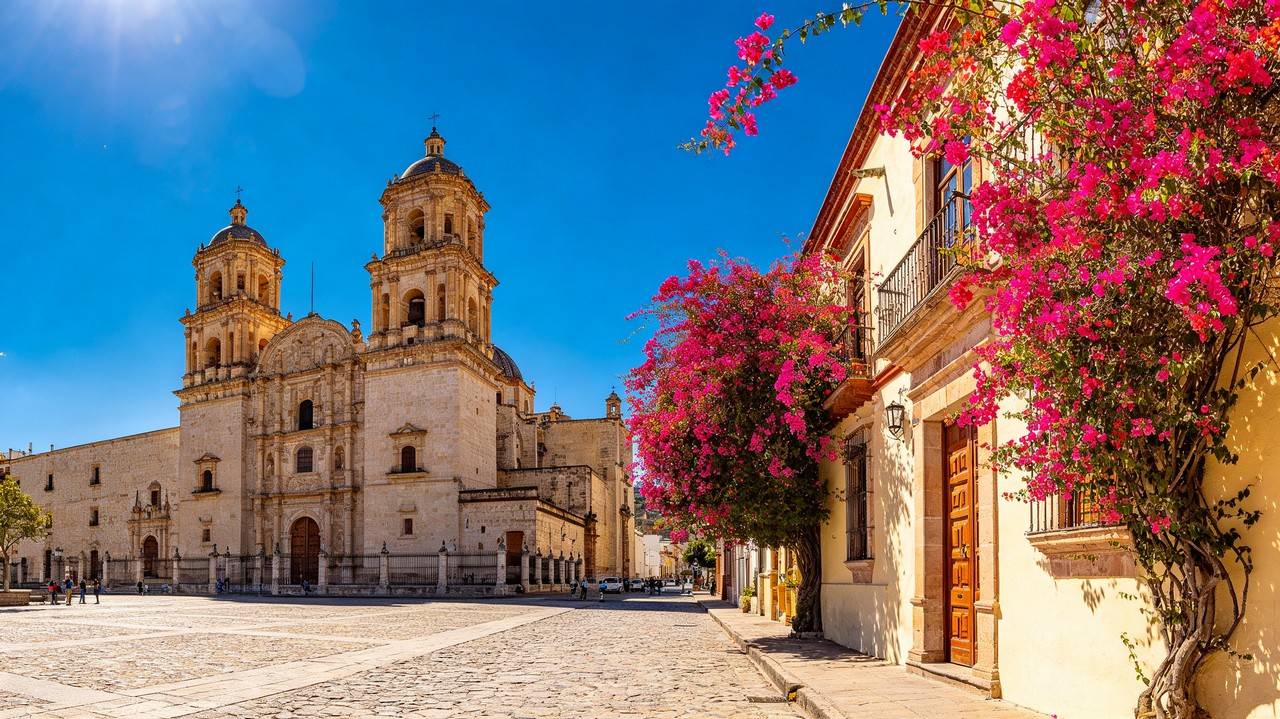
📍 Destination Overview
Oaxaca, in a valley in southern Mexico, is one of the country's richest indigenous regions, its colonial centre a World Heritage site. The magnificent Church of Santo Domingo glitters with gold leaf, and the hilltop ruins of Monte Alban were the ancient capital of the Zapotecs. Culinary heart of Mexico, it is famed for its grand Day of the Dead, with marigolds and painted-skull parades.
💀 Location
Mexico · Oaxaca · indigenous ancient city in the southern valley
🗓️ Best Season
Nov-Apr / Jun-Sep
🕐 Time Difference
14 hours behind Beijing
💰 Currency / Language
Mexican Peso MXN / Spanish
🕐 Suggested Duration
2-3 days · old town + Monte Albán + cuisine
🔌 Outlet / Voltage
Type A / B outlets · 127V · adapter needed
☀️ Best Time to Visit & Climate
🌤️ Dry Season: Nov–Apr
Dry and pleasant — old town strolls at their best.
🌧️ Jun–Sep
Afternoon showers in the rainy season.
January
☀️
28°/9°
Best
February
☀️
30°/10°
Best
March
🌡️
32°/12°
Best
April
🌡️
33°/14°
Best
May
🌦️
32°/15°
June
🌧️
29°/15°
Good
July
🌧️
28°/14°
Good
August
🌧️
28°/14°
Good
September
🌧️
27°/14°
Good
October
💀
27°/12°
November
🌤️
27°/10°
Best
December
🌤️
27°/9°
Best
📷 Top Attractions
More Attractions →
Monte Albán
Monte Alban, also rendered Al-banshan, lies in Oaxaca state, Mexico, about ten kilometres and twenty minutes' drive southwest of Oaxaca City, at roughly 1,940 m above sea level.
Nature and date: this was the political and religious centre of the Zapotec civilisation, founded around 500 BC and a capital for more than a thousand years, one of the earliest large cities in Mesoamerica. The city sits on an artificially levelled mountaintop platform standing about 400 m above the Oaxaca valley, with views over three converging valleys, and at its peak held a population estimated in the tens of thousands.
Heritage status: in 1987 Monte Alban and the historic centre of Oaxaca City were inscribed together on the UNESCO World Heritage List.
Three things most often got wrong.
First, the Dancers do not dance. The three hundred-odd carved slabs along the south side of the plaza are known as the Danzantes, a nineteenth-century misreading: the twisted human figures are sacrificed war captives and conquered rulers, not dancers, and date back to around 500 BC.
Second, Stelae 12 and 13 from the plaza carry early carved dates and count among the earliest evidence of writing in Mesoamerica.
Third, Tomb 7 did yield Mexico's richest pre-Hispanic gold hoard, but those pieces are now in the museum inside the Santo Domingo church in Oaxaca City, not at Monte Alban itself, so anyone coming for the gold will be disappointed.
On the buildings: the Gran Plaza runs about 300 by 200 m; Building J is an arrowhead-shaped observatory set at an angle to the whole city, with one reading aligning its axis to Capella and its surface slabs read as a list of conquered places; climb the North Platform early for the layout and the South Platform for the best sunset view.
Admission (2026): 210 pesos for foreign visitors and 105 for Mexican citizens and legal residents, nearly double since 1 January, so the hundred-peso figures in older guides are dead. Tripods and video cameras cost about 63 pesos extra.
Practical: early morning is best, cooler, emptier and softer in the light. There is almost no shade on the platform, so a hat and high-factor sunscreen are conditions rather than comforts, and carry at least a litre of water each. Wear closed shoes with grip, as the South Platform has no railings. Cell coverage on the summit is patchy, so arrange your return ride before you go up. And do not walk the nine-kilometre trail from the city: it is almost entirely uphill with very little shade, and robberies have been reported along it.
Old Town & Historic District

Templo de Santo Domingo
The Templo y Ex Convento de Santo Domingo de Guzman stands on the pedestrian Calle Macedonio Alcala in the historic centre of Oaxaca City, about ten minutes' walk from the Zocalo.
Construction and layered identity: the church was built by Dominican friars from the 1570s, consecrated in 1611 and completed in stages into the early eighteenth century. The facade is carved volcanic tuff in a Renaissance and Baroque blend, while the interior is a Baroque space of high-relief plasterwork gilded with gold leaf. From the Mexican Revolution of 1910-1920 onward the convent complex served as a barracks and military building, a use that continued into the 1990s. Today church, museum and botanical garden stand side by side, and that layering is what makes it singular.
A detail found nowhere else: across the ceiling of the first bay spreads the genealogical tree of the Santo Domingo de Guzman family, a Baroque installation without any real counterpart in Mexico. Most visitors look up and see only painted decoration; what is actually there is the tree-like lineage of the saint's family.
The attached convent now houses the Museum of Oaxacan Cultures, fourteen halls on two floors arranged chronologically. Its crown is the Tomb 7 treasures from Monte Alban: in 1932 Alfonso Caso recovered more than four hundred objects in gold, silver, turquoise, jade, obsidian, coral and carved bone, the most startling of them a Mixtec gold pectoral depicting the god of death at a level of craft that goldsmiths still cannot fully replicate. Monte Alban in the morning and this in the afternoon connects the excavation site with the place the finds now rest.
The ethnobotanical garden behind the convent was designed by the Oaxacan artist Francisco Toledo, opened in 1998, and holds more than 1,500 species of local plants. Entry is guided only: English tours Tuesday, Thursday and Saturday at 11:00, about two hours and about 100 pesos, Spanish tours Monday to Saturday at 10:00, 12:00 and 17:00 for about 50 pesos.
Admission and hours: the church is free, the museum about 90 pesos with other figures of 85 and 210 quoted, open Tuesday to Sunday 10:00-18:00 and closed Mondays, and the audio guide costs about 50 pesos. Morning light suits the convent's stone corridors best.
Church & Religious Site

Mitla Archaeological Site
The Zona Arqueologica de Mitla lies inside the modern town of San Pablo Villa de Mitla in Oaxaca, Mexico, reached by running about 39 km east from Oaxaca City on Federal Highway 190 and then 4 km north.
Name and date: the Zapotec name Lyobaa means 'resting place', while the Nahuatl name used by the Mexica, Mictlan, means 'place of the dead'. This was the religious centre of the late Zapotec and Mixtec world, flourishing from roughly 900 AD until the Spanish arrival.
The Mixtec question: Mitla is often described as a Mixtec city, which is not quite right. As interaction with the Mixtec grew, the Zapotec tradition remained the base, so two cultures overlap here rather than one replacing the other.
The geometric fretwork, or grecas, is Mitla's true specialty: the stepped lines and meanders on the walls are built from thousands of precisely cut small stones fitted without mortar. Fourteen distinct pattern systems have been identified, each designed for a particular building rather than being interchangeable decoration.
Three groups matter. In the Group of the Columns the Hall of Columns is carried by six monolithic stone columns, and its inner courtyards hold the most photographed fretwork on the site; below it the Tomb of the High Priest is a cruciform chamber and very dark, so bring a phone light. In the Group of the Church the Catholic church of San Pablo, built in the late sixteenth century, sits directly on pre-Hispanic foundations and was raised with material from temples the Spanish demolished, so the seam between two eras is visible in the wall.
One thing to state plainly: Mitla itself is not on the World Heritage List. The World Heritage inscription covers Monte Alban and the historic centre of Oaxaca City, and Mitla is a separate site in the same region. Plenty of Chinese-language guides conflate the two.
Admission (2026): 210 pesos for foreign visitors and 105 for citizens and residents. The fee went from 100 to 210 pesos on 1 January 2026, nearly doubling, so the 90 or 100 peso figures in older guides are dead.
Conservation in plain terms: tombs and some rooms close on rotation, and the Church Group has been under slow restoration since 2023 with parts possibly roped off. The Columns Group, the headline sight, is fully open. Being unable to enter a particular tomb is not an anomaly.
Prohibitions: do not touch the stonework and do not insert fingers or objects into the gaps. The small blocks of the fretwork are being prised out exactly that way. No smoking, food or pets on site.
Historic Ruins & Heritage

Basilica de la Soledad
The Basílica de Nuestra Señora de la Soledad is a principal church of Oaxaca city, completed in the late 17th century and dedicated to the city's patroness, the Virgin of Solitude. Its façade is Mexican baroque, built in the local green tuff with tiers of carving stacked like a screen; the image itself, robed in black velvet with pearls and gold embroidery, is central to religious life in Oaxaca. The small plaza alongside is known for its sweet stalls, especially nieve, where locals linger after Mass.
Church & Religious Site

Ethnobotanical Garden
The Oaxaca Ethnobotanical Garden lies in the former monastery of Santo Domingo's rear grounds, initiated by artist Francisco Toledo and designed by botanists, planting native species zoned by Oaxaca's diverse ecosystems. Part living collection, part open-air classroom on how Oaxaca's peoples depend on plants, it is visited only with a guided tour.
Park & Garden

Museo de las Culturas de Oaxaca
The Museo de las Culturas de Oaxaca occupies the conventual buildings of Santo Domingo, itself a masterwork of 16th–17th-century Dominican architecture. The collection runs chronologically through the history of the Oaxaca valleys, from prehistory into the colonial and modern eras; its centrepiece is the material from Tomb 7 at Monte Albán — Mixtec goldwork, turquoise mosaic and rock-crystal vessels of extraordinary refinement, the benchmark of pre-Hispanic metalwork in Mexico. The cloisters, and the view of the Santo Domingo façade from the garden, are worth lingering over.
Museum
🎯 Oaxaca Experiences
Día de los Muertos
Candlelit cemeteries and painted parades.
Monte Albán
The Zapotec hilltop capital.
Mezcal Tasting
The flavor of the famed agave spirit.
Mole Cuisine
Oaxacan dishes with seven types of sauce.
Craft Villages
Black pottery and wool blankets.
Oaxaca is famous for its grandest Día de los Muertos (late Oct–early Nov); book far in advance. The dry season (Nov–Apr) is pleasantly dry. The rainy season (Jun–Sep) brings afternoon showers. This is the homeland of Mexican cuisine and indigenous culture.
🚌 Transport & Stays
City Transport
✈️Taxi fare depends on distance (reference)
Oaxaca Airport
About 20 min to downtown
Taxi fare depends on distance (reference)
🚶—
Walking
Compact old town, ideal on foot
—
🚗Daily hire depends on itinerary (reference)
Private Car
To Monte Albán, Tule Tree
Daily hire depends on itinerary (reference)
🚌Depends on class (reference)
ADO Bus
To/from Mexico City
Depends on class (reference)
Recommended Stay Areas
⛪ Historic Center (top pick)
Near Santo Domingo and markets
🎨 Near Craft Villages
Indigenous craft atmosphere
🚌 Around the Bus Station
Convenient for transit
🏙️ Pair with Mexico City
Base trips from the big city
Free Consultation
Want to plan your Oaxaca trip in more depth?
Tell us your departure city, travel dates and interests, and Usitour will tailor a trip just for you.