Cairo

Cairo Travel Guide

Key facts

  • On this page: 1 travel guides and 41 attractions
  • Attractions include opening hours, ticket prices, transport and suggested visit duration
  • Guides cover itinerary planning, visas, accommodation and budget tips
  • Content is updated from the CMS and verified facts

This page collects all travel content for Cairo: 1 guides covering itinerary planning, attraction recommendations, visa application, transport and accommodation, plus 41 attractions with opening hours, ticket prices and practical tips, continuously verified and updated.

Cairo: the largest city of the Arab world on the Nile, where pharaonic treasures meet the Islamic old city.

★ 1 Guides · 41 Attractions

📍 Destination Overview

Cairo is Egypt's capital and the largest city in the Arab world and Africa, nestled on the banks of the Nile. The Egyptian Museum houses the golden mask of Tutankhamun and tens of thousands of pharaonic artifacts—a hall for understanding ancient Egyptian civilization—while the brand-new Grand Egyptian Museum will showcase unparalleled treasures. In the old city, the Citadel of Saladin stands atop the heights and the Mohammed Ali Mosque gleams with its silver dome; in the alleys of Khan el-Khalili bazaar, the scents of spices, brassware and shisha fill the air. The Hanging Church of Old Cairo tells the history of Coptic Christianity. Noisy, ancient and full of life, Cairo is the gateway to the pyramids and the civilization of the Nile.

🏛️ Location
Egypt · Cairo Governorate · A millennia-old capital on the Nile
🗓️ Best Season
Oct-Apr Cool Season
🕐 Time Difference
6 hours behind Beijing
💰 Currency / Language
Egyptian Pound EGP / Arabic
🕐 Suggested Duration
2 - 3 days · Museums + old city + pyramids
🔌 Outlet / Voltage
Type C / F outlets · 220V · Chinese two-pin plugs mostly work

☀️ Best Time to Visit & Climate

☀️ Cool Season: Oct–Apr
Mild and pleasant—best for sightseeing and desert trips.
🔥 Hot Season: May–Sep
Desert heat often above 35°C; stay cool and hydrated.
Jan
🌞
19°/9°
Best
Feb
🌞
21°/10°
Best
Mar
🌞
24°/12°
Best
Apr
🌤️
28°/15°
Best
May
🔥
32°/18°
Jun
🔥
35°/20°
Jul
🔥
35°/21°
Aug
🔥
34°/21°
Sep
🔥
33°/19°
Oct
🌞
30°/17°
Best
Nov
🌞
25°/13°
Best
Dec
🌞
20°/10°
Best

📷 Top Attractions

More Attractions →
Salah El-Din Citadel
No.1 Cairo
Salah El-Din Citadel
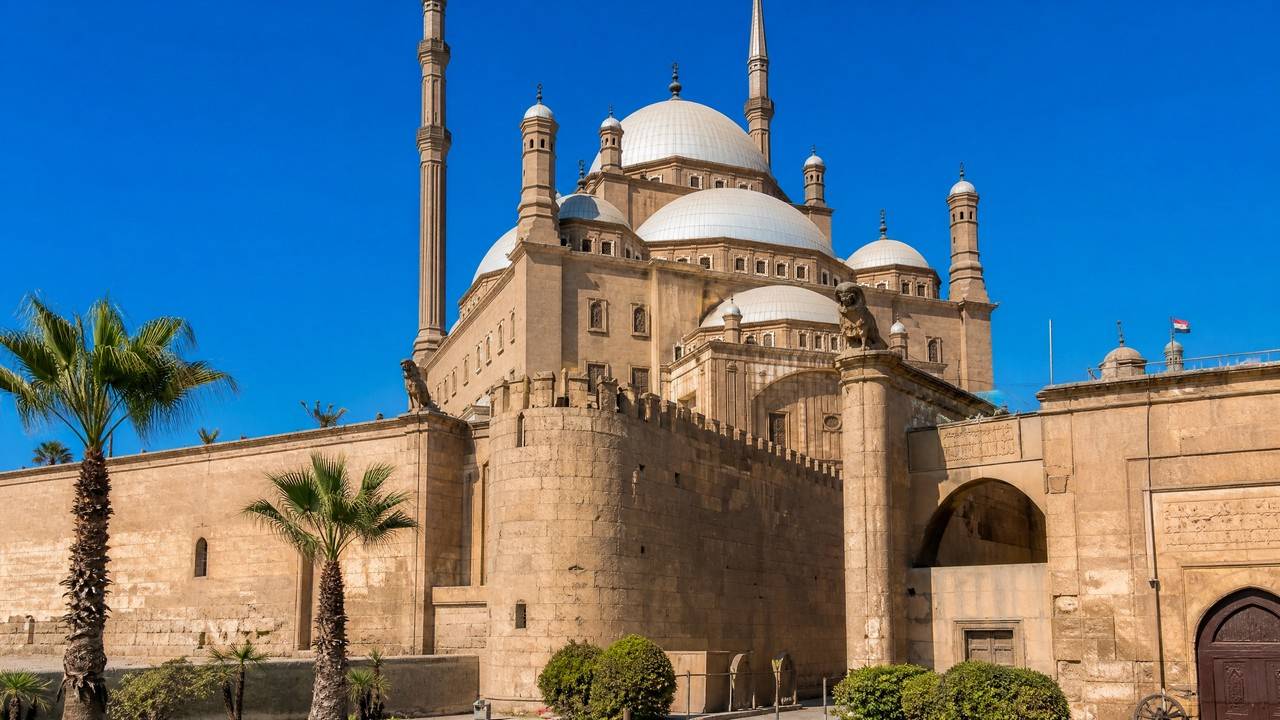
The Saladin Citadel is not a single building but a wide fortress complex across the Mokattam hill. Saladin ordered it built in 1176 for a specific purpose: to link Fustat with the newer city of al-Fustat and Cairo against Crusader attack from both the coast and the desert. Work continued after his death, and for about seven centuries the citadel served Ayyubid, Mamluk, Ottoman and modern Egyptian rulers in turn. The point of visiting is therefore the layering rather than any one structure — walls, gates and mosques stacked over each other, with the oldest Mamluk fabric mostly hidden under later Ottoman work and visible only at the edges and below ground. The visual centre is the nineteenth-century Mosque of Muhammad Ali, commissioned by Muhammad Ali Pasha. Its central dome with four semi-domes sits between two minarets about 84 metres tall, and the facade is faced entirely in two-tone alabaster panels that glow almost white at midday. The interior follows the Ottoman model of Istanbul, with a forest of large crystal chandeliers over a geometric painted brick floor in the courtyard. The clock tower was a French diplomatic gift linked to the exchange that sent the Luxor Obelisk to Paris. The terrace in front of the mosque is among the most underrated views in Cairo: the minaret forest of the old city, the Nile and palms in one frame, and on very clear days the direction of the Giza pyramids. Also on site are the Mosque of al-Nasir Muhammad (Mamluk, with its green dome), the Mosque of Sulayman Pasha, the Military Museum, the Police Museum and the Al-Jawhara Palace Museum. An hour covers the mosque and the viewpoints; the museums turn it into a half day, and they do not always keep the same hours as the grounds.
Castle & Fortress
Egyptian Museum (Tahrir Square)
No.2 Cairo
Egyptian Museum (Tahrir Square)
The Egyptian Museum on Tahrir Square opened in 1902, its pink neoclassical facade and columned entrance designed by a French architect, and it remains one of the world's densest collections of ancient Egyptian material. The single most common mistake today is about its contents: Tutankhamun's golden mask and all 5,398 objects from his tomb were moved to the Grand Egyptian Museum at Giza when that museum fully opened in November 2025. Anyone coming here specifically for the mask will miss it — it is now beside the pyramids. What remains is still formidable: royal statues of the Twelfth Dynasty and Old Kingdom, the Narmer Palette, Old and Middle Kingdom stone sculpture, the finds from the royal tombs at Tanis and Abydos, and the rooms where Carter's team first catalogued the Tutankhamun material. Crucially the Royal Mummies Hall is still in this building, holding 22 rulers in climate-controlled cases, among them Ramesses II, Seti I and Thutmose III, on a separate ticket. The building itself is part of the experience. The 1902 display style sets case after dense case with none of the modern narrative flow or lighting design; papyri, sarcophagi, mummies and thousands of shabti figures sit in close proximity. Some find it cluttered, others find it closer to an excavation than an exhibition — and seen against GEM's considered presentation, it shows a century of Egyptian collecting in the making. The relationship between the two Cairo museums is worth sorting out before you book. GEM is larger, better narrated and nearly three times the price, but the mummies hall and the royal jewellery from Tanis remain on the Tahrir side. The two are about twenty minutes apart, so both in one day works if you plan it rather than discover it on the ground.
Museum
Great Sphinx of Giza
No.3 Cairo
Great Sphinx of Giza
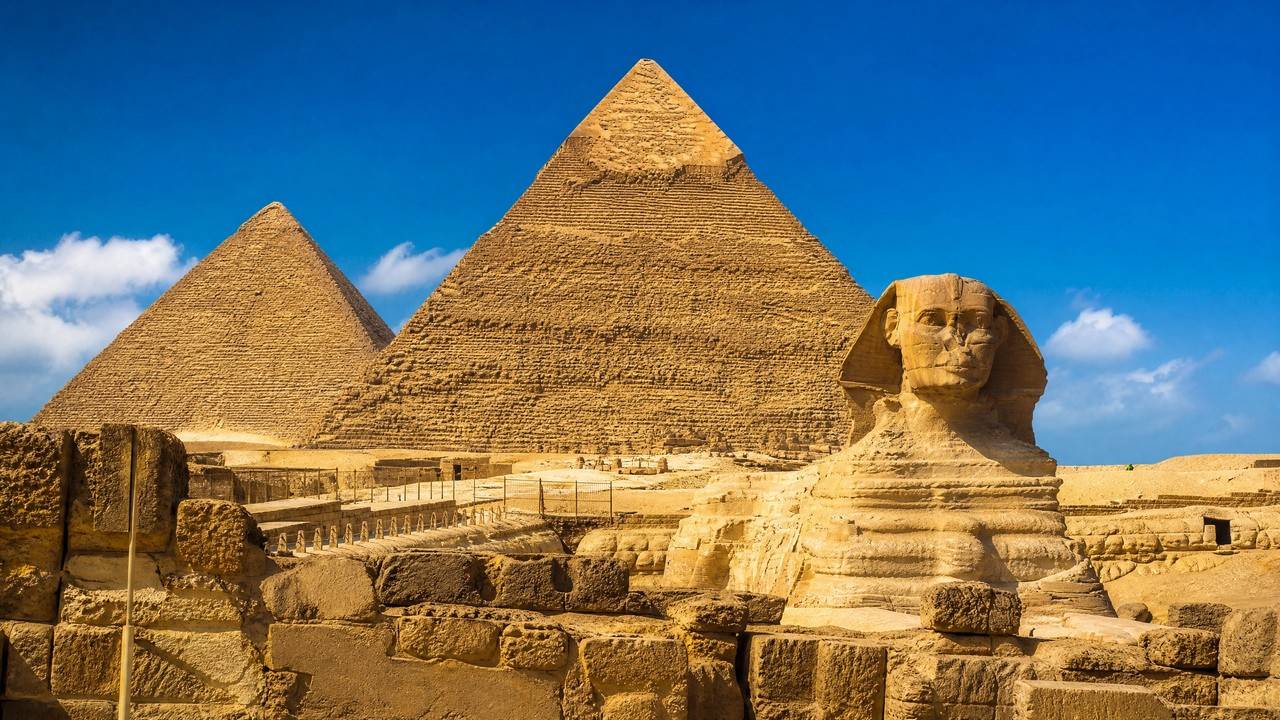
The Great Sphinx was not sculpted and then placed here; it was carved out of the ground it stands on. The bedrock of the Giza plateau is limestone. Masons levelled off a layer of sandstone, drew the outline on the native rock left below, and cut the lion's body and human head down to a floor cut beneath the original surface. The pyramids were built around that block rather than the statue being brought in beside them, which is unusual in Egypt and is why scholars still debate whether the Sphinx is a religious guardian figure or an earlier statement of royal power. In size and orientation it is about 73 metres long and 20 metres from base to crown, among the largest monolithic statues on earth. It faces due east so that the rising sun lights the whole body, which is read as a direct link to solar worship. The proportions of the body are strikingly refined — the shoulders, the line of the flank, the modelling of the muscles — so this is not a rough mass with an animal shape but a work with real aesthetic intent. On the dating, leave some room. The traditional attribution to Khafre rests on the resemblance and on matching stone; more recent stratigraphy and weathering studies lean toward an earlier date, possibly within Khufu's early pyramid-building phase. So when you read that the Sphinx is Khafre's, know that the judgement is still being revised. Condition and restoration: its chest and neck long carried repair layers — the body is limestone, but granite and plaster blocks were once inserted into the head and chest — and protective consolidation has been going on since the nineteenth century. Recent cleaning has removed the chest repairs in stages, exposing more of the original rock face and sharpening the outline of the nemes headdress and mane. The cause of the missing nose is still unproven. The most repeated story attributes it to Napoleon's troops firing on it in 1798, but stone-quarrying and earlier weathering are also proposed, and the evidence for the cannon story is generally considered thin. For most visitors the point is not to walk once round the enclosure and leave. From the high ground on the north you get the only view in which the Sphinx and all three pyramids sit in one frame; from the terrace on the southwest the Sphinx stacks directly beneath Khafre's pyramid, which is the clearest answer to why it has always been called a guardian — it stands exactly on the axis leading to that pyramid's mortuary temple.
Historic Ruins & Heritage
Giza Pyramids
No.4 Cairo
Giza Pyramids
The Giza Pyramids crown the desert plateau southwest of Cairo — the only surviving wonder of the ancient world. The three pyramids of Khufu, Khafre and Menkaure stand with the Great Sphinx, the most eternal and staggering symbol of Egyptian civilisation. Hilltop viewpoints and camel tracks are the classic frames for capturing the three pyramids with the Sphinx.
Historic Ruins & Heritage
Khan el-Khalili & Islamic Cairo
No.5 Cairo
Khan el-Khalili & Islamic Cairo
Khan el-Khalili and Islamic Cairo form the oldest commercial and religious core of the city; the 14th-century bazaar maze brims with gold, spices and copper. Surrounding mosques, madrasas and minarets sketch a millennium of Islamic skyline — a living museum for shopping and losing yourself in alleys.
Old Town & Historic District
The Hanging Church
No.6 Cairo
The Hanging Church
The Hanging Church is Cairo's most celebrated Coptic church, named for the way it rests above the water gate of the ancient Roman Babylon Fortress — a site of worship traceable from roughly the 3rd to 9th centuries and among Egypt's oldest. Dedicated to the Virgin Mary, it holds a prized carved wooden iconostasis fronted by thirteen columns representing Christ and the twelve apostles. Set within Coptic Cairo alongside a synagogue and the Church of St. Sergius, it anchors a walkable district that tells a millennium of Egyptian Christianity. Only when you descend and look up does 'hanging' stop being a figure of speech.
Church & Religious Site

🎯 Cairo Experiences

Egyptian Museum
The golden treasures of Tutankhamun.
Khan el-Khalili
A thousand-year-old market of spices and brassware.
Citadel of Saladin
Overlooks the whole city and its mosques.
Nile Dinner Cruise
Egyptian flair on the river.
Shisha & Coffee
The Arab ambience of the old city.
Cairo is desert climate; the cool season (Oct–Apr) is mild and ideal, while the hot season (May–Sep) is scorching at noon—use sun protection, hydrate and plan mornings/evenings. Dress modestly at mosques and the old town.

📰 Travel Guides

More Guides →

🚌 Transport & Stays

City Transport
✈️
Cairo Airport
About 45 min drive from the city
Fare depends on distance (reference)
🚈
Metro
Avoid surface traffic
Per-trip fare depends on zone (reference)
🚗
Ride-hailing App
City transport; avoid peak hours
Base fare depends on distance (reference)
✈️
Domestic Flights
To Luxor and Aswan
Depends on fare class (reference)
Recommended Stay Areas
🌊 Nile Riverside (Top Pick)
River views and central convenience
🏛️ Around Tahrir Square
Near the Egyptian Museum
🏘️ Islamic Old City
Strongly historic old-town atmosphere
🔺 Giza Pyramids Side
Rooms with pyramid views
Free Consultation

Want to plan your Cairo trip in more depth?

Tell us your departure city, travel dates and interests, and Usitour will tailor a trip just for you.