📍 Destination Overview
La Fortuna is Costa Rica's premier eco-tourism town at the northern foot of Arenal Volcano, the country's most active volcano, glowing with lava on clear nights. Geothermal hot springs, luxury resorts and the 70-meter La Fortuna Waterfall dot the landscape, while hanging bridges cross a canopy rich in sloths and toucans, a perfect nature escape.
☀️ Best Season
Dec-Apr dry season
⏱️ Suggested Days
3-4 days
👥 Suitable For
Nature lovers, adventure travelers
⭐ Highlights
Arenal Volcano, hot springs, waterfalls
💰 Budget Level
Mid-range (higher in tourist zones)
📋 Preparation
Mosquito repellent, light rain jacket, water shoes
☀️ Best Time to Visit & Climate
☀️ Dry Season: Dec–Apr
Best travel season — dry and clear, volcanoes in full view, prime for outdoors
🌧️ Rainy Season: May–Nov
Lush rainforest at its greenest with full waterfalls; sunny mornings, afternoon showers
Jan
☀️
31°/19°
Best
Feb
☀️
32°/19°
Best
Mar
☀️
33°/20°
Best
Apr
☀️
33°/21°
Best
May
🌧️
32°/21°
Jun
🌧️
30°/21°
Jul
🌧️
30°/20°
Aug
🌧️
30°/20°
Sep
🌧️
30°/20°
Oct
🌧️
30°/20°
Nov
🌧️
30°/20°
Dec
☀️
30°/19°
Best
📷 Top Attractions
More Attractions →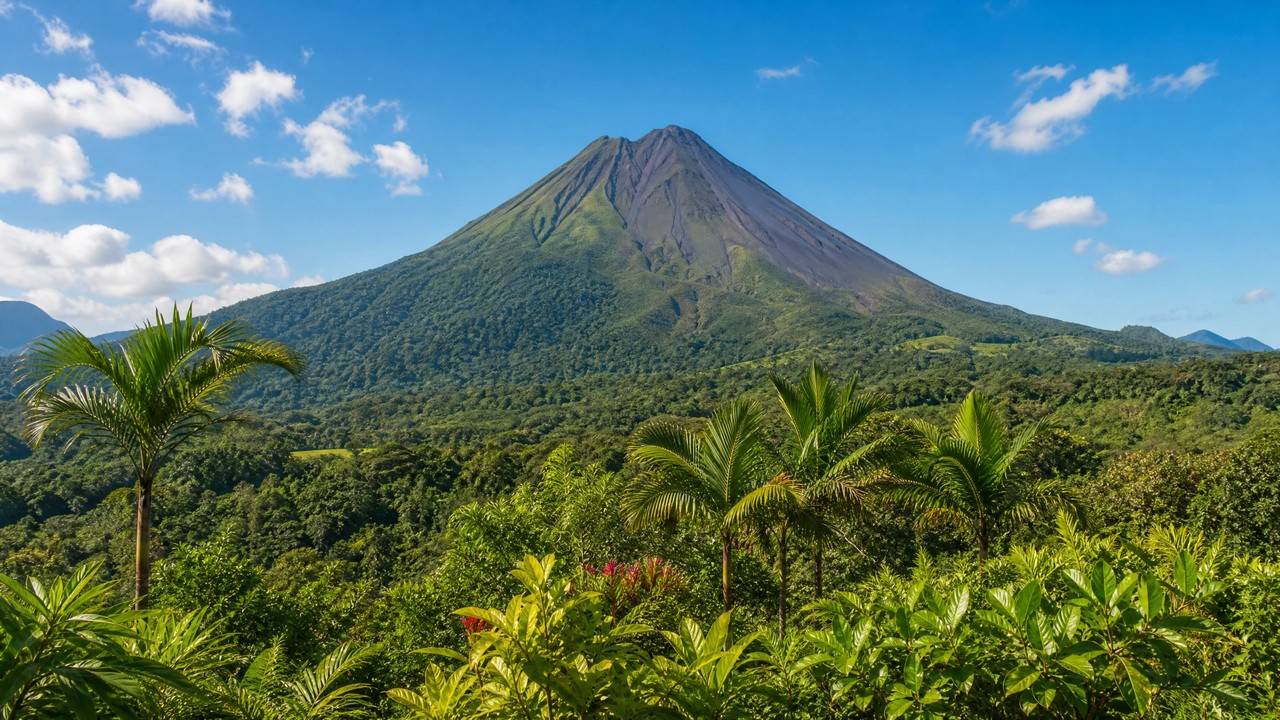
Parque Nacional Volcán Arenal
Parque Nacional Volcán Arenal lies in Costa Rica's northern Alajuela province, built around the 1,670-metre andesitic cone of Volcán Arenal, and is among Central America's most visited protected areas. The volcano erupted violently in July 1968, devastating its western slope and killing dozens, then entered a 42-year active period that continually reshaped the cone with lava flows and ash. The park's landscape of black lava fields set against vivid rainforest is that history made visible. One important clarification: since the eruption ended in December 2010, Arenal has been dormant— today you may see the occasional wisp of steam or hear a faint rumble, but there is no lava flow and no night-time crater glow. If a fiery eruption is the core of your trip, this volcano can no longer deliver; what it does offer is lava geology, rainforest ecology and the record of a monitored live volcano. The park splits into the Volcano Sector and the Peninsula Sector, with trails of 2–6 km taking 1–3 hours. Howler monkeys, white-faced capuchins, coatis, sloths and more than 400 bird species live in the forest; the Ceiba trail runs through the canopy, while the lava trail reaches the 1968 flow front. Nearby Tabacón hot springs, the Mistico hanging bridges, cloud forest and La Fortuna waterfall make it easy to fill a whole day. There is also a conservation logic worth noting: the park prices admission by nationality so that Costa Ricans, whose incomes are far below visitor incomes, can still afford to enter their national parks, with ticket revenue funding upkeep and protection—an idea that sits at the heart of Costa Rica's nature-tourism model.
National Park & Nature
Arenal Volcano
Volcán Arenal is Costa Rica's most recognisable natural landmark: a textbook near-perfect andesitic cone of about 1,670 metres standing beside La Fortuna on the eastern shore of Lake Arenal, and the core symbol of the country's geography and ecotourism. Its history is equally dramatic. As one of the youngest volcanoes here, its earliest eruptions date back about 7,000 years, but it had been dormant for nearly a millennium until the violent eruption of 29 July 1968 tore the western flank apart and killed dozens, opening 42 years of continuous activity in which lava, explosions and pyroclastic flows kept reshaping the cone until it finally stopped in December 2010. One thing must be clear: Arenal is dormant today. The crater shows only intermittent steam and white vapour—there is no lava, and the famous night-time crater glow of old photographs has not existed since late 2010. Even so, the volcano has lost none of its appeal: the symmetrical cone remains a highly photogenic landmark, and its geothermal legacy runs through the whole region—Tabacón and the Arenal hot springs are volcanic by-products, joined by the Mistico hanging bridges, La Fortuna waterfall, Lake Arenal and helicopter flights into a complete volcanic-geothermal circuit. Seeing the volcano takes a little luck and a little strategy: cloud/moisture from both coasts wraps it most of the year, so early mornings and the December–April dry season offer the best odds, while wet-season afternoons often hide it completely—leaving only the outline above a sea of cloud, which is its own reward. Geologically it is still young and unstable: the 1968 flank collapse left a debris field the trails cross today, and the crater rim itself is off limits because of rockfall and gas risk, so the volcano is admired from a viewpoint rather than climbed. That combination—near-ideal cone, accessible viewpoints, and a whole geothermal landscape to explore around it—is what keeps Arenal among the most visited natural sights in Central America.
National Park & Nature

La Fortuna Waterfall
La Fortuna Waterfall (Catarata La Fortuna) drops about 70 to 75 metres in the rainforest roughly six kilometres west of La Fortuna, pouring into a jade pool ringed by basalt. One common misconception deserves clearing up: although the waterfall carries the Arenal name and is marketed with it, it does not pour from Arenal's crater — the water rises on the neighbouring Cerro Chato and crosses a river valley before dropping. The site is managed by the local community association ADIF (Asociación de Desarrollo Integral de La Fortuna), and ticket revenue funds community and conservation work, which is why the fee runs a little above national park prices and why the facilities are unusually well kept.
The visit is essentially one long staircase. About 530 stone and metal steps descend from the ridge to the pool in ten to fifteen minutes, and the climb back takes twenty to thirty; the slope is steep and slick, with a rest platform every hundred steps. The pool holds roughly 22 degree water all year, run straight off forested slopes, and swimming is allowed only in the marked zone — the water directly below the falls and any rip current are genuinely dangerous, especially in the rainy season. The entrance area has changing rooms, showers, toilets, a cafe and locally made chocolate, and parking is free.
Aim for before 9am or after 3pm: angled light gives the falling water volume, and the crowds thin out. Midday is packed with tour groups. The waterfall pairs naturally with the Mistico hanging bridges, the Tabacon hot springs and a walk up Cerro Chato to fill a full day in the area.
National Park & Nature

Parque Mistico Puentes Colgantes
Mistico Park lies in the lowland rainforest west of La Fortuna, near the Lake Arenal dam, and its loop trail covers about 3.2 kilometres through 16 bridges: six genuine suspension spans, the highest roughly 45 metres above the forest floor and the longest close to 100 metres across, plus ten fixed walkways anchored at both ends. The suspension bridges sway gently while the fixed ones are rock steady, which makes the mix a fair choice for anyone uneasy with heights.
One clarification first: this is not part of Arenal National Park. Mistico is a privately managed nature reserve, and the company maintains the boardwalks, bridges, restrooms and cafe to a standard you will not find in the national parks. The higher ticket buys clearer interpretation, cleaner facilities and a forest that private vehicles cannot simply drive into. Its ecology is nothing like the Monteverde cloud-forest canopy walks: this is warm, wet lowland rainforest, which is why resident birds and mammals are present year-round.
The bridges are an excuse to spend time at canopy height. Keel-billed toucans, trogons, hummingbirds, three-toed sloths and howler monkeys all move around eye level, and a naturalist's spotting scope peels the layers apart. More than 350 bird species have been recorded on the property, and a self-paced circuit takes two to three hours.
Early morning is best for keel-billed toucans bounding along the treetops, their red and green bills standing out against wet foliage; in the ravine below the bridges the air stays cooler, and after rain trogons line the branches to preen. With only half a day, walking the suspension section and turning back beats forcing the full loop. Guided walks are charged separately but are the single most effective investment if seeing wildlife is the goal.
National Park & Nature

Tabacón Grand Spa Thermal Resort
Among La Fortuna's many hot springs, Tabacon takes the all-natural route: instead of pumping thermal water into concrete pools, the resort lets the volcano-heated Tabcon River cascade through tropical gardens, forming a chain of stone pools and waterfall curtains that climb from roughly 25°C to 50°C. Day passes are capped daily and usually bundle a buffet dinner, so you can soak into the night with the silhouette of Arenal overhead—steam and starlight in the same frame, the most lavish stop after a hike.
Leisure & Entertainment

Baldí Hot Springs Hotel Resort and Spa
Baldi turns hot springs into a full-blown water park: several dozen pools stack down the hillside at temperatures from the low 30s to above 40°C, with heated water slides threaded between them that drop you into the lower pools with a splash. A swim-up bar and waterfall walls punctuate the tropical gardens, while the day pass—typically covering buffet meals and drinks—offers some of the best value in La Fortuna. Families with kids and sore-legged hikers share the same steaming water, and both leave satisfied.
Leisure & Entertainment
🎯 La Fortuna Experiences
Canopy Zip-line
Fly above the rainforest canopy with views of Arenal Volcano and Lake Arenal; longest cable nearly 1 km
Night Rainforest Tour
Join a naturalist guide with flashlight to spot tree frogs, snakes and nocturnal mammals
White-Water Rafting
Tackle Class II-III rapids on the Balsa or Sarapiquí River with riverside wildlife viewing
Hanging Bridges Walk
Walk suspension bridges at canopy height for a unique perspective on mid-level rainforest ecology and birds
Organic Farm Visit
Tour local coffee and chocolate farms, learn the bean-to-cup process and make chocolate by hand
Dry season Dec-Apr is ideal; in green season, mornings are usually sunny for activities while afternoon showers are perfect for hot spring soaks
🚌 Transport & Stays
City Transport
🚌5000-8000 CRC
Public Bus
Direct from San Jose to La Fortuna, budget-friendly but ~4.5 hours
5000-8000 CRC
🚐30-50 USD
Shared Shuttle
Hotel-to-hotel service, comfortable and convenient for most travelers
30-50 USD
✈️80-150 USD
Domestic Flight
San Jose to Arenal airstrip in just 30 minutes
80-150 USD
Recommended Stay Areas
♨️ Hot Spring Resort Area
Resorts with private thermal pools, volcano views and luxury amenities
🏠 Town Center
Walking distance to restaurants and tour agencies, convenient for activities
🌿 Rainforest Eco-Lodge
Jungle cabins and tents immersed in nature for close wildlife encounters
🏕️ Lake Arenal Shore
Quiet lake-view area ideal for birdwatching and water sports
Free Consultation
At the Foot of the Volcano, Embrace the Raw Power of the Rainforest
La Fortuna—where hot springs, waterfalls and rainforest converge in an eco-paradise awaiting your discovery