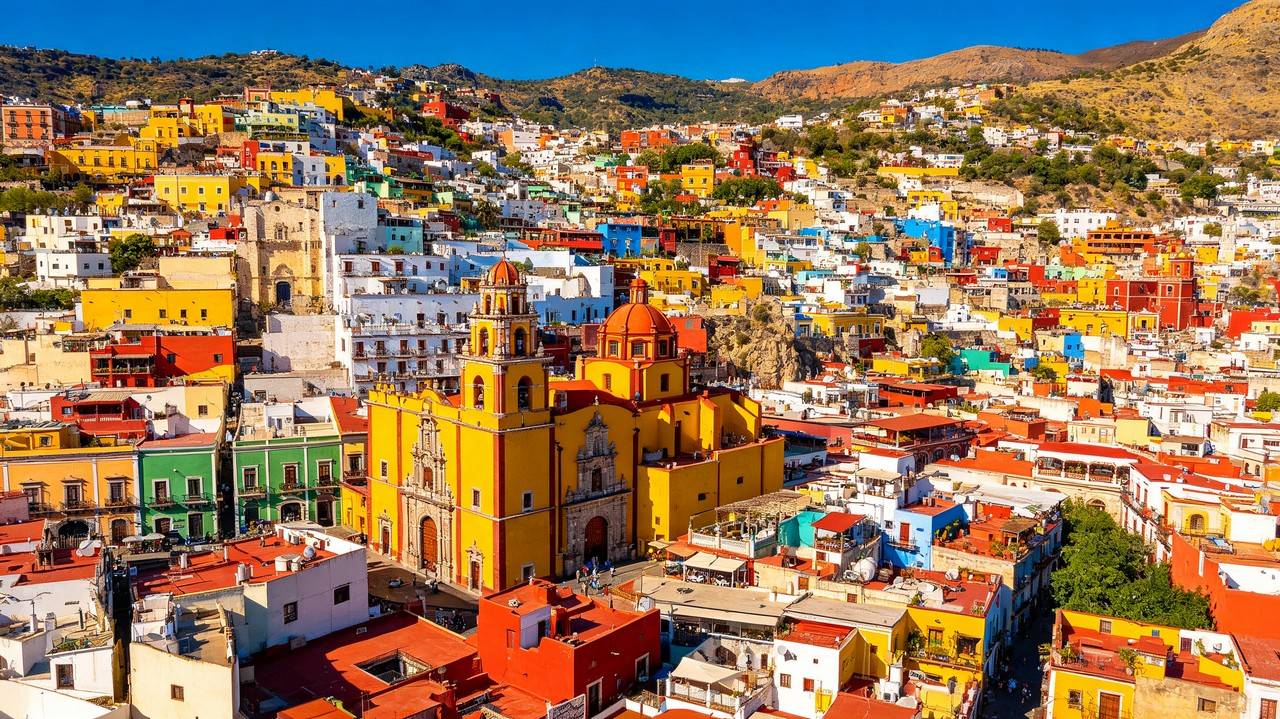
📍 Destination Overview
Guanajuato, in a valley in central Mexico, was once a leading silver-mining centre and is a World Heritage site. Colourful houses cascade down slopes, and the Alley of the Kiss is famed for a romantic legend. Underground tunnels double as streets; the Pipila monument overlooks the town, and every October the Cervantes arts festival electrifies it.
🏘️ Location
Mexico · Guanajuato · a UNESCO mountain town on the central plateau
🗓️ Best Season
Oct-Apr
🕐 Time Difference
14 hrs behind Beijing
💰 Currency / Language
Mexican Peso MXN / Spanish
🕐 Suggested Duration
1-2 days · colorful town + viewpoints + tunnels
🔌 Outlet / Voltage
Type A/B outlets · 127V · different from China, bring adapter
☀️ Best Time to Visit & Climate
☀️ Dry season: Oct–Apr
Clear and dry at 22–30°C—ideal for exploring the colourful alleys and the underground tunnel roadway on foot.
🎭 Cervantes Arts Festival: October
The International Cervantino Festival fills the city with street theatre and performances—book lodgings months ahead.
Jan
🌤️
23°/6°
Best
Feb
☀️
25°/7°
Best
Mar
☀️
28°/9°
Best
Apr
🌤️
30°/11°
Best
May
🌤️
30°/13°
Jun
🌧️
28°/14°
Jul
🌧️
26°/13°
Aug
🌧️
26°/13°
Sep
🌧️
25°/13°
Oct
🎭
25°/10°
Festival
Nov
🌤️
24°/8°
Best
Dec
🌤️
22°/6°
Best
📷 Top Attractions
More Attractions →
Guanajuato Mummy Museum
The Museo de las Momias de Guanajuato stands inside the grounds of the Panteon Municipal de Santa Paula, on the hillside west of the historic centre of Guanajuato, Mexico.
Where the mummies came from: these are not Egyptian-style embalmed mummies but naturally desiccated bodies. In the nineteenth century a local burial tax required families to keep paying a plot fee, and those who could not had their relatives' remains removed. From 1865 onward, as graves were opened, it emerged that Guanajuato's dry, mineral-rich soil had desiccated some bodies without any embalming, preserving skin, hair, nails and even the texture of clothing.
The collection: more than a hundred naturally mummified bodies are laid out along a single corridor through several rooms, ending at a gift shop. Alongside men and women are children, infants, pregnant women and victims of the nineteenth-century cholera epidemics, among them some of the smallest mummies in the world.
Why it should not be treated purely as a freak show: the existence of these remains is itself a product of poverty. Families who could not keep paying the plot fee were forced to part with their dead, and removing the bodies accidentally produced this set of natural specimens. What is here is also a record of nineteenth-century burial practice, cemetery economics and cholera.
Admission (2026): sources differ widely, quoting 85, 97 or 106 pesos for adults and 45 to 62 for children and students with ID. The booth is the authority.
Photography normally costs about 30 pesos extra and enforcement varies, so read the notices at the entrance rather than assuming you may shoot freely.
Timing and route: weekday mornings just after the 9:00 opening are calmest, while weekends and the Day of the Dead period in early November are the busiest. Allow forty-five minutes to an hour, and budget for the twenty-minute uphill walk or a short taxi from the old town.
Museum

Estatua del Pipila
The Pipila Monument stands atop the hill south of Guanajuato, honoring Pipila, a miner hero who stepped forward in the Mexican War of Independence. It is the best viewpoint over the colorful hill city—tiered colorful houses, church domes and the valley city unfold below, most charming at dusk and when the lights first come on. Reach it by cable car or on foot through the alleys. After paying respects to this commoner hero's statue, enjoy the magnificent panorama of the whole World Heritage city—unforgettable.
Sightseeing

Templo La Valenciana
Templo La Valenciana is the most ornate 18th-century Baroque church in Guanajuato, Mexico, built between 1765 and 1788 during the mining boom. Funded by the local silver mine, its main altar is entirely covered in 24-karat gold leaf, glowing brilliantly and often called "the jewel box of Guanajuato." The pink-stone façade is richly carved, and its two asymmetric towers are distinctive. The church is a pinnacle of Mexican Baroque religious architecture and a key site to understand the link between colonial mining wealth and religious art.
Church & Religious Site

Musem of Siglo XIX
The Museo del Siglo XIX occupies a restored colonial mansion in Guanajuato and focuses on Mexican life after Independence — the Reform War and the Porfirian era. Furniture, dress, portraits and everyday objects fill the rooms, and the building's patio and stained glass themselves evoke 19th-century Guanajuato as a mining boomtown.
Museum

Museo Exhacienda San Gabriel de Barrera
The Museo Ex-Hacienda San Gabriel de Barrera lies just outside Guanajuato — a 17th–18th-century mining hacienda later turned into a residence with celebrated European-style gardens. The museum is known for its period room settings and terraced gardens, a quiet, refined escape from Guanajuato's bustling hillside streets.
Museum

Alhondiga de Granaditas
The Alhóndiga de Granaditas is a late 18th-century grain store in Guanajuato that became, in September 1810, the site of the first major battle of Mexico's war of independence: Father Hidalgo's insurgents besieged the Spanish holding out inside, and the miner known as El Pípila, shielded by a stone slab on his back, set fire to the door and let them through. After the reversal the Spanish executed Hidalgo and three other leaders and hung their heads at the building's four corners for years. It now houses the Guanajuato regional museum, with murals by Chávez Morado in the stairwell.
Museum
🎯 Guanajuato Experiences
Pípila Viewpoint
Overlook the colorful town panorama.
Alley of the Kiss
The romance of touching balconies.
Colorful Alleys
A stroll through the layered town.
Juárez Theatre
A splendid colonial hall.
Cervantes Festival
An October arts celebration.
Guanajuato's highland climate is mild year-round. The October Cervantes International Arts Festival is a citywide event, so book rooms early. The rainy season (Jun–Sep) brings afternoon showers. The old town has many slopes and is best on foot; the Pípila viewpoint offers the finest panorama of the colorful town.
🚌 Transport & Stays
City Transport
✈️Taxi fare by distance (reference)
León Airport
About 40 min to Guanajuato
Taxi fare by distance (reference)
🚶—
Walking
Old town slopes, good on foot
—
🚞By ticket price (reference)
Pípila Cable Car
To the viewpoint
By ticket price (reference)
🚌By cabin class (reference)
ADO Bus
To/from Mexico City etc.
By cabin class (reference)
Recommended Stay Areas
🏘️ Old Town Center (top pick)
Near theatres and colorful alleys
🌆 Near Pípila Viewpoint
High spot overlooking the town
🎭 Around Jardín Union
Convenient dining and nightlife
🚌 Around the Bus Station
Easy transit, friendly prices
Free Consultation
Want to plan your Guanajuato trip in more depth?
Tell us your departure city, travel dates and interests, and Usitour will tailor a trip just for you.