📍 Destination Overview
Tulum sits on the Caribbean coast south of Cancún, famed for its clifftop Maya ruins, the only Maya city built by the sea. Stone temples rise above turquoise water and white sand, where ancient civilization meets seascape. The beaches carry a bohemian, eco-chic vibe, while jungle cenotes invite diving into clear caves. Ruins, beaches and cenotes give Tulum its unique Caribbean character.
🏛️ Location
Mexico · Quintana Roo · Caribbean coast south of Cancún
🗓️ Best Season
Dec-Apr dry season
🕐 Time Difference
13 hrs behind Beijing
💰 Currency / Language
Mexican Peso MXN / Spanish
🕐 Suggested Duration
2-3 days · ruins + beach + cenotes
🔌 Outlet / Voltage
Type A/B outlets · 127V · adapter needed
☀️ Best Time to Visit & Climate
🏖️ Dry Season: Dec–Apr
Dry and sunny — beaches and ruins at their best.
🌀 Jun–Nov
Stay weather-aware — rainy and hurricane season.
Jan
🏖️
28°/20°
Best
Feb
☀️
29°/20°
Best
Mar
☀️
30°/22°
Best
Apr
🏖️
31°/23°
Best
May
🌡️
32°/24°
Jun
🌧️
32°/25°
Jul
🌧️
33°/25°
Aug
🌧️
33°/25°
Sep
🌀
32°/24°
Oct
🌧️
31°/23°
Nov
🌦️
30°/22°
Dec
🏖️
28°/21°
Best
📷 Top Attractions
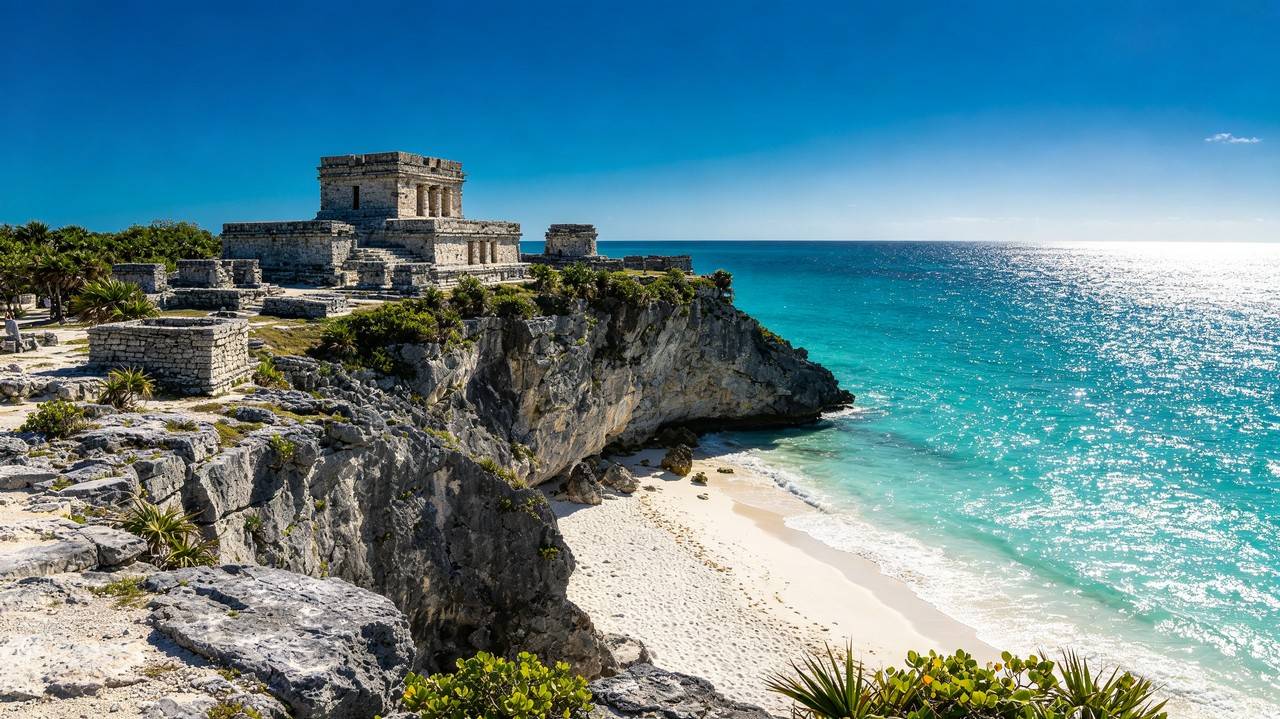
Tulum Archaeological Site
Tulum is Mexico's most photogenic Maya ruin on the Caribbean coast: a Postclassic Maya city of the 13th-15th centuries on a 12 m limestone cliff, walled on three landward sides and open only to the sea. Tulum means 'wall' in Yucatec Maya, while its original name Zama meant 'place of the dawn'.
Roughly contemporary with Chichen Itza, it was a trading port for jade, obsidian and turquoise, and one of the few Maya cities still inhabited when the Spanish sighted it in 1518. Some 60 structures survive across six hectares.
El Castillo on the cliff's highest point is the star, commanding the whole Caribbean and said to have doubled as a lighthouse for canoes. The north end groups the Temple of the Wind God, the Temple of the Frescoes, and the Temple of the Descending God, whose doorway bears an upside-down winged figure and is the most recognisable detail on the site. Iguanas sun themselves on the steps and walls, a charm unique to Tulum.
Climbing the structures has been banned since 2008. If you want to climb a Maya pyramid, the nearest alternative is Coba, 44 km inland, whose Nohoch Mul pyramid stands 42 m and reopened for climbing in December 2025, in groups of no more than 15 with no more than 15 minutes at the top.
One thing that is easily confused and worth stating plainly: the beach and the ruins are separate. Mexico's Tourism Secretariat has confirmed that Tulum's beaches are freely accessible via public routes, but that does not include entry to the archaeological site. Beach access at Playa Ruinas below the cliffs opens and closes with the park works, and the stairway down from below El Castillo is restricted, so ask at the entrance and do not treat a swim as a given.
Admission has been a unified 265 pesos since 20 July 2026, replacing the previous separate INAH, national park and Jaguar park charges. There is a bag check at the gate with queues that can be long, disposable plastic and smoking gear are not allowed, so travel light and bring cash in pesos.
Historic Ruins & Heritage

Casa Cenote
Casa Cenote, formally Cenote Manati, lies in Quintana Roo, Mexico, about twelve kilometres north of Tulum town on the east side of Highway 307, inside the Tankah development, and about 1.5 km down the Tankah dirt road.
What it is: this is one of the rare semi-open cenotes on the Yucatan Peninsula. Most cenotes are vertical shafts walled in by rock; this one connects to the near-shore sea through an underwater cave system, so the water is open and elongated, with a mangrove bank on one side and a small beach on the other, and both light and water exchange resemble a coastal lagoon rather than a closed shaft. Inside, fresh water mixes with seawater into a brackish habitat where small fish such as the Yucatan gambusia school in numbers.
The name: casa means 'house' in Spanish, after the restaurant and lodging beside it; the formal name Cenote Manati means 'manatee cenote'.
What it is today: boardwalks and platforms run along the water for swimming, snorkelling, kayaking and paddleboarding, and a dive shop across the road offers open-water discovery dives. Facilities include changing rooms, lockers, a rustic Mexican restaurant, massage stalls that appear on weekends, and kayak and paddleboard rental, with a small beach beside the cenote to rest on.
Three things to know in advance. Only cash in pesos is accepted, no cards and no dollars. Phone cameras are free, but an action camera costs about 100 pesos extra and a professional camera about 500, and drones are not allowed. And crocodiles are recorded here, so keep your distance from the mangrove edge, never feed them, and supervise children at all times.
One more honest note that affects the visit: the toilets are porta-potties in poor condition and the changing rooms are equally basic, so use the facilities before you arrive and swim in your swimwear. On timing, the 9:00-11:00 window is the quietest and the light clearest, and is the real golden hour here.
National Park & Nature

Ziggy Beach
Ziggy Beach, formally Ziggy's Beach Club, lies in the Tulum hotel zone, Quintana Roo, Mexico, at kilometre 7.5 of the Carretera Tulum-Boca Paila, about ten minutes by road from Tulum town centre.
Positioning: this is the beach club on this stretch known for being quiet, in sharp contrast to the DJ-driven clubs nearby. Sources return to the same word for it, calm: no loud music, no scene to perform, loungers facing the sea and service attentive enough to remember names. It suits couples who want to read, families who want to hear each other, and anyone who needs a recovery day after a big night.
Grounds and facilities: wooden loungers, double day beds, rope hammocks and palm-thatch shade sit straight on the sand, with no large structures and no swimming pool. The sea and the beach are the whole programme. Towels are complimentary and staff keep the beach groomed through the day. It is child friendly, with sand toys provided and staff watching children as closely as cocktails, though there is no children's pool.
Food and drink: Mexican and Caribbean coastal cooking, with passionfruit and coconut ceviche, beer-battered fish tacos, rum-spiked coconut and the Ziggy burger among the recurring recommendations, and reviews generally rating the food above beach-club standard. The cocktail list has real range, covering spritzes, mojitos, margaritas and creative builds.
Music and evenings: acoustic sets run through the afternoon, with live music roughly 19:30-21:30. Each day of the week has a separately charged theme, from cocktail tasting and tequila with mariachi through salsa and Caribbean seafood to Mexican wine and mezcal tastings.
Two practical notes to finish on. There is no cover and no separate lounger fee, but there is a per-person minimum of roughly 50 to 75 US dollars, generally not applied to children. And the 7:00 opening is the earliest on the strip, letting early risers own the sand for hours before the midday wave, while the 22:30 close means the beach can become dinner without moving.
Beach & Island
🎯 Tulum Experiences
Clifftop Ruins
The awe of a seaside Maya city.
Cenote Swim
The cool of jungle sinkholes.
Coba Pyramid
Climbing deep in the rainforest.
Cave Diving
Exploring underground water caves.
Beach Yoga
Bohemian healing.
Tulum's Caribbean coast is hot. The dry season (Dec–Apr) is dry and sunny — the best time; Jun–Nov is the rainy and hurricane season. Visit the clifftop ruins early morning to avoid crowds. In summer, sargassum may appear near shore.
📰 Travel Guides
More Guides →🚌 Transport & Stays
City Transport
✈️Transfer by option (reference)
Cancún Airport
About 1.5 hrs to Tulum
Transfer by option (reference)
🚗Daily by car type (reference)
Rental Car
Most flexible for scattered sights
Daily by car type (reference)
🚲Daily by shop (reference)
Bike Rental
Between town and beach
Daily by shop (reference)
🚌By cabin class (reference)
ADO Bus
To/from Cancún and Mérida
By cabin class (reference)
Recommended Stay Areas
🌿 Beach Area (top pick)
Thatched-roof boutique hotels, sea view
🏘️ Tulum Town
Friendly prices, convenient dining
🧘 Yoga Resort
Mind-body healing atmosphere
🏛️ Near the Ruins
Stay a night to see the ruins at sunrise
Free Consultation
Want to plan your Tulum trip in more depth?
Tell us your departure city, travel dates and interests, and Usitour will tailor a trip just for you.