📍 Destination Overview
Chichén Itzá, the Maya-Toltec holy city in Mexico's Yucatán, is a UNESCO World Heritage site and one of the New Seven Wonders. Its pyramid, the Castillo, has 365 steps for the days of the year; at equinoxes a serpent shadow descends the stairway. The great ball court is Mesoamerica's largest, and the Sacred Cenote served rituals—Mexico's most celebrated ruin.
🗓️ Best Season
Oct-Apr
🕐 Duration
3-5 days
👪 Best For
Photo · Couples · Family
🎯 Highlights
Culture · Food · Nature
💰 Budget
Moderate
🧳 Preparation
Passport · Visa · Insurance
☀️ Best Time to Visit & Climate
☀️ Dry Season · Nov-Apr
Sunny, low rain, ideal for beaches & outdoors.
🌴 Shoulder · Apr-May/Oct-Nov
Mild transition, best value.
Jan
☀️
28°/18°
Best
Feb
☀️
30°/19°
Best
Mar
☀️
32°/21°
Best
Apr
🌤️
34°/24°
Best
May
🌧️
34°/24°
Jun
🌧️
33°/25°
Jul
🌧️
33°/24°
Aug
🌧️
33°/24°
Sep
🌧️
32°/24°
Oct
🌧️
31°/22°
Good
Nov
🌤️
29°/20°
Best
Dec
☀️
28°/19°
Best
📷 Top Attractions
More Attractions →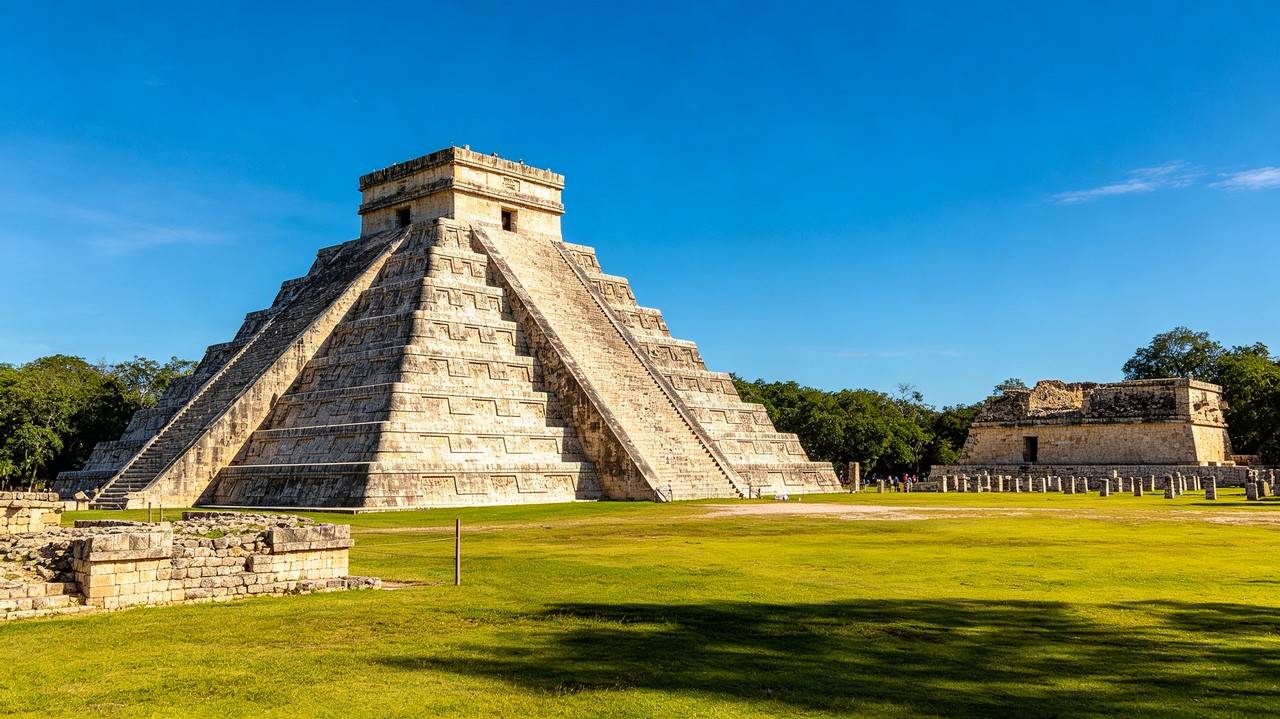
Pre-Hispanic City of Chichen-Itza
Chichén Itzá is one of the most important and best-preserved Maya cities, in the Tinum municipality of Yucatán, Mexico, beside the village of Pisté: a UNESCO World Heritage Site since 1988, a New Seven Wonder of the World since 2007, and host to over 2.5 million visitors a year, the most visited archaeological site in Mexico.
The city flourished from 600 to 1200 CE, spanning the Late Classic into the Postclassic. Its architecture is a blend of Maya tradition and Toltec style, the latter carried south into Yucatán by influence from central Mexico, so this is neither a purely Maya nor a Toltec site but two architectural languages meeting on one axis. The northern half holds Late Classic Maya buildings, while the southern stretch known as Old Chichén concentrates the Toltec columned architecture.
The centerpiece, the Pyramid of Kukulcán or El Castillo, rises 24 m in nine receding tiers, with a staircase of 91 steps on each face and 365 in all including the top platform, the number of days in the Maya solar year. Around the spring and autumn equinoxes the shadow cast by its north-west corners draws a serpent of Kukulcán down the northern staircase for several hours; the effect is nearly identical 3 to 5 days either side of the equinox, with far fewer people. Climbing has been banned since 2006 and it is viewed from the ground only.
The Great Ball Court, 168 by 70 m with 8 m walls, is the largest in Mesoamerica, with acoustics that carry a whisper from one end to the other and sacrifice scenes carved on its walls. The round El Caracol observatory stands on a raised platform with openings aligned to the rise and set of Venus and the equinox sunrise, one of the most precise astronomical buildings in Mesoamerica and evidence of Maya command of the 584-day Venus cycle. The Sacred Cenote, about 60 m across at the end of a 300 m causeway, yielded gold, jade and human remains when dredged in the early twentieth century, confirming it as the focus of rain and sacrifice rituals, but it is not open for swimming.
Three practical points matter most. The ticket is bought at two separate windows, federal INAH plus the Yucatán state CULTUR fee, 697 MXN in total. The booths close at 16:00 sharp and last entry is strictly enforced, with no re-entry on a day ticket. And there is almost no shade, so a hat, water and long sleeves are conditions rather than comforts. The best windows are 8:00-10:00 or after 14:00, avoiding the 10:30-14:30 coach peak when temperatures regularly pass 35 degrees. Yucatán runs one hour behind Quintana Roo, so count that hour if you are coming from the coast for the opening.
Historic Ruins & Heritage

Cenote Ik Kil
Cenote Ik Kil is the most visited open cenote on the Yucatan Peninsula, about three kilometres east of the Chichen Itza ruins beside Highway 180 towards Valladolid, near the village of Piste.
Form and scale: the opening is almost perfectly round, roughly 60 m across, with walls dropping about 26 m to the water and another 40 m below it, some 48 m in all, among the deepest open cenotes in Yucatan. Vines and tree roots hang from the walls, midday sunlight falls through the canopy onto the pool, and visibility reaches ten metres or more. The water comes from the limestone aquifer and holds at 24-26 degrees C year-round, about eight degrees cooler than midday air, so swimming is possible in any season.
Maya belief: Ik Kil means 'place of the winds' in Yucatec Maya. The Maya treated cenotes as doorways to the realm of the rain god Chaac, from whom rain was thought to well up out of the underworld. Early divers recovered human bones and jade offerings from the depths, so the site shared the rain-making and sacrificial character of the Sacred Cenote at Chichen Itza.
What it is today: a stone-and-wood staircase winds down the wall to a platform at the water's edge, and the platform carries two stone diving boards, about 3 m and 5 m above the water, both supervised by lifeguards. Changing rooms, showers, lockers, a shop and the Yucatecan restaurant Ek Balam are all on site.
Three practical points matter most. This ticket is separate from the Chichen Itza ruins ticket, and the booth takes cash in pesos only, no cards and no dollars. Everyone entering the water must wear a life jacket, and jumping from the rim some 26 m up is prohibited, fenced off and fined, with people injured there every year. And sunscreen and repellent are barred from the water, so rinse at the showers first.
On timing, the crowd curve here runs about two hours behind Chichen Itza: entering at the 9:00 opening is quietest, 11:00-13:30 is the coach peak with queues at the platform, and numbers fall off clearly after 14:00.
National Park & Nature

Pre-Hispanic City of Chichen-Itza
La Iglesia ("The Church") is the most richly decorated building within the Las Monjas Group at Chichén Itzá, Mexico. This small stone structure from the Postclassic period (c. 10th-13th century) features dense Chaac rain-god mask reliefs on its facade, a corbel-vaulted interior and feathered-serpent ornaments — an outstanding example of Maya religious architectural decoration. Spanish conquistadors named it "La Iglesia" for its church-like appearance. Though small, the facade is covered in layered Chaac masks with exquisite carving. The interior uses the Maya corbel vault. The Las Monjas Group is the core Postclassic complex at Chichén Itzá, and La Iglesia is its most striking structure. Visiting to appreciate Maya decorative exuberance and religious devotion in layered rain-god reliefs is a rewarding niche stop within Chichén Itzá.
Historic Ruins & Heritage
No.4 Chichen Itza
Las Monjas
Las Monjas ('The Nunnery') is a late-period complex at Chichén Itzá, named by Spaniards for its resemblance to a convent—actually a Maya elite administrative and residential compound. Its facades brim with fine reliefs and Gulf-coast-style mosaic decoration; four buildings enclose a square court, blending Puuc and Maya–Toltec styles—a textbook of the site's later architecture.
Sightseeing
No.5 Chichen Itza
El Caracol
El Caracol, the Snail, is the odd one out at Chichen Itza: instead of a stepped pyramid, it is a round tower on two square platforms with a spiral stone stair winding up inside, which earned it the Spanish name. Its remaining narrow windows were not decorative. Maya priests aligned them with the extreme positions of Venus and particular stellar events, using the observations to set planting, calendars and ritual, making this one of the most cited examples of pre-Columbian astronomy in the Americas. Visitors cannot climb the tower today, but can circle the base to study the round masonry and window slits. It shares the site with El Castillo, the Great Ball Court, the Temple of the Warriors and the Sacred Cenote, all covered by one entrance ticket. Chichen Itza became a World Heritage site in 1988 and was named one of the New Seven Wonders in 2007.
Sightseeing
No.6 Chichen Itza
Gran Juego de Pelota (Great Ball Court)
The Gran Juego de Pelota is the largest ancient ball court in Mesoamerica, about 120 m long with stone rings high on its side walls, where the Maya played the ritual game pok-ta-pok. Players struck a rubber ball with hips, elbows and knees through the rings; outcome was tied to sacrifice — the winning captain might be offered to the gods. The court's astonishing acoustics let a whisper at one end reach the other, showing Maya architectural and astronomical skill. It is a core highlight of Chichén Itzá, a UNESCO World Heritage site and New7Wonder.
Sightseeing
🎯 Chichen Itza Experiences
Cultural Deep Dive
Discover Chichen Itza's historic sites and museums.
Food Exploration
Taste authentic cuisine and local specialties in Chichen Itza.
Outdoor Adventure
Explore Chichen Itza's outdoor activities and natural scenery.
Shopping Experience
Browse local markets and shops in Chichen Itza.
Nightlife & Entertainment
Experience Chichen Itza's nightlife and entertainment.
This destination is hot year-round; the best time to visit is Nov–Mar, with temperatures around 18–32°C. April is hottest (up to 34°C), so pack sun protection and drink plenty of water.
🚌 Transport & Stays
City Transport
✈️
Flight
International and domestic flights connect the region.
🚗
Car Rental
Rental cars available, good for exploring at your own pace.
🚌
Public Transit
Local buses and trains serve key routes.
Recommended Stay Areas
🏨 City Center
Stay in Chichen Itza's City Center for easy access to attractions.
🏡 Tourist District
Stay in Chichen Itza's Tourist District for easy access to attractions.
🏕️ Waterfront Area
Stay in Chichen Itza's Waterfront Area for easy access to attractions.
🏠 Historic Quarter
Stay in Chichen Itza's Historic Quarter for easy access to attractions.
Free Consultation
Start Your Chichen Itza Journey
Discover the wonders of Chichen Itza.