Parthenon
Quick Facts
- Location
- Greece, Athens
- Category
- Historic Ruins & Heritage
- Duration
- 20–30 minutes for the temple; 2–3 hours for the Acropolis, half a day with the museum.
- Opening Hours
- 1 April-31 August 08:00-20:00; 1-15 September 08:00-19:30; 16-30 September 08:00-19:00; 1-15 October 08:00-18:30; 16-31 October 08:00-18:00; 1 November-31 March 08:00-17:00; last admission 20 minutes before closing; closed on 1 January, 25 March, 1 May, Orthodox Easter Sunday, 25 and 26 December
- Ticket Price
- Adult: 30 EUR · Senior: 15 EUR · Valid ID required at the gate for reduced tickets; free-day tickets cannot be booked online and must be obtained at the ticket office
- Address
- Parthenon, Acropolis of Athens, Athens 105 58, Greece
- Coordinates
- 37.9715, 23.7266
Introduction
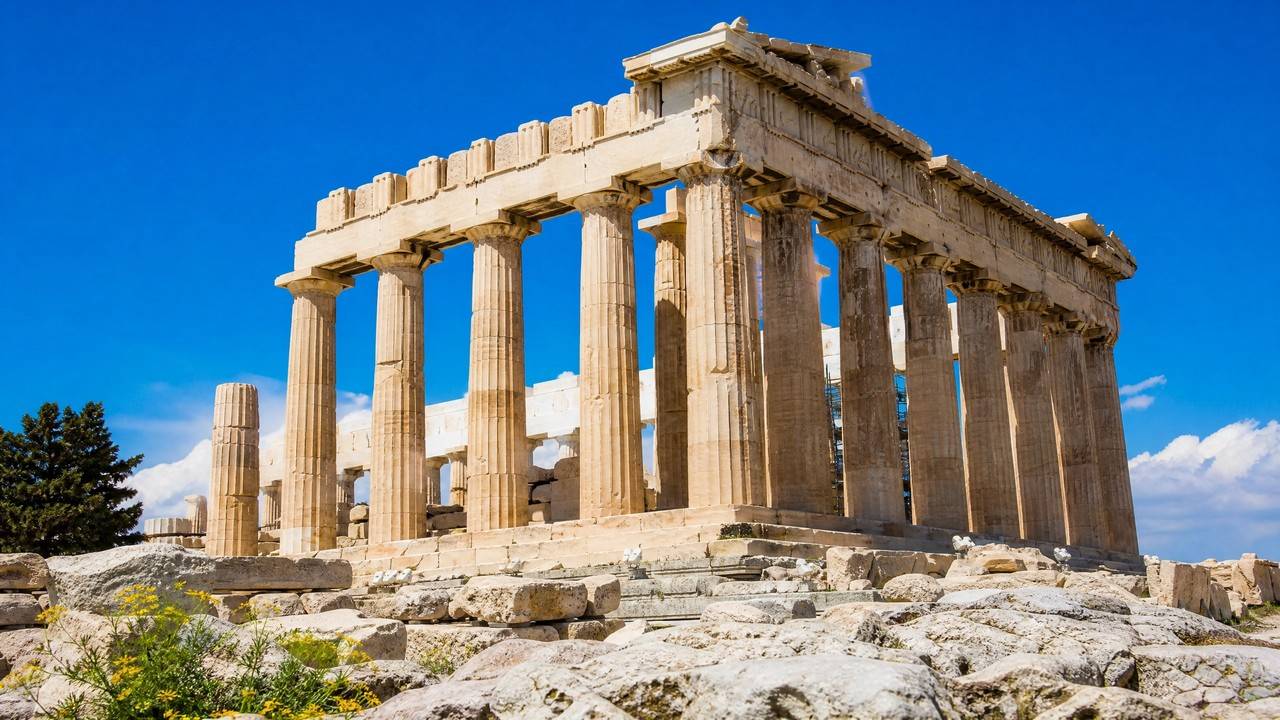
The Parthenon (Greek for "maidens' chamber") stands at the highest point of the Acropolis, the greatest legacy of ancient Greek architecture and the summit of the Doric order. Begun in 447 BC and completed in 432 BC, it was designed by Ictinus and Callicrates with sculpture supervised by Phidias. Built of Pentelic marble on a stylobate of 69.5 by 30.9 metres, its 8-by-17 Doric colonnade (46 outer columns, about 10.4 m tall) hides refined optical corrections: entasis in the shafts, a curved base and thickened corner columns. The cella housed Phidias' colossal Athena Parthenos, some 11.5 m of gold and ivory, long lost, and once served as the Delian League treasury. The pediments told the birth of Athena; 92 metopes and a 160-metre Ionic frieze of the Panathenaic procession rank among the finest Greek sculpture. The marbles removed by Lord Elgin in the early 1800s remain in the British Museum in a still-running restitution dispute, while a 1687 Venetian bombardment detonated a powder magazine that blew off the roof and most of the sculpture. Anastylosis restoration has continued since 1975. The temple is the centrepiece of the Acropolis timed-entry ticket.
✨ Highlights
🛈 Practical Info
Ticket Information
| Adult | 30 EUR |
|---|---|
| Senior | 15 EUR |
| Student | 15 EUR |
Valid ID required at the gate for reduced tickets; free-day tickets cannot be booked online and must be obtained at the ticket office
💡 Tips
FAQ
What are the opening hours of Parthenon?
1 April-31 August 08:00-20:00; 1-15 September 08:00-19:30; 16-30 September 08:00-19:00; 1-15 October 08:00-18:30; 16-31 October 08:00-18:00; 1 November-31 March 08:00-17:00; last admission 20 minutes before closing; closed on 1 January, 25 March, 1 May, Orthodox Easter Sunday, 25 and 26 December
How much is the admission for Parthenon?
Adult: 30 EUR; Senior: 15 EUR; Student: 15 EUR; Valid ID required at the gate for reduced tickets; free-day tickets cannot be booked online and must be obtained at the ticket office
Any practical tips for visiting Parthenon?
The interior is not open to visitors — walking the perimeter is the whole experience, so spend the time on the columns, frieze and pediment. The 8 a.m. slot or after 4 p.m. gives raking light across the columns and half the midday crowd.
How long should I spend at Parthenon?
A typical visit takes 20–30 minutes for the temple; 2–3 hours for the Acropolis, half a day with the museum..