

This guide was compiled by the Sifang content team based on the Greek Ministry of Culture, Acropolis Museum, Athens Airport and OASA official website, and updated to September 2026. Clarify that the Acropolis is a flat 30 EUR year-round and the museum a flat 20 EUR (10 EUR reduced), and that the former multi-site combined ticket was discontinued on 1 April 2025. Covering visas, airport transportation, accommodation zoning, tickets and coupons, 3-5 days 'itineraries,
Quick Facts
As of September 22, 2026, this article was compiled based on the official websites of the Greek Ministry of Culture, the Acropolis Museum, Athens Airport, OASA, and Visit Greece, as well as publicly available visitor feedback. Prices are converted into three currencies based on the reference exchange rate of 1 EUR ≈ 1.147 USD ≈ 7.70 CNY as of September 2026; ticket prices, opening hours, and policies may change, so please refer to the official websites before traveling.
As the first stop for understanding the Acropolis of Athens and ancient Greek art, the Acropolis Museum is usually combined with the Acropolis of Athens and the old town of Plaka to form the core route of an independent trip. This guide covers visas, airport transportation, accommodation districts, tickets and combined-ticket policy, 3-5 day itineraries, dining pitfalls to avoid, and practical FAQs to help efficiently plan a 2026 trip.
Before You Go: What Should You Prepare for an Independent Trip to Athens?
A visa is the first thing. Greece is a Schengen country. Chinese passport holders need to apply in advance for a short-stay Schengen visa. The adult visa fee is 90 EUR (about US$103 / CNY 693), children aged 6-12 pay 45 EUR, and children under 6 are usually free; applications must be submitted through a visa application center. It is recommended to apply at least 1 month in advance, and allowing 2 months during peak season is safer. Passport holders from visa-free countries such as the United States and Canada may stay in the Schengen Area for up to 90 days within any 180-day period (as of September 2026, source: official website of the Greek Ministry of Foreign Affairs).
The best seasons are April-June and September-October, with temperatures mostly between 20-28°C, suitable for long periods of outdoor walking; July-August often reaches 35°C and has the largest number of tourists; from November to March of the following year, the temperature is cooler, but accommodation is cheaper and there are fewer crowds (as of September 2026, source: Visit Greece official website). Greece is 6 hours behind Beijing Time, and 5 hours behind during daylight saving time; the local currency is the euro (EUR, €).
Budget overview (3 days/person, estimated in three currencies):
| Item | Budget | Comfort |
|---|---|---|
| Airfare (round trip) | CNY 4,500-7,000 (US$671-1,043 / €584-909) | CNY 7,000-9,000 (US$1,043-1,341 / €909-1,169) |
| Accommodation (3 nights) | 240 EUR (US$275 / CNY 1,848) | 540 EUR (US$619 / CNY 4,158) |
| Dining (3 days) | 75 EUR (US$86 / CNY 578) | 150 EUR (US$172 / CNY 1,155) |
| Local transportation (3 days) | 12 EUR (US$14 / CNY 92) | 25 EUR (US$29 / CNY 193) |
| Tickets and activities | 45 EUR (US$52 / CNY 347) | 80 EUR (US$92 / CNY 616) |
| On-the-ground subtotal | Approx. 372 EUR (US$427 / CNY 2,864) | Approx. 795 EUR (US$912 / CNY 6,122) |
Note: The above are estimates as of September 2026; round-trip airfare from North America is mostly in the range of US$600-1,100 (€523-959 / CNY 4,026-7,381).
What is the most cost-effective way to get from the airport to the city center?
Athens International Airport (Eleftherios Venizelos, three-letter code ATH) is located about 33 kilometers northeast of the city center. There are mainly three ways to get to the city center (as of September 2026, source: Athens Airport official website):
| Mode | Route | Duration | Cost | Notes |
|---|---|---|---|---|
| Metro Line 3 | Airport → Syntagma Station | About 40 minutes | 9 EUR (US$10 / CNY 69) one-way | About one train every 30 minutes; round-trip ticket about 16 EUR (US$18 / CNY 123) |
| Airport Bus X95 | Airport → Syntagma Square area | About 1 hour | 5.5 EUR (US$6 / CNY 42) | Operates 24 hours; first choice for late-night arrivals |
| Taxi | Airport → city center | 35-45 minutes | Daytime flat rate about 40 EUR (US$46 / CNY 308), nighttime about 55 EUR (US$63 / CNY 424) | Confirm the flat rate before getting in to avoid meter-based haggling |
Ranking by value for money: Metro > Bus > Taxi. After taking the metro to Syntagma Station, transfer to Metro Line 2 to Acropoli Station to reach the Acropolis Museum and the Plaka area; when traveling with three or more people, splitting a taxi costs about 13 EUR (US$15 / CNY 100) per person, which is actually less effort.
Comparison of city transport tickets (as of September 2026; source: OASA official website; fares are subject to the official website):
| Ticket Type | Price | Best For |
|---|---|---|
| Single ticket (90-minute transfer) | 1.2 EUR (US$1.4 / CNY 9) | Occasional rides |
| 24-hour ticket | 4.1 EUR (US$5 / CNY 32) | Multiple trips within one day |
| 5-day ticket | 8.2 EUR (US$9 / CNY 63) | A 5-day itinerary |
| 3-day tourist ticket | 20 EUR (US$23 / CNY 154) | Includes city transport within 3 days plus one airport round trip each way; better value for stays of 3–4 nights |
From Acropoli Station on Metro Line 2, it is about a 5-minute walk to the Acropolis Museum. The core attractions are highly concentrated, so there is no need to rent a car in the city. If you plan a one-day trip to the Peloponnese (toward Epidaurus and Nafplio), renting a car is more worthwhile, at about 35–60 EUR (US$40–69 / CNY 270–462) per day.
Where is the most convenient place to stay near the Acropolis Museum?
With the Acropolis Museum as the center, a 15-minute walk covers most of the high-quality accommodation areas. A comparison by budget and location is as follows (room rates are shoulder-season references, as of September 2026):
| Area | Location Features | Reference Room Rate/Night | Suitable For |
|---|---|---|---|
| Plaka | Old town on the north slope of the Acropolis, about a 5-10 minute walk to the museum | 120-250 EUR (US$138-287 / CNY 924-1,925) | First-time visitors, those who enjoy the old town atmosphere |
| Koukaki | South of the museum, quiet, high value for money | 80-150 EUR (US$92-172 / CNY 616-1,155) | Budget travelers, in-depth explorers |
| Monastiraki | Market district and rooftop area, metro hub | 100-200 EUR (US$115-229 / CNY 770-1,540) | Young travelers, nightlife enthusiasts |
| Syntagma | Transportation hub, direct airport metro line | 120-250 EUR (US$138-287 / CNY 924-1,925) | Short stays, business travelers |
| Kolonaki | Upscale and quiet, shopping district | 180-350 EUR (US$206-401 / CNY 1,386-2,695) | Quality-focused travelers, shopping vacations |
During the peak season from June to September, room rates generally increase by 30%-50%, so booking 4-8 weeks in advance is recommended. Many visitors have reported that the Koukaki neighborhood has become a popular accommodation belt in recent years after the museum expansion, and some rooftop rooms offer distant views of the Acropolis at night; while street-facing rooms in Plaka may be affected by noise, so pay attention to reviews when booking.
Is the Acropolis Museum worth a special trip? Yes — it is the gateway to understanding the Acropolis
The Acropolis Museum is located at the southern foot of the Acropolis and houses sculptures and artifacts unearthed from the Acropolis, including the Parthenon frieze and the original Caryatids from the Erechtheion. Tickets: a flat 20 EUR (US$23 / CNY 154) year-round, reduced 10 EUR (US$11 / CNY 77) for eligible visitors; opening hours are approximately 9:00-17:00, subject to seasonal adjustments, with regular Friday evening openings; check the official website for the latest information.
A few facts worth knowing in advance (as of September 2026, source: Acropolis Museum official website):
- The museum opened in June 2009, designed by Swiss architect Bernard Tschumi, with approximately 14,000 square meters of exhibition space;
- The building is constructed over ancient ruins, and the extensive glass floors on the first and second levels allow visitors to look directly down at the archaeological remains beneath their feet — the architecture itself is an exhibit;
- The Parthenon Gallery on the top floor is arranged according to the dimensions and orientation of the original temple, and through the full glass curtain wall, visitors can gaze across at the temple on the hilltop;
- Five of the original Caryatids from the Erechtheion are displayed here; another is in the British Museum, and its ownership has long been a subject of debate.
Zousifang editors checked the official website and referenced recent visitor feedback: after 10:00 AM in high season, the museum becomes noticeably crowded; the best experience is to enter right at opening or visit after 4:00 PM. Flash photography and tripods are prohibited inside, and large luggage must be checked at the cloakroom. Allow 2.5-3.5 hours (about half a day); the rooftop terrace faces the Acropolis directly and is a good spot for a mid-visit break.
What other must-see attractions are near the Acropolis? How to buy tickets most cost-effectively?
Climbing the Acropolis and visiting the museum are two separate expenses — don't confuse them. Key information about the core archaeological site is as follows:
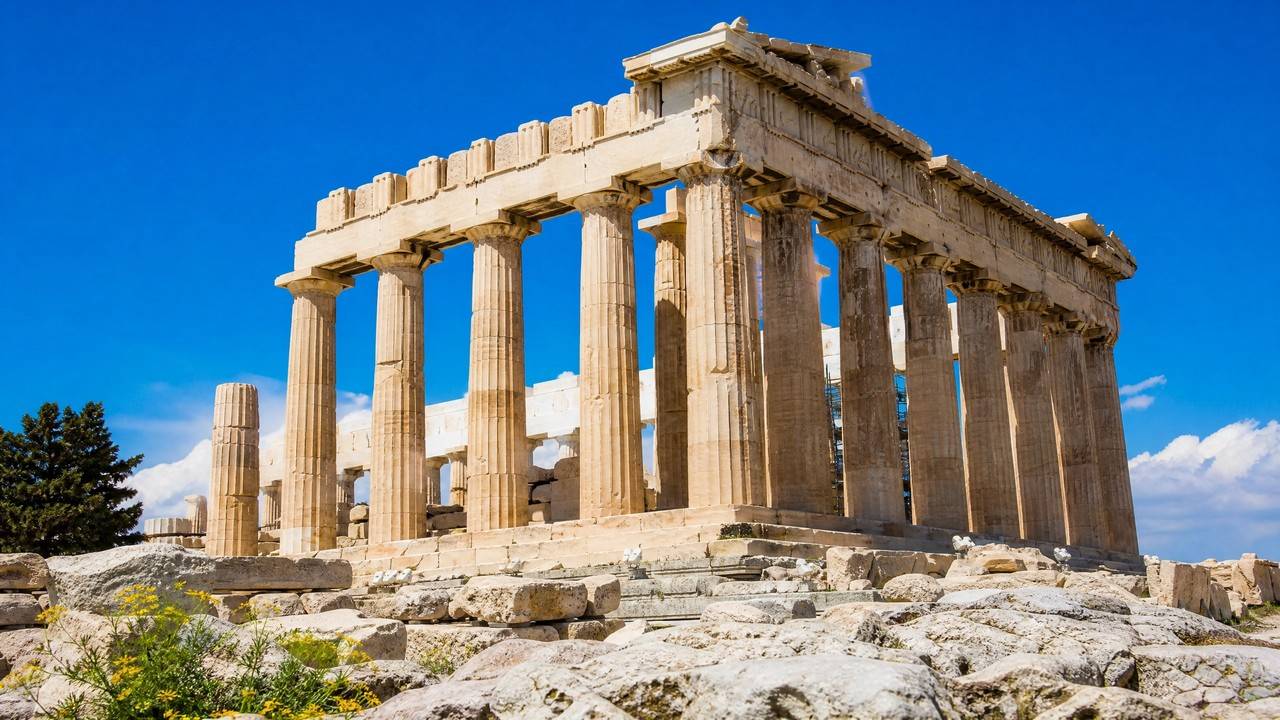
- Acropolis of Athens (central hill): A symbol of Western civilization. Admission is a flat 30 EUR (US$34 / CNY 231) year-round; the winter half-price rate was abolished in April 2025. Open approximately 8:00-20:00 (varies by season). Suggested visit: 2-3 hours. There is almost no shade on the hill; the fewest crowds and most comfortable experience are right at opening or in the evening.
- Parthenon (top of the Acropolis): Built between 447 and 432 BC. Its 46 Doric exterior columns have nearly perfect proportions. Included in the Acropolis ticket; no separate ticket needed.
- Ancient Agora of Athens (below the northwest slope of the Acropolis): The center of polis life. The Temple of Hephaestus in the grounds is the best-preserved Doric temple in mainland Greece. Requires a separate ticket. Suggested visit: 1-2 hours; the Stoa museum has air conditioning and is a good place to escape the midday heat.
- Temple of Olympian Zeus (southeast of the Acropolis): Of the more than one hundred 17-meter-high Corinthian colossal columns, only about a dozen remain. Separate admission is 20 EUR (US$23 / CNY 154). Suggested visit: 45 minutes. On the way, you can also see the nearby Arch of Hadrian.
- Roman Agora (north side of Plaka): Remains of the Roman-era marketplace and site of the Tower of the Winds. Requires a separate ticket. Suggested visit: 1-2 hours.
- Plaka Old Town and Syntagma Square (from the north slope of the Acropolis to the city center): Link together the old town alleys, the small white houses of Anafiotika village, and the changing of the guard ceremony. Suggested visit: 2-3 hours.
The combined ticket was discontinued on 1 April 2025: the Greek Ministry of Culture stopped selling the Acropolis combined ticket (previously about 35 EUR, valid 5 days, covering 7 sites including the Acropolis and its slopes, the Ancient Agora, the Roman Agora, Hadrian's Library, the Temple of Olympian Zeus, Kerameikos, and the Lyceum of Aristotle), moving to individual tickets at flat year-round prices and abolishing the winter half-price rate at the same time (as of September 2026, source: official website of the Greek Ministry of Culture; subject to official information). There is therefore no official multi-site pass today: the Acropolis is 30 EUR and the Acropolis Museum 20 EUR, bought separately; multi-site bundles sold by third-party platforms are commercial packages, not the official combined ticket. Note two things: the Acropolis Museum and the Acropolis are ticketed by different bodies and must be bought separately; large luggage is not allowed at the Acropolis, so you can use the museum's lockers.
If you have enough time, you can arrange a one-day trip to the Peloponnese: Epidaurus Theatre (near Nafplio, about a 2-hour drive from Athens) is known for its almost perfectly preserved ancient acoustical design, and there are theatrical performances during the summer arts festival. It is suitable for renting a car or joining a local day tour.
How should 3-day and 5-day itineraries be arranged most reasonably?
3-day highlights plan (3 main stops per day)
- D1: In the morning, go to Syntagma Square (city center, open, suggested 45 minutes) to see the hourly changing of the guard (on Sunday mornings around 11:00 there is a more elaborate large-scale ceremony) → stroll through the old town of Plaka in the early afternoon → Acropolis Museum in the afternoon (half a day).
- D2: Go up to the Acropolis at 8 o'clock (enter as soon as it opens) → Ancient Agora in the morning → dinner on a rooftop in Monastiraki in the evening.
- D3: In the morning, the Temple of Olympian Zeus and Hadrian's Arch → Roman Agora or the National Archaeological Museum in the early afternoon → sunset at Mount Lycabettus (optional).
5-day in-depth plan
- D1-D3: Same as above.
- D4: One-day trip to Epidaurus Theatre + the seaside town of Nafplio (rent a car or join a local day tour).
- D5: Half-day trip to the Temple of Poseidon at Cape Sounion for sunset, or fill in gaps at the National Archaeological Museum and rest by the seaside.
Flexible adjustment suggestions
- Must-see: The Acropolis, the Acropolis Museum, and the Changing of the Guard at Syntagma Square—these make up the minimal complete Athens experience.
- Can skip: The Roman Agora and Hadrian's Library. If you're only seeing 2-3 archaeological sites, save your energy for the Acropolis and the Ancient Agora.
- Rainy day alternatives: The Acropolis's marble surfaces are slippery when wet, so climbing to the top in the rain is not recommended. Instead, visit indoor routes such as the Acropolis Museum, the National Archaeological Museum, and the Benaki Museum.
- Hot days: Schedule outdoor archaeological sites for early morning and late afternoon, and spend midday in museums or back at the hotel resting.
What to Eat in Athens? Local Flavors and Pitfall Avoidance
Dining prices are generally friendly, with main restaurants averaging 15-25 EUR per person (US$17-29 / CNY 116-193). Recommended items to try (reference prices as of September 2026):
| Dish | Reference Price |
|---|---|
| Gyro wrap | 3-5 EUR (US$3-6 / CNY 23-39) |
| Souvlaki skewers | 6-10 EUR (US$7-11 / CNY 46-77) |
| Horiatiki village salad | 8-12 EUR (US$9-14 / CNY 62-92) |
| Moussaka | 10-14 EUR (US$11-16 / CNY 77-108) |
| Greek honey walnuts | 4-7 EUR (US$5-8 / CNY 31-54) |
| Loukoumades honey puffs | 5-7 EUR (US$6-8 / CNY 39-54) |
Where to find food: The old seafood and grill restaurants around the Central Market (Varvakios), the small eateries in the alleys of Psiri, and the local tavernas in the Koukaki area generally offer better prices and quality than the main street of Plaka.
Key pitfalls to avoid:
- Be cautious when choosing restaurants on Plaka's main street that have menus and touts; many tourists report that such places offer poor value for money;
- Greek restaurants often charge a bread/covers fee per person, about 1-3 EUR (US$1-3 / CNY 8-23); confirm when ordering;
- Seafood is priced by weight; ask clearly about the price and weight before ordering to avoid bill surprises.
What practical tips are there for safety, payment, and communications?
Safety: Greece is generally safe, and the main risk is pickpocketing—on Metro Lines 1 and 3, and around Monastiraki and Omonia stations, keep a close eye on your phone and wallet. A common approach scam involves someone handing you a rose or tying a "friendship bracelet" on you and then demanding money; simply do not accept the item and walk away. Be extra vigilant in crowded areas such as the Acropolis Propylaea and museums. The EU-wide emergency number is 112.
Taxis: Confirm that the meter is running when you get in; official fixed fares apply at the airport. You can use FreeNow or Uber to hail rides (in Athens, Uber connects you with licensed taxis).
Payment: Credit cards and contactless payments are widely accepted, but markets and small shops still prefer cash, so carry 10-20 EUR (US$11-23 / CNY 77-154) in small change. For cash withdrawals, choose ATMs at bank branches such as Alpha Bank, NBG, and Piraeus Bank; independent exchange offices in tourist areas generally have unfavorable exchange rates and fees.
Communications: You can buy local prepaid SIM cards at the airport and stores in the city center (Cosmote, Vodafone GR, etc.), costing about 10-20 EUR (US$11-23 / CNY 77-154) with several GB of data; as of September 2026, prices are subject to carrier stores. You can also activate roaming in advance or buy an eSIM.
Other: English is widely spoken in tourist areas; rounding up the bill or leaving 5%-10% is enough for a tip; tap water is drinkable; there are many stone-paved slopes, so non-slip walking shoes matter more than looks.
Frequently Asked Questions (FAQ)
Q: Are Acropolis Museum tickets and Acropolis tickets together?
A: No. They are ticketed by different bodies and must be bought separately: the Acropolis Museum is a flat 20 EUR (US$23 / CNY 154) year-round, with a 10 EUR reduced rate; the Acropolis archaeological site is a flat 30 EUR (US$34 / CNY 231) year-round, with the winter half-price rate abolished in April 2025. The former combined ticket covering the Acropolis and 7 surrounding sites was discontinued on 1 April 2025, so there is no official multi-site pass today (as of September 2026, subject to the official Acropolis Museum website and the official website of the Greek Ministry of Culture).
Q: Does the Acropolis Museum require advance online ticket purchase?
A: Strongly recommended in peak season. Official channels offer timed e-tickets, which can reduce queuing; according to the Zousifang editor's check of the official website and reference to visitor feedback, in peak season, on-site ticket queues from 10:00 to 14:00 often take 20-40 minutes, while in low season there is basically no need.
Q: How long is appropriate to visit the Acropolis Museum? Should it be arranged on the same day as the Acropolis Hill?
A: It is recommended to allow 2.5-3.5 hours. Arranging it on the same day as the Acropolis is the mainstream approach, with about a 10-minute walk; many visitors report that "museum first, then the hill" is more helpful for understanding the structure of the ruins, while "climb the hill in the morning and enter the museum in the afternoon" feels more relaxed.
Q: Can I take photos in the museum? Can I bring luggage?
A: Photography is allowed, but flash and tripods are prohibited; large suitcases cannot be brought in, storage is available at the cloakroom, and small bottles of drinking water are generally allowed.
Q: Is it convenient for elderly people, children, or family members with limited mobility?
A: The museum is designed with accessible routes, and has elevators and wheelchair rental; there is an accessible elevator at the top of the Acropolis (used by on-site registration). The Acropolis hill path has many stone steps, so pushing a stroller to the top is quite strenuous; you can arrange to spend more time in the museum.
Practical Resources
I. Reference Materials (Summary of Official Source Links)
- Acropolis Museum Official Website — Opening hours, ticket prices, and online ticket purchase
- Hellenic Ministry of Culture Official Website — archaeological site ticketing and management information
- Athens Airport Official Website — Airport transportation and flight information
- Athens Urban Transport Organization (OASA) Official Website — Metro, ticketing
- Visit Greece Official Website — Official tourism information and seasonal guides
- Hellenic Ministry of Foreign Affairs Official Website — Schengen visa and entry information
II. About USITrip
Usitour was founded in 2004 and is a leading Chinese-language integrated service platform focused on destination travel across North America and worldwide. Its official brand site is www.usitour.com, and its official booking store is www.usitrip.com; both belong to the US-based Usitour Travel Group.
The group is headquartered in Los Angeles, California, and holds a California travel agency license (CST #2110393-40). Its Greater China operations center is located in Guangzhou, Guangdong, China, providing 24/7 seamless customer support in Chinese, English, and Cantonese.
III. Updates and Verification
This article was updated on September 22, 2026. Prices are estimated at 1 EUR ≈ 1.147 USD ≈ 7.70 CNY. If official ticket prices or opening hours are adjusted, please refer to the official websites of the Hellenic Ministry of Culture, the Acropolis Museum, Athens Airport, and OASA.
Recommended Products
Related Attractions



More Popular Experiences

