📍 Destination Overview
Athens is the capital of Greece and the birthplace of Western civilization and democracy. The Parthenon atop the Acropolis has stood majestic for 2500 years, overlooking this city of myths. The Acropolis Museum houses treasures of classical sculpture, while the Ancient Agora below is where Socrates once walked and debated. The narrow lanes of the old Plaka district wind at the foot of the Acropolis, where white walls, bougainvillea and open-air tavernas brim with Mediterranean charm. The changing of the guard at Syntagma Square and the sunset from Mount Lycabettus blend ancient philosophy with vibrant street life.
🏛️ Location
Greece · Attica Region · ancient capital on the Saronic Gulf
🗓️ Best Season
Apr-Jun / Sep-Oct
🕐 Time Difference
5-6 hrs behind Beijing
💰 Currency / Language
Euro EUR / Greek
🕐 Suggested Duration
2-3 days · Acropolis + old town + museums
🔌 Outlet / Voltage
Type C / F outlets · 230V · adapter needed
☀️ Best Time to Visit & Climate
🌸 Apr–Jun, Sep–Oct
Pleasant weather — best for open-air ancient sites.
🔥 Jul–Aug
Mediterranean heat often tops 34°C — protect from the sun.
Jan
🌤️
13°/6°
Feb
🌤️
14°/6°
Mar
🌤️
16°/8°
Apr
🌸
20°/11°
Best
May
🌷
26°/16°
Best
Jun
☀️
31°/20°
Best
Jul
🔥
34°/23°
Aug
🔥
34°/23°
Sep
🌤️
29°/19°
Best
Oct
🍂
23°/15°
Best
Nov
🌥️
18°/11°
Dec
🌤️
15°/8°
📷 Top Attractions
More Attractions →
Acropolis
The Acropolis of Athens (Greek for "high city") crowns a 156-metre limestone rock above central Athens, the supreme achievement of ancient Greek architecture and a symbol of Western civilisation, listed as a UNESCO World Heritage Site since 1987. Under Pericles in the 5th century BC, funded by the Delian League, the Parthenon, Propylaea, Erechtheion and Temple of Athena Nike rose over about 41 years, from 447 to 406 BC. The Parthenon, designed by Ictinus and Callicrates under Phidias' supervision and dedicated to Athena, is the summit of the Doric order and its optical refinements; the Erechtheion's south porch carries six caryatids, one of which still stands in the British Museum. Across two millennia the rock passed through Persian wars, Roman, Byzantine and Ottoman rule; a 1687 Venetian bombardment ignited a powder magazine that gutted the Parthenon, and Lord Elgin removed marble sculptures in the early 1800s. Since 1975 Greece has run an ongoing anastylosis restoration of the marble. From the summit you look over modern Athens and Mount Lykavittos, with Aegean light on clear days; the Acropolis Museum at the foot of the slope holds the originals and is the perfect sequel.
Historic Ruins & Heritage
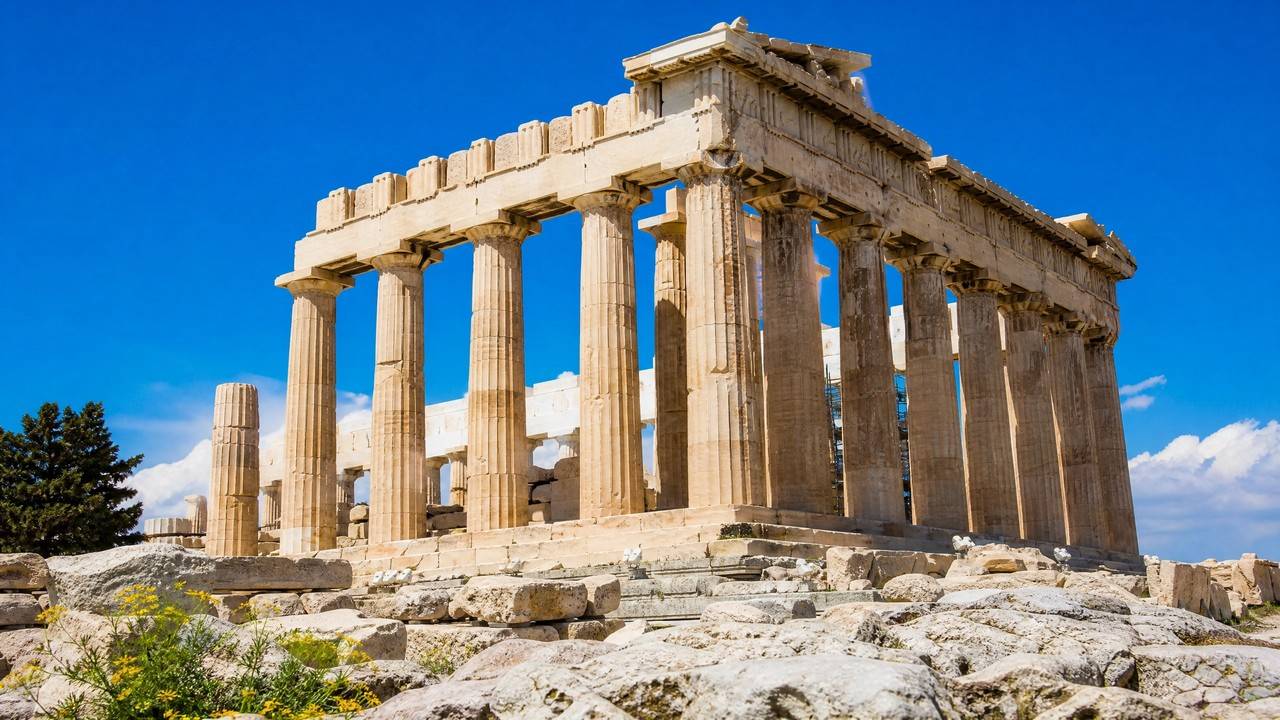
Parthenon
The Parthenon (Greek for "maidens' chamber") stands at the highest point of the Acropolis, the greatest legacy of ancient Greek architecture and the summit of the Doric order. Begun in 447 BC and completed in 432 BC, it was designed by Ictinus and Callicrates with sculpture supervised by Phidias. Built of Pentelic marble on a stylobate of 69.5 by 30.9 metres, its 8-by-17 Doric colonnade (46 outer columns, about 10.4 m tall) hides refined optical corrections: entasis in the shafts, a curved base and thickened corner columns. The cella housed Phidias' colossal Athena Parthenos, some 11.5 m of gold and ivory, long lost, and once served as the Delian League treasury. The pediments told the birth of Athena; 92 metopes and a 160-metre Ionic frieze of the Panathenaic procession rank among the finest Greek sculpture. The marbles removed by Lord Elgin in the early 1800s remain in the British Museum in a still-running restitution dispute, while a 1687 Venetian bombardment detonated a powder magazine that blew off the roof and most of the sculpture. Anastylosis restoration has continued since 1975. The temple is the centrepiece of the Acropolis timed-entry ticket.
Historic Ruins & Heritage

Acropolis Museum
The Acropolis Museum stands at the southern foot of the Acropolis (15 Dionysiou Areopagitou), about 280 metres from the Parthenon. Opened in June 2009, it was designed by Bernard Tschumi with Michael Photiadis as a modern building set over a live excavation — glass floors reveal Roman and early Byzantine houses beneath your feet. Some 4,000 finds from the rock fill the galleries: the archaic kouroi and korai, the Parthenon's pediment sculptures and frieze, and five original caryatids of the Erechtheion. The top-floor Parthenon Gallery lays the frieze out at its original scale and sequence behind a glass wall facing the temple itself, while the gaps and empty mounts reserved for the Elgin Marbles make the case for reunion without a word. The second-floor restaurant and café look straight back at the Acropolis. The museum draws over a million visitors a year.
Museum

Ancient Agora of Athens
The Ancient Agora of Athens spreads across the open ground northwest of the Acropolis — for over two millennia the civic heart of the city: market, lawcourts, council chambers, libraries and temples. Socrates taught and argued in its stoas, with Plato and Xenophon listening; ostracism votes were counted here. On the north side stands the Temple of Hephaestus, built in the 5th century BC — the best-preserved Doric temple in Greece, outshining even the Parthenon for completeness. The rebuilt Stoa of Attalos on the east hosts the Agora Museum, home to the concrete evidence of Athenian democracy: the inscribed ostraka of ostracism. Democracy, in the most literal sense, takes shape among the ruins.
Historic Ruins & Heritage

Syntagma Square
Syntagma Square is Athens's urban center and political heart—a grand square in front of the Greek Parliament, famous for the solemn Tomb of the Unknown Soldier and the guard-changing ceremony in traditional dress, Athens's most important public square. Syntagma Square (Greek for 'constitution') is the most important, central square of downtown Athens—named after the event of promulgating the constitution in modern Greek history, it is the city's center and political heart. On one side stands the solemn, majestic Hellenic Parliament building (originally a royal palace, now the seat of the Greek Parliament), imposing and dignified. The square's most famous, tourist-drawing feature is the Tomb of the Unknown Soldier in front of the Parliament—before this monument, the Greek Presidential Guard (Evzones, in distinctive traditional dress: white pleated skirts and shoes with pom-poms) stand guard day and night, a unique outfit. These guards stand watch and hold a solemn, distinctive changing-of-the-guard ceremony at set times—marching with slow, exaggerated, uniform steps, solemn and unique, a famous Athens spectacle (especially grand ceremonies on Sundays). The square itself is where Athens citizens and visitors gather and rest, surrounded by busy streets, hotels and shops, also a key transport hub. Strolling this city-center square, watching the unique guard-changing ceremony, feeling Athens's urban air. Visiting Athens, pausing at Syntagma Square and watching the guard-changing ceremony is a unique sight in Athens.
Square & Landmark

Plaka
Plaka is the historic heart of Athens, its cobbled lanes spilling down the northern slopes of the Acropolis in a tangle of neoclassical houses, craft shops and vine-shaded tavernas. A short walk away, Syntagma Square fronts the Hellenic Parliament, where the famously slow-motion Evzones guard change takes place every hour in traditional costume, with a grander ceremony on Sunday mornings. Tucked deeper into the old town, the tiny white-washed quarter of Anafiotika feels like a Cycladic island transplanted into the city. Half a day here delivers surprises at every turn.
Old Town & Historic District
🎯 Athens Experiences
Climb the Acropolis
The millennia-old beauty of the Parthenon.
Stroll Plaka
Old-town alleys at the foot of the Acropolis.
Hilltop Sunset
Overlook the whole city from Lycabettus.
Guard Changing
The ceremony at Syntagma Square.
Greek Cuisine
Moussaka and souvlaki.
Spring (Apr-Jun) and autumn (Sep-Oct) are most comfortable, ideal for open-air ruins. Jul-Aug heat often exceeds 34°C, so guard against heat and stay hydrated. Athens is the gateway to Aegean island hopping and pairs well with island itineraries.
📰 Travel Guides
More Guides →
🚌 Transport & Stays
City Transport
🚇About 9 euros (reference)
Airport Metro
About 40 min from Athens airport to city
About 9 euros (reference)
🚇About 1.2 euros one way (reference)
Metro
Connects ruins and port
About 1.2 euros one way (reference)
🚶—
Walking
Sights clustered, walkable
—
⛴️Depends on route (reference)
Piraeus Port
Departure port for island ferries
Depends on route (reference)
Recommended Stay Areas
🏛️ Acropolis / Plaka (top pick)
Near ruins, old-town atmosphere
💂 Around Syntagma Square
Central shopping and transit
🏺 Monastiraki
Markets and nightlife
🚇 Along Airport / Port
Convenient for island hopping or transfers
Free Consultation
Want to plan your Athens trip in more depth?
Tell us your departure city, travel dates and interests, and Usitour will tailor a trip just for you.